Two Guys Who Built a Lecture Recording App for Professors Are Now Making $42,000/Month
A small app built in 2019 to solve university professors' lecture recording problems evolved through the COVID pandemic into a knowledge management platform for all organizations. Harry Brodsky and Khanan Grauer, with a team of just 5, acquired over 100,000 users and achieved $42,000 MRR through bootstrapping alone. Free strategy failures, an AppSumo experiment, giving up on paid ads — this is the growth formula they found after 7 years of failures and pivots.

Harry Brodsky & Khanan Grauer
Professors Couldn't Record Their Lectures — And That Was the Problem
"Every team — not just teachers — has knowledge that needs to be captured, documented, and shared."
It took Harry Brodsky a long time to arrive at that realization. In 2019, he kept witnessing the same scene on university campuses: professors frustrated by complex equipment and software every time they tried to record a lecture. Lecture capture systems were too complicated, and most professors weren't IT professionals.
Harry came up with a simple solution. What if a single iPhone app could load a PowerPoint or PDF and record slide by slide? That was the first version of Kommodo — a straightforward screen recording app for professors, without even a proper name yet.
The problem was the education market itself. B2B sales cycles were too long. It required board approval, budget reviews, and offering an entire semester as a pilot. Harry and Khanan gave universities free or heavily discounted access, but they soon realized this model was unscalable.
B2B education sales cycles run 6 months to over a year, requiring board approval and budget reviews. For a small team, this long cycle is fatal. Harry and Khanan generated almost no revenue in this market for years.
COVID Changed Everything — But Not How They Expected
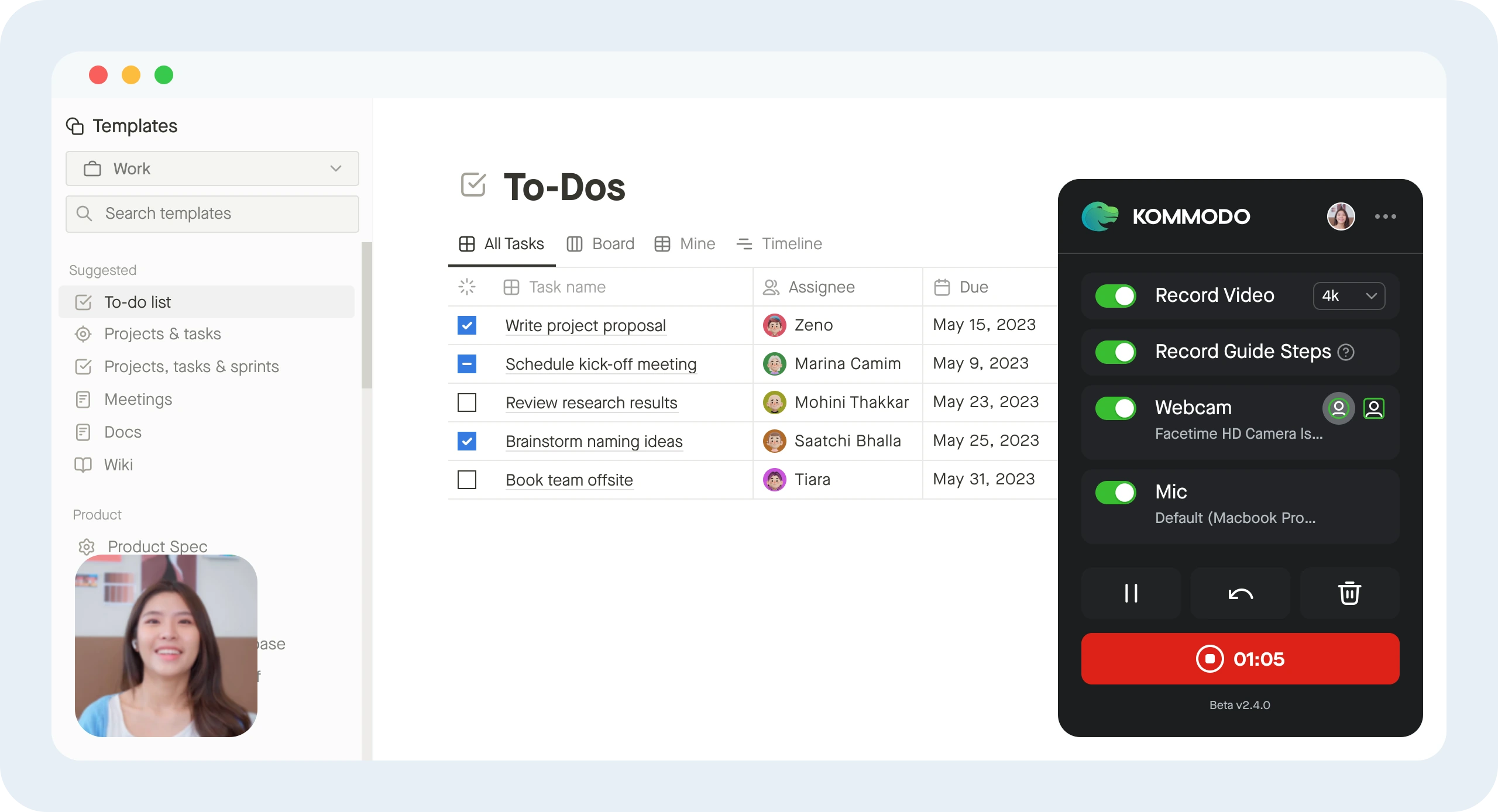 In 2020, the world went into lockdown. Teachers suddenly had to teach remotely, recording their lectures to upload to Google Classroom or Canvas. Kommodo downloads surged.
Most founders would have been thrilled. They'd have thought they finally found product-market fit. But Harry was seeing something different. The exact same problem teachers had with recording lectures — corporate onboarding teams, sales teams, and customer success teams had it too.
Every team — not just teachers — has knowledge that needs to be captured, documented, and shared. Teachers recorded lectures, but companies faced the exact same problem with onboarding, SOPs, product demos, bug reports, and client walkthroughs.
This was the beginning of the pivot that changed Kommodo's destiny — from a simple lecture recording app to an AI-powered platform for capturing and managing knowledge across all organizations.
Kommodo by the Numbers
What Kommodo Does — Loom, Scribe, and Fireflies in One
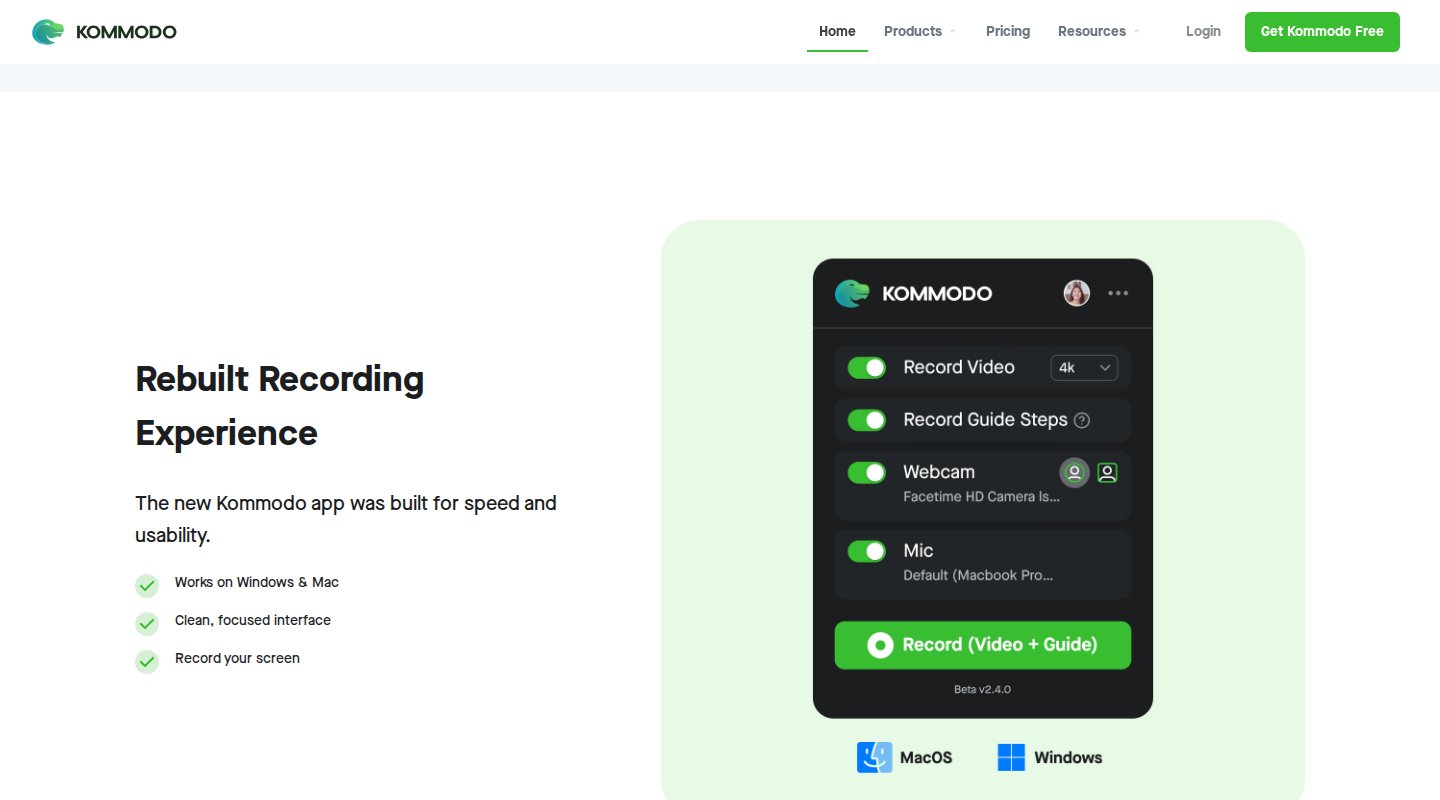 Kommodo in one sentence: record your screen, and AI automatically generates the documentation.
When someone at a company needs to onboard a new employee, they typically do one of two things: record their screen (Loom), write a step-by-step guide (Scribe), or record and summarize a meeting (Fireflies). Kommodo does all three in one platform.
| Feature | Loom | Scribe | Fireflies | Kommodo |
|---|---|---|---|---|
| Unlimited Screen Recording | Paid | ❌ | ❌ | Free |
| AI Auto-Transcription | Paid | ❌ | ✅ | ✅ |
| Auto SOP Generation | ❌ | ✅ | ❌ | ✅ |
| AI Meeting Recording | ❌ | ❌ | ✅ | ✅ |
| AI Video Library Search | Limited | ❌ | Limited | ✅ |
| Team Collaboration | ✅ | ✅ | ✅ | ✅ |
AI is at the core. Record your screen and AI automatically generates a transcript, creates a step-by-step SOP document, and summarizes meetings. Everything accumulated can be searched with an AI assistant. Knowledge moves from inside one person's head to a searchable database for the entire organization.
Unlimited Screen Recording — Free recording with no watermarks, no time limits, no credit card required
AI Transcription & Summary — Automatically converts recordings to text and generates key summaries
Auto SOP Generation — Automatically generates step-by-step guide documents from videos
AI Meeting Recorder — Integrates with Google Calendar to auto-record and summarize meetings
AI Assistant — Search your accumulated video library using natural language
Custom Branding — Replace logos, colors, and domain with your own brand
7-Year Failure Timeline
The $42,000 MRR figure looks smooth from the outside, but the path to that number was a series of failures.
What Failed — Most Things Did
What's usually missing from success stories is the detail of the failures. Let's look specifically at what Harry and Khanan tried and failed at.
Failure 1: The WhatsApp Model — Unlimited Free
At first, Harry followed WhatsApp's growth model: offer unlimited free recording to users and expect 1–2% to voluntarily convert to paid. The results were dismal. Organic traffic grew, but it never translated into revenue.
"If you give everything away for free, users will come. But converting users who are accustomed to free is nearly impossible. It was the most expensive lesson we learned." — An unlimited free model doesn't work for products without sufficient network effects.
Failure 2: 3 Free Downloads
The next attempt was unlimited recording but capping downloads at 3. This was an even bigger failure. Users downloaded 3 recordings and immediately left. Barely anyone converted to paid. The test was abandoned within 3 days.
Failure 3: Paid Ads
They tried paid ads too. But at a $15/month price point, customer acquisition cost (CAC) exceeded customer lifetime value (LTV). Ads were immediately stopped.
Ads didn't work. At our price point, the customer acquisition cost exceeded the customer lifetime value.
Failure 4: 60-Day Time Gate
They also tried putting a 60-day time limit on free content. This time-based approach — rather than usage-based — failed to distinguish between active users and occasional visitors.
Failure 5: AppSumo — Wrong Customers
In late 2022, they ran a lifetime deal on AppSumo. Freelancers and solo entrepreneurs flooded in, and the system underwent massive stress testing. While useful for validating infrastructure stability, these users weren't Kommodo's ideal customers — they were there for personal recording, not team-based knowledge management.
What Finally Worked — Three Growth Engines
Growth Engine 1: Shared Links (Viral Loop)
The #1 way people discover Kommodo is through a link. When someone shares a recording or a guide, the recipient experiences the product firsthand before they ever visit the site.
When you share a Kommodo recording or SOP with a colleague, that person naturally experiences Kommodo through the link. Without any separate marketing spend, product usage itself becomes marketing. This accounts for the largest share of Kommodo's new user acquisition.
Growth Engine 2: Free Standalone Tools
Harry and Khanan built free tools that work directly in the browser without installation — a quick screen recorder, a teleprompter, a tool that generates SOPs from video. These tools attract high-intent traffic through searches like "free screen recorder" and "SOP generator."
Free standalone tools convert at a much higher rate than paid ads. The reason is simple — someone searching for these tools already needs that feature. Showing a screen recording SaaS to someone searching "free screen recorder" drives conversion at a completely different rate than interrupting someone's Instagram feed with an ad.
Growth Engine 3: Usage-Based Freemium Gate
After countless experiments, Harry's optimal pricing model: allow 15 free videos, then gate features based on usage. The key is focusing on power users.
Growing revenue by targeting power users is effective. These users are closest to our ideal customer profile. Trying to upsell users who have no intention of subscribing doesn't work.
Tech Stack — How 5 People Run 6 Platforms
One of the most impressive things about Kommodo is that a team of just 5 simultaneously operates 6 platforms: iPhone, Android, desktop (Windows/Mac), Chrome extension, and web app. This is possible thanks to Khanan Grauer's architectural design.
Khanan spent 10 years as a mobile engineer at large companies. He designed a centralized upload service architecture so that recordings from any platform are processed through the same pipeline.
Kommodo Tech Stack
The hardest thing about running multiple platforms isn't the coding. It's network stability across diverse global ISPs, firewalls, and VPN environments, and optimization for low-spec devices (limited RAM, weak processors). The Kommodo team invests significant engineering resources into this problem.
Cost Structure — The Reality of Bootstrapping
Kommodo has never taken outside investment. It's 100% bootstrapped. With $42,000 MRR, after paying 5 salaries, infrastructure costs, and AI API costs — how much is left?
| Cost Item | Estimated Monthly Cost | Notes |
|---|---|---|
| Payroll (5 people) | $20,000–25,000 | Small team, global remote estimate |
| Cloud Infrastructure (GCP, DO, CF) | $3,000–5,000 | Video storage/delivery is the main cost |
| AI API (OpenAI) | $1,000–3,000 | Transcription, summary, search features |
| Stripe Fees | $1,200–1,500 | 2.9%+30¢ of revenue |
| Other (domain, tools, etc.) | $500–1,000 | FFmpeg, monitoring, etc. |
| Estimated Total Cost | $25,700–35,500 | 61–85% of MRR |
This is the reality of bootstrapping. Not all $42,000 MRR is profit. But Harry and Khanan are growing every month, and margins improve as revenue increases. Video processing costs scale with users, but development payroll is relatively fixed.
Marketing Strategy — How They Reached 100K Users Without Spending
Kommodo's marketing spend is effectively $0. After abandoning paid ads, Harry and Khanan chose three strategies.
1. The Product Is the Marketing (Product-Led Growth)
When you share a Kommodo video with someone, they naturally discover Kommodo. Product usage itself is marketing. It's the same principle behind Loom's viral growth — but Kommodo enables sharing in more formats (SOP documents, guides, and more), creating more touchpoints.
2. Free Tools for SEO
They built free tools usable directly in the browser without installation, targeting searches like "free screen recorder," "online screen recorder," and "SOP generator." These tools attract high-purchase-intent users. They've also published 36 SEO-optimized blog posts.
3. Customer Support = Market Research
Harry personally handled customer support for a long time. He treated every conversation as a user interview, consistently asking two questions.
I asked every customer two things: "How did you find us?" and "Why do you need us?" Those answers shaped our messaging, SEO, and product direction more effectively than any strategy meeting.
Competitor Comparison — Why Kommodo Over Loom
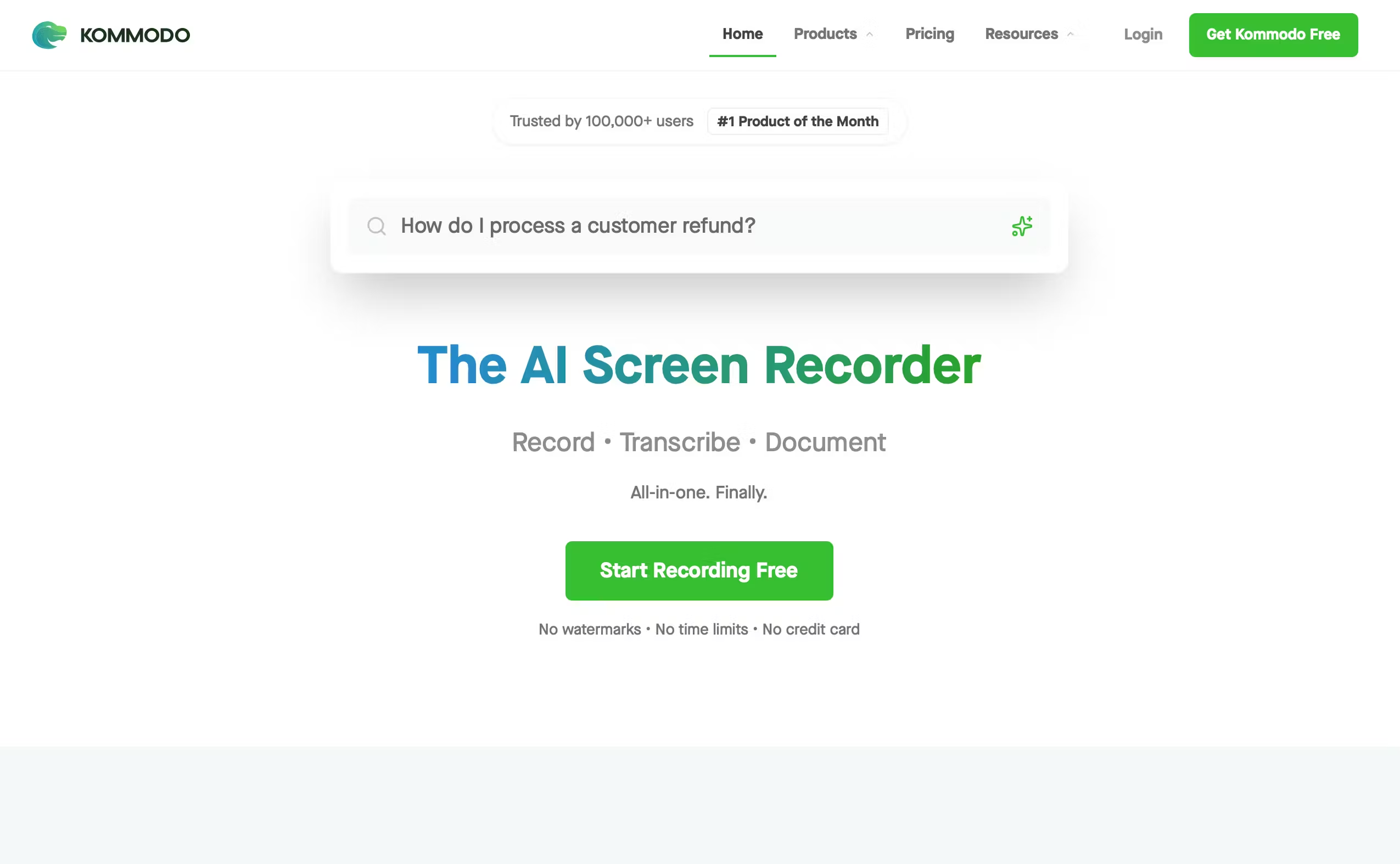
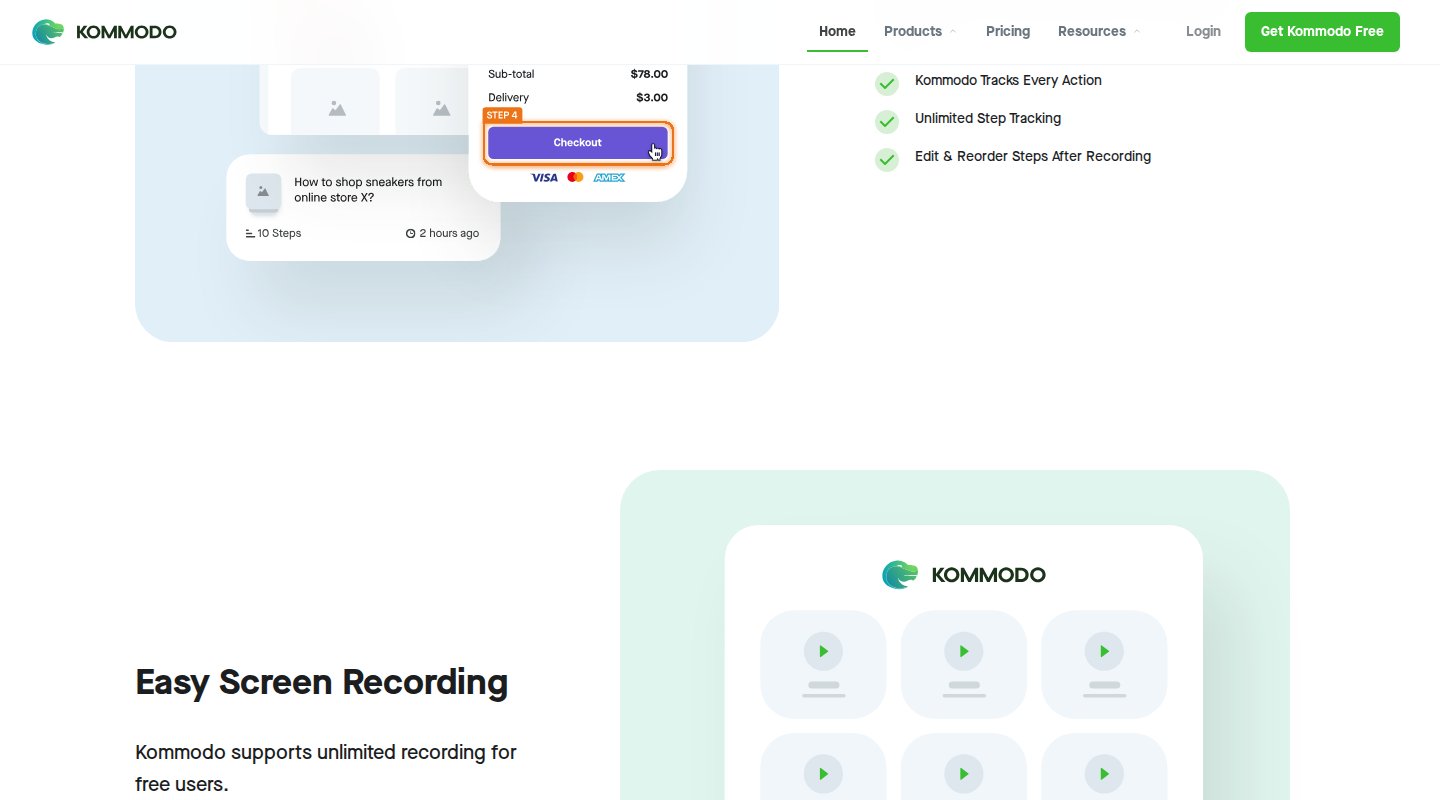 Kommodo competes in a massive market. There are well-known tools like Loom (acquired by Atlassian), Scribe, Fireflies, and Vidyard. Kommodo's positioning: "all of these, in one."
| Comparison | Loom | Scribe | Kommodo |
|---|---|---|---|
| Free Recording Limit | 25 clips, 5 min | N/A | Unlimited |
| Monthly Price (Individual) | $15 | $29 | $9–15 |
| AI SOP Generation | ❌ | ✅ | ✅ |
| AI Meeting Recording | ❌ | ❌ | ✅ |
| AI Video Search | Limited | ❌ | ✅ |
| Mobile Native App | ✅ | ❌ | ✅ (iOS/Android) |
Kommodo doesn't compete on recording features. Recording is a solved problem. Instead, they focus on "video intelligence" — extracting knowledge from recorded videos and improving team productivity. That's the differentiator from simple recording tools.
Operating Philosophy — The 24-Hour Learning Loop
The most distinctive element of Harry and Khanan's operating philosophy is the "24-hour learning loop." Every morning starts with two questions.
Question 1: "What did we learn in the last 24 hours?"
Question 2: "What action will we take based on that learning?"
If the answer to Question 1 is empty, it means the data collection mechanism itself has a problem. Doing daily reviews instead of weekly reviews dramatically accelerates iteration speed.
Here's a real example: they launched new feature X, and 24–48 hours of data showed it was negatively impacting conversions. The free feature was good enough that users had no reason to upgrade to paid. Harry and Khanan removed the feature immediately.
"Maintaining the pulse of learning every 24 hours increases speed and focus. Weekly reviews only surface problems after a week of wasted time and resources. We discover and act within 24–48 hours." — Harry Brodsky
A Team Obsessed with Data
Harry emphasizes: "Don't wait until you need data to start collecting it." The Kommodo team decided that existing analytics tools (Google Analytics, etc.) weren't sufficient for tracking their unique usage patterns, so they built a custom analytics system.
Kommodo Custom Analytics Stack
Pricing
| Plan | Price | Key Features | Target |
|---|---|---|---|
| Starter (Free) | $0 | Unlimited recording, basic editing, AI transcription | Individual Users |
| Monthly | $15/mo | Full AI features, unlimited storage, team collaboration | Small Teams |
| Yearly (Best Value) | $9/mo ($108/yr) | All Monthly features + 40% discount | Growing Teams |
| Enterprise | Contact Us | SSO, custom domain, advanced permissions | Enterprise |
The key is how generous the free plan is: unlimited recording, no watermarks, no time limits, no credit card required. This is the biggest differentiator from Loom and the key that enables Kommodo's viral growth.
Lessons from the Payment System
Here's one small but important architectural decision worth sharing. Kommodo operates a centralized payment system as a single source of truth. Stripe webhooks send data to this system, and no part of the code touches the payment system directly. This design ensures payments from all 6 platforms are processed consistently.
Revenue at a Glance
A quick summary of Kommodo's key revenue figures:
| Metric | USD | — |
|---|---|---|
| Monthly Recurring Revenue (MRR) | $42,000 | — |
| Annual Recurring Revenue (ARR) | $500,000 | — |
| Paid Plan Price (Monthly) | $15 | — |
| Paid Plan Price (Annual) | $9/mo | — |
A team of 5 generating $500K ARR — $100K in revenue per person per year. By any measure, it's impressive for a bootstrapped company. And every dollar was earned without outside investment.
The screen recording and knowledge management market is growing rapidly. Many companies today use multiple tools — a video recorder, a process documentation tool, a meeting transcriber — paying for each separately. Kommodo's "unlimited free recording" strategy is especially attractive to cost-conscious startups and SMBs looking for an all-in-one solution.
Khanan Grauer — The Invisible Co-founder
If Harry Brodsky is the face of the product and business, Khanan Grauer is the person who built the technical foundation. Khanan spent 10 years as a mobile engineer at large companies, and that experience was decisive in designing the clean architecture that lets Kommodo operate across multiple platforms with a small team.
In particular, the centralized upload service architecture is Khanan's work. Whether you record on iPhone, Chrome extension, or desktop — it all flows through the same pipeline. This is the secret to running 6 platforms with 5 people.
7 Lessons from Kommodo
Offering unlimited free drives explosive user growth, but those users have an extremely low probability of converting to paid. The free plan should be generous, but design a pricing gate that identifies power users and focuses on them.
They brought in large numbers of users through AppSumo, but freelancers and solo entrepreneurs didn't fit Kommodo's core value (team knowledge management). Getting the right customers matters more than the numbers.
Getting ROI-positive from paid ads on a $15/month SaaS is nearly impossible. Instead, building free tools targeting high-purchase-intent searches delivers far better conversion rates than ads.
"How did you find us?" and "Why do you need us?" — just these two questions can shape your messaging, SEO, and product direction. Founders doing support directly get more insights than any strategy meeting.
"Don't wait until you need data to start collecting it." By the time you need it, it's already too late. Instrument everything from Day 1.
Education → AppSumo users → freelancers → enterprise teams. Finding Kommodo's right customer required multiple pivots. Each failure provided data for the next pivot.
When a Kommodo user shares a video, the recipient naturally experiences Kommodo. This viral loop accounts for the largest share of new user acquisition. The best marketing is product usage itself.
What's Next
Harry Brodsky shared his plans for the future.
We'll grow the business by serving our customers, figuring out distribution, and shipping products that help customers become more productive.
No grand vision. No fundraising plans, no IPO talk. Give customers value, let that value spread naturally, and build revenue on top of it.
Starting from professors' lecture recording problems in 2019, through 7 years of failures, a team of 5 now making $42,000 per month. Kommodo's story is not one of "fast success" but of "relentless iteration." And that iteration isn't over yet.
Get more AI business stories
We break down how real people are making money with AI
Join Telegram Channel