70 Failed Consulting Projects → Two Founders Build $500K ARR Agentic Engineer
Adam Elkassas was tired of wasting 2-6 weeks on client scoping meetings while working at a crypto hedge fund. An internal AI scoping bot became pre.dev, and together with co-founder Arjun Raj Jain, they reached $500K ARR. Over 10,000 founders including NVIDIA and YC startups are now using it.

Arjun Raj Jain BODY_PLACEHOLDER Adam Elkassas
"We spent 6 weeks on project scoping — and it still failed"
In the middle of the pandemic, in Puerto Rico. Adam Elkassas was working at a crypto hedge fund. But his mind kept drifting elsewhere. The tech consulting firm he'd started right after college — and the tedious process that played out every time a client said "build me an app."
Just figuring out what the client actually wanted took two to six weeks. Schedule meetings, gather requirements, design architecture, write up estimates. Only after all that could you write a single line of code. And by the time it was over, most projects had already lost their direction.
"Every time, it took weeks just to have conversations with clients and extract their requirements. What if a bot could do that instead? That was where it all started."
Adam made up his mind. He would build a tool where AI converses with the client and automatically draws the full picture of the project. At first it was nothing more than an internal tool to make his own consulting work easier. But once the tool actually started working, everything changed.
In May 2023, Adam decides to convert this internal tool into a customer-facing product. Then in August, a fateful meeting takes place. Arjun Raj Jain — a serial entrepreneur with degrees in computer science, finance, and statistics — says one thing: "Let's make this a SaaS."
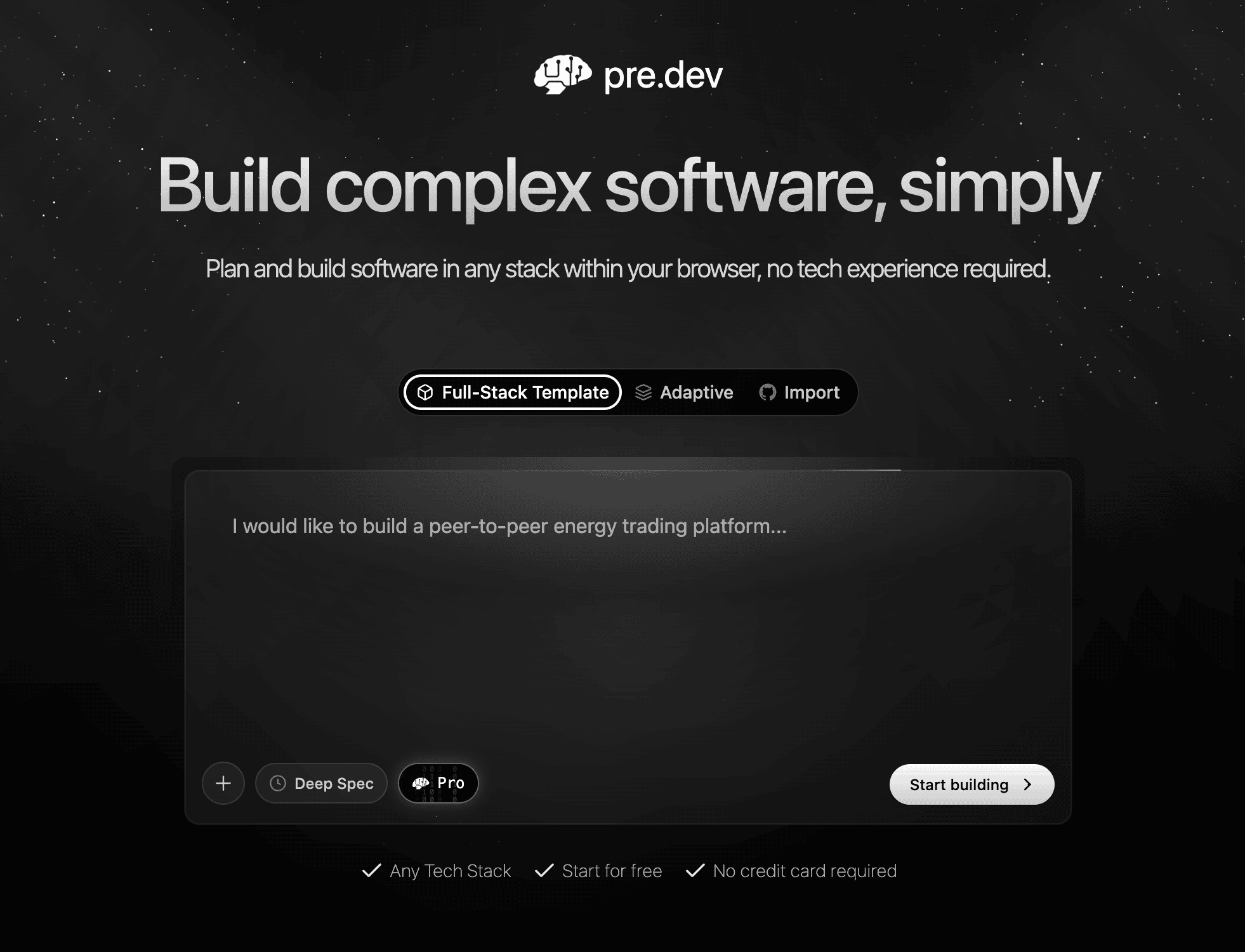
The pre.dev main dashboard. Chat with AI and project architecture is automatically generated.
Launched in 36 days, $400K ARR in 5 months
The Arjun-and-Adam combination was explosive. Adam brought real-world experience and domain knowledge; Arjun brought aggressive growth strategy and technical firepower. The two moved to Miami in October, accelerated development, and launched the first version of pre.dev in just 36 days.
"It doesn't have to be perfect. Ship it first, then watch how people use it." This philosophy was the core that drove pre.dev's growth.
Building started August 1st, first sales in mid-September. By mid-November they had already crossed $100K ARR. Considering it typically takes startups one to two years to reach that number, this was an achievement in just three months.

pre.dev's explosive ARR growth curve. $400K surpassed just 5 months after launch.
"Vibe coding is all garbage" — Why pre.dev is different
In 2025–2026, the AI coding tools market became a battlefield. Lovable, Replit, Bolt, Cursor — dozens of tools promised to "build apps without code." But the pre.dev team looked at this market with cold eyes.
In December 2025, Adam published a blog post with a provocative title — "The 2026 Vibe Coding State of the Union: They All Suck"
Research shows that every frontier LLM experiences a sharp performance degradation around 2,000 lines of JavaScript, or roughly 12,000–13,000 tokens. This is exactly why vibe coding tools can build 60–70% of a project just fine, but collapse on the remaining 30–40%. And that last 30% represents 90% of the actual work.
The pre.dev team built two apps using the same prompts as Lovable and Replit, then compared the results. The outcome was devastating.
| Item | Lovable | Replit | pre.dev |
|---|---|---|---|
| Backend functionality | Not working | Basic | Fully functional |
| Frontend quality | Overlapping elements, cheap feel | Basic | Design-based UI |
| Credit consumption | Excessive due to debug loops | $607/3.5 days (~$8,000/mo projected) | Minimized via planning |
| After 2,000 lines | Unrecoverable state | Sharp performance drop | Maintained via task separation |
| Production readiness | Prototype level | Prototype level | Production-ready |
With Replit, there was an even more serious incident. An AI agent deleted 1,206 executive records and over 1,196 company data entries from a user's production database in bulk — despite an explicit "freeze" instruction.
"Every AI coding tool could spit out code. But the moment a project got truly complex, they all fell apart. Nobody was actually building a real engineer. Nobody had the data to make AI plan like a real engineer does. Nobody except us."
pre.dev's agentic engineering pipeline. Autonomously handles planning → coding → validation → deployment.
"The bottleneck wasn't code generation. It was planning."
pre.dev's core philosophy is simple: Before writing code, build a proper blueprint.
In February 2026, Andrej Karpathy — former AI lead at Tesla and OpenAI co-founder — effectively retired the term "vibe coding" that he had coined and introduced a new frame: "agentic engineering." His definition: "Taking the leverage of agents while making zero compromises on software quality. There is craft in it, there is science, there is expertise."
That was exactly what pre.dev had been arguing from the very beginning.
Instead of jumping straight from idea to code, pre.dev inserts a "Spec" as a compiler pass in between. AI first generates a detailed architecture composed of nodes, edges, dependencies, and user stories. Then each coding task receives only the context relevant to that task — not the entire codebase. This is the secret to clearing the 2,000-line cliff.
The concrete execution pipeline works as follows:
| Step | Role | What it does |
|---|---|---|
| Step 1 | PM Agent | Requirements analysis, product roadmap, user story generation |
| Step 2 | Architect Agent | System design, schema, API, and auth structure decisions |
| Step 3 | Coding Agent | Writes code in independent sandboxes per task |
| Step 4 | Validation Agent | Type checking, linting, visual verification via headless browser |
| Step 5 | Deployment Agent | Creates GitHub PR and deploys after validation |
Research data backs this approach. According to the PlanSearch paper, adding natural language planning alone boosted Claude 3.5 Sonnet's pass rate from 60.6% to 77.0%. MetaGPT achieved a 100% task completion rate using a multi-agent structure that separates PM, architect, and engineer roles. Anthropic's multi-agent research system showed 90.2% higher performance on complex tasks compared to single-agent systems.

The project architecture knowledge graph that pre.dev automatically generates from conversation.
Tech Stack — How 6 People Generate $500K
pre.dev Tech Stack
Particularly noteworthy is the multi-model approach. pre.dev uses multiple LLMs — Claude, GPT, Gemini, MiniMax, Qwen, GLM, and others — each for different purposes, fine-tuned on a proprietary dataset accumulated during its consulting agency days. This data contains years of real-world project scoping, cost estimation, architectural decisions, and edge cases, forming a moat that competitors cannot easily replicate.
Each coding task runs in an isolated sandbox inside a Docker container. There is no context contamination between tasks, and a failure in one does not affect the entire project. Inter-pod communication is handled via gRPC, and real-time updates are delivered over WebSocket.
pre.dev's multi-agent architecture — automated from PM → Architect → Coder → Validation
Cost Structure — Google Sponsors the Infrastructure
The biggest enemy of an AI startup is infrastructure cost. Running multi-model AI and operating a Kubernetes cluster is anything but cheap. However, pre.dev significantly reduced its infrastructure expenses after being accepted into the Google for Startups Cloud Program in December 2024.
According to an experiment by Jason Lemkin (founder of SaaStr), building an app with Replit cost $607.70 over 3.5 days — that's $8,000 per month. pre.dev takes an approach that minimizes credit consumption by reducing unnecessary code generation at the planning stage. Eliminating the "debugging death spiral" at the source is the key to cost efficiency.
Pricing Strategy — "Charge More Than Your Competitors"
pre.dev's pricing philosophy is clear: value-based pricing. Arjun's advice — "Starting too high is far better than starting too low."
| Plan | Monthly Price | Key Features | Target |
|---|---|---|---|
| Free | $0 | 100 credits, no card required | Trial users |
| Plus | $25 | Basic planning tools | Individual developers |
| Premium | $49 | Expanded AI features | Freelancers |
| Pro | $199 | Deep Spec autonomous planning | Startup founders |
| Enterprise | $2,000+ | Unlimited credits + dedicated engineer | Development agencies |
The key is the Enterprise tier. At $2,000/month, a dedicated solutions engineer is assigned to each development agency. As of January 2024, 11 agencies were on this plan, generating over $22,000 in monthly revenue from this tier alone.
"Pricing should be based on the value you replace, not what competitors charge. Our product replaces traditional development costs of $50,000 or more. The ROI more than justifies the price."

pre.dev's 5-tier pricing plan — from free trial to $2,000/month Enterprise
Marketing Strategy — Hunting Clients Directly on Clutch.co
pre.dev's early growth wasn't driven by flashy marketing — it was pure outbound sales. And the approach was quite clever.
Clutch.co is a platform where development agencies publicly list their profiles and minimum project rates. The pre.dev team filtered for agencies with high minimum project rates, reasoning that agencies charging more would place greater value on increased throughput. They sent value propositions directly through agency website contact forms, booked calls, delivered live demos, and converted prospects into structured trials.
Initially targeting founders building MVPs, they quickly pivoted upon realizing that agencies had deeper pockets and offered larger recurring revenue.
Marketing channels evolved with each stage of growth.
| Stage | Channel | Result |
|---|---|---|
| Early (0→$100K) | Clutch.co outbound sales | Direct demos → high conversion rate |
| Growth ($100K→$400K) | Content marketing + word of mouth | Blog ("The $50K MVP Is Dead") went viral |
| Expansion ($400K→$500K) | Partnerships + self-serve | Google, Polkadot, Mana Tech Miami |
Their content marketing is distinctive too. Arjun calls it "worldview documentation" — not simple marketing copy, but provocative perspectives like "The $50K MVP Is Dead" and "Vibe Coding 2026: It's All Garbage" designed to spark industry debate. When these posts get shared on Indie Hackers, Hacker News, and similar platforms, they organically build the brand.

pre.dev's blog aims for 'worldview documentation,' not just marketing
Competitor Comparison — pre.dev vs. Vibe Coding Tools
The AI coding tool market splits into two main camps: no-code app builders for non-technical users (Lovable, Replit, Bolt) and AI code editors for developers (Cursor, GitHub Copilot). pre.dev occupies a unique position between the two.
| Tool | Approach | Target | Production Readiness | Price Range |
|---|---|---|---|---|
| Lovable | Prompt → UI generation | Non-technical users | Low (prototypes) | From $20/mo |
| Replit | Prompt → full-stack app | Non-technical to beginners | Low | From $25/mo |
| Bolt | Prompt → demo app | Non-technical users | Very low | From $20/mo |
| Cursor | AI code editor | Professional developers | High | From $20/mo |
| pre.dev | Plan → Code → Validate → Deploy | Founders & agencies | High | $25–$2,000/mo |
Lovable and Replit promise "idea → code" but fall short of production-level quality. Cursor produces production-ready code but requires professional developers. pre.dev autonomously handles "idea → design → production code → deployment" while providing a structure where humans can review each stage. This is "agentic engineering," not "vibe coding."
Operating Philosophy — "Use Your Own Product Every Day"
The most distinctive culture of the pre.dev team is dogfooding. pre.dev is used every day to build pre.dev itself. Being the most passionate user of your own product — this is Arjun's belief that it is the fastest feedback loop for product improvement
"We keep building pre.dev with pre.dev. This is the fastest feedback mechanism. It's far better to use your own product and feel the friction firsthand than to stare at an analytics dashboard"
Here are the 6 principles Arjun distilled for reaching $500K ARR
1. Get paid early — Lower the barrier to entry with promo codes, but always require actual payment. It's the only way to distinguish real demand from polite interest
2. Pick an embarrassingly narrow niche — Going broad from the start means no one comes. You can always expand later
3. Launch in weeks, not months — Launched in 36 days. A rough first version beats a hypothetical perfect one
4. Don't hide behind your product — Early sales conversations give you more insight than any analytics dashboard
5. Use your own product every day — The fastest feedback loop
6. Price based on value — If your product replaces $50,000 in development costs, that price point is justified

The pre.dev team. A Miami-based team of 6 serving over 10,000 founders worldwide
Customer Portfolio — From NVIDIA to YC Startups
pre.dev's customer mix is quite impressive. It covers a wide spectrum from solo founders to large enterprises
The fact that NVIDIA is a customer speaks to pre.dev's technical credibility. It also carries significant weight that YC and Techstars alumni teams are using it for real production projects. Hundreds of development agencies are deploying pre.dev on client projects, and they are the primary driver of word-of-mouth growth
Through a partnership with Venture Miami, pre.dev also served 200 startups in the Built In Miami accelerator
The Future — AI That Operates Autonomously for Weeks, Not Hours
Currently, pre.dev's agents can work autonomously for hours to days. The next step Arjun envisions is extending this to weeks
The goal is clear. Humans focus on describing requirements, reviewing code, and making strategic decisions. Everything else — planning, coding, testing, deployment, and even iterating based on user feedback — is handled by AI agents. This is what Arjun calls "a fundamental paradigm shift in how software is built"
"The fundamental way software is built is changing. You describe requirements, an agentic engineer executes, and humans focus on review and strategy. That's the future we're building"
pre.dev's agent completing a task and automatically creating a GitHub PR
KRW Conversion — Implications for Korean Founders
| Item | USD | KRW (at ₩1,300/USD) |
|---|---|---|
| Monthly Revenue (MRR) | $42,000 | approx. ₩54.6M |
| Annual Revenue (ARR) | $500,000 | approx. ₩650M |
| Enterprise Monthly Subscription | $2,000 | approx. ₩2.6M |
| Pro Monthly Subscription | $199 | approx. ₩259,000 |
| Traditional MVP Development Cost (replaced) | $50,000–$100,000 | approx. ₩65M–₩130M |
Korea also has a vast number of development agencies and outsourcing firms. pre.dev's success started from a very specific pain point: "automating the scoping process for development agencies with AI." Given the scale of Korea's outsourced development market, there is an opportunity to build Korean-language specialized tools in a similar niche. In particular, the pattern of "consulting/agency experience → internal tool → SaaS pivot" is directly applicable to the Korean market
Lessons — 5 Takeaways from This Case
pre.dev started from the pain Adam personally experienced running a consulting agency. "I hate spending 6 weeks on client scoping" — that personal frustration became the seed of a $500K/year business. The best SaaS ideas are the ones where the founder is the first customer
They covered product development costs with consulting agency revenue, while simultaneously accumulating real project data. This "service-to-product" transition model is a realistic path to building an AI product without outside investment. Service revenue covers RBODY_PLACEHOLDERD costs, and real customer data becomes AI training data — a flywheel is born
"The bottleneck wasn't code generation. It was planning." In the age of AI — perhaps because of it — the value of good design has only grown. The real competitive edge isn't generating code faster; it's producing better designs
Waiting for perfection means never launching. pre.dev shipped its first version in 36 days and iterated quickly based on real user feedback. "A rough first version plus rapid iteration" always beats "endless development toward a perfect first version"
Years of consulting experience distilled into project scoping, cost estimation, and architecture decision data — this is pre.dev's true competitive advantage. A moat that competitors trained on synthetic data cannot easily close. In the AI business, models are becoming commodities, but proprietary data remains scarce

pre.dev's journey — from internal tool to a $500K ARR AI agentic engineering platform
Sources
- Indie Hackers — Building a fully-agentic engineer to $500K ARR
- Indie Hackers — Hitting 100K ARR from an AI tool
- Indie Hackers — Hitting $144K ARR within 5 months
- Starter Story — How Two Founders Scaled Pre.dev to $400K ARR
- Refresh Miami — Pre.dev AI software planning
- pre.dev Blog — Self-Driving Agentic Engineering
- pre.dev Blog — The 2026 Vibe Coding State of the Union
- pre.dev Blog — The $50K MVP Is Dead
- Arjun Raj Jain Indie Hackers Profile
Get more AI business stories
We break down how real people are making money with AI
Join Telegram Channel