Python Is Getting 12% Faster — Volunteers Revived a Speed Project After Its Funding Was Cut
Python, the core language behind AI and vibe coding, is getting 5–12% faster with a JIT compiler. After budget cuts nearly killed the project, volunteer developers finished it a full year ahead of schedule.
AI chatbots, data analysis, apps built with vibe coding — behind all of these is a programming language called Python. Over 80% of AI tools worldwide are built with Python. But Python has had one long-standing weakness: it's slow.
The JIT compiler (a technology that pre-translates frequently run code into machine language so it executes faster) coming to Python 3.15 has finally started delivering real results. 12% faster on Mac, 6% faster on Linux — and some tasks are running more than 2x faster. The developer community is buzzing, with 328 upvotes and 151 comments on Hacker News.
- Python 3.15's JIT compiler achieves 12% speed improvement on Mac and 6% on Linux
- After budget cuts disbanded the core team, volunteer developers finished the project a full year ahead of schedule
- AI tools and vibe-coded apps built with Python will get faster automatically — no code changes needed
Same Car, New Engine
Until now, Python has worked by reading and executing code one line at a time (an interpreter). It's like reading a book out loud one letter at a time — naturally slow.
The JIT compiler (Just-In-Time compiler) changes this approach. As your program runs, it identifies sections that repeat frequently and pre-translates them into machine code (the low-level language your computer directly understands). Think of it like memorizing your daily commute route — from the second time on, you can drive without checking the GPS.
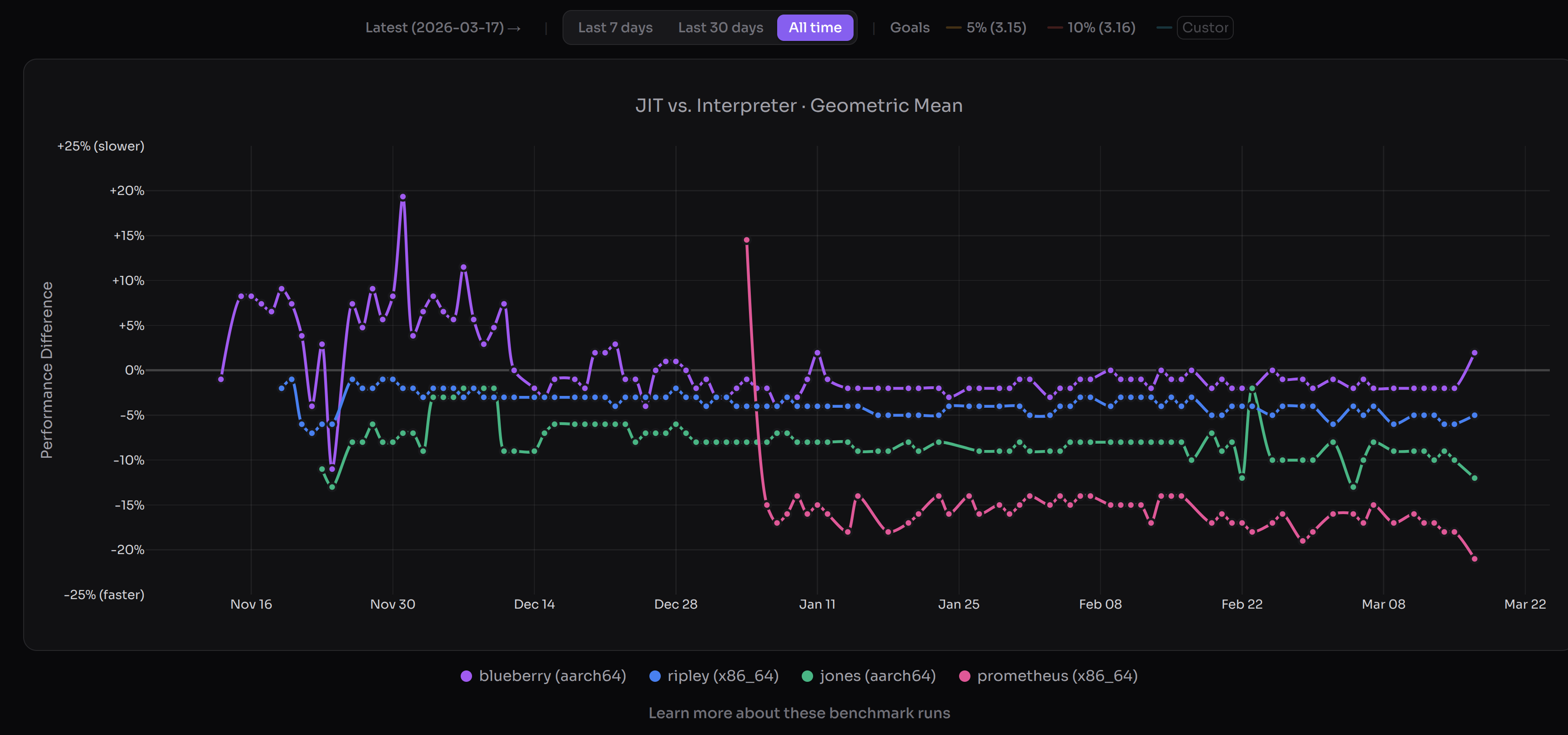
▲ JIT compiler vs. traditional interpreter performance comparison. Blue bars show speed with JIT enabled. (Source: Ken Jin's Blog)
How Much Faster, Exactly?
Here's a summary of the benchmark results:
Linux (x86-64): 5–6% faster than before
Windows (MSVC 18): 15–20% faster than before, with up to 40% improvement on long-running tasks
Per-task variation: Some tasks see over 100% improvement (more than 2x faster)
You might think "12% doesn't sound like much." But for tasks like AI model training that run for hours, 12% means saving tens of minutes. And this is just the beginning — the Python team is planning further optimizations in versions 3.16 and 3.17.
The Budget Was Cut and the Team Scattered
The fact that this project made it this far is a story in itself.
The 'Faster CPython' project, aimed at speeding up Python, was originally run by a professional team funded by Microsoft. But when key funding was cut in 2025, the team was effectively disbanded. JIT compiler development was on the verge of stopping entirely.
That's when volunteer developers stepped up. Led by Ken Jin, contributors including Savannah Ostrowski, Mark Shannon, Diego Russo, and Brandt Bucher continued the work unpaid. By studying the source code of PyPy (an alternative, high-performance implementation of Python) and welcoming community contributors, they hit their performance targets a full year ahead of schedule on macOS and several months early on Linux.
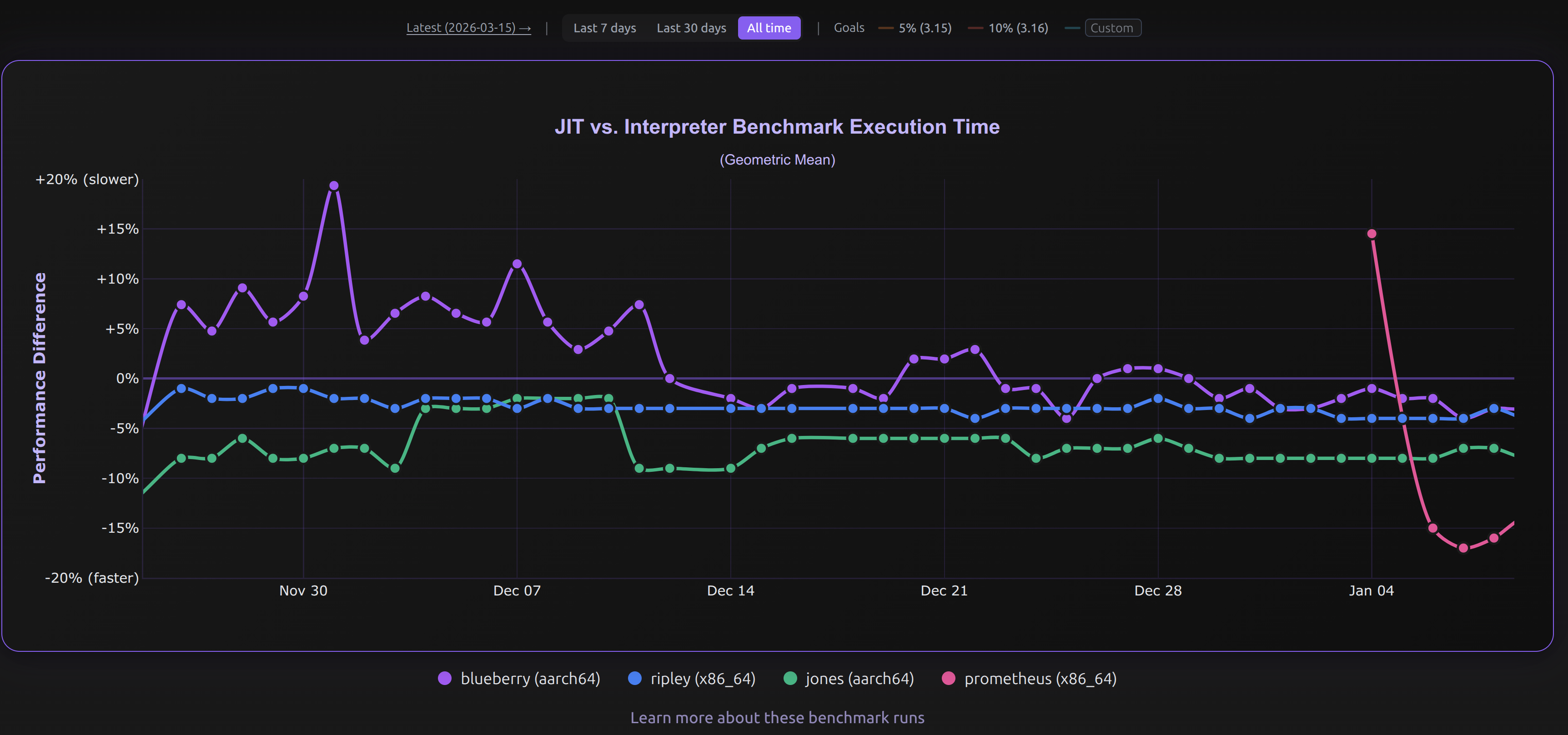
▲ JIT performance gradually improving through the community optimization process. (Source: Ken Jin's Blog)
What Technologies Drove the Speed Gains?
For those curious about the technical details, here are the key innovations:
Other Speed Improvements Beyond JIT
Python 3.15 includes several other notable performance improvements beyond the JIT compiler:
- Base64 encoding 2x faster, decoding 3x faster — Converting images and files to text format (a common operation in web and AI applications) gets significantly quicker
- Lazy Import — Instead of loading all libraries at once when the program starts, they load only when actually needed. This speeds up startup time
- Tachyon Profiler — A built-in tool that checks program state up to 1 million times per second to precisely pinpoint performance bottlenecks
- frozendict — A new immutable dictionary type (a data structure that can't be modified after creation) is added, enabling safer and faster data handling
What This Means for AI Users and Vibe Coders
"I'm not a Python developer — why should I care?"
If your vibe-coded app is Python-based (and most AI-related projects are), simply upgrading to Python 3.15 gives you a speed boost without changing a single line of code. It's like swapping in a new engine — you drive the same way, but the car goes faster.
If you're an AI tool user — ChatGPT, Claude, and many other AI services run on Python servers. As Python gets faster, these services' response times will gradually improve too.
If you're a data analyst — the Python layer of data processing tools like Pandas and NumPy will run faster, giving you a noticeable speed boost when working with large datasets.
How Developers Are Reacting on Hacker News
This news has generated a lively discussion on Hacker News, with 328 upvotes and 151 comments.
Key takeaways from the discussion:
- "Python's fundamental design choices (dynamic typing, etc.) limit how far JIT optimization can go" — but achieving 12% despite those constraints is impressive
- "PyPy (a faster alternative Python implementation) is already quicker, isn't it?" — true, but PyPy has compatibility issues with some libraries, making the official Python JIT more significant in practice
- "Does Python's speed even matter in an age where AI writes code for us?" — the prevailing view is yes, because AI-generated code still runs on Python
When Is the Official Release?
Python 3.15 is currently at the alpha 7 stage (a test version still in development). Following Python's release schedule, the stable version is expected in October 2026. If you'd like to try it out early:
# Install the latest alpha version with pyenv
pyenv install 3.15.0a7
pyenv local 3.15.0a7

# Enable JIT (requires --enable-experimental-jit flag at build time)
python -X jit your_script.py
⚠️ Since this is an alpha version, it's recommended for testing purposes only — don't use it in production projects just yet.
Related Content — Get Started with AI Using EasyClco | Free Learning Guide | More AI News
Sources
Stay updated on AI news
Simple explanations of the latest AI developments