Hindsight gives AI agents memory that actually learns
Hindsight is an open-source memory system that lets AI agents retain, recall, and reflect — like a human brain. Already deployed at Fortune 500 companies.
Every time you start a new conversation with an AI assistant, it forgets everything you told it before. Your preferences, your project context, the mistakes it made last time — all gone. Hindsight is an open-source project that gives AI agents a real memory system — one that doesn't just store chat history, but actually learns and improves over time.
Built by Vectorize.io, Hindsight has reached 4,900 GitHub stars (2,100+ this week alone) and is already running in production at Fortune 500 companies. Its benchmark performance has been independently verified by researchers at Virginia Tech.

Three operations inspired by the human brain
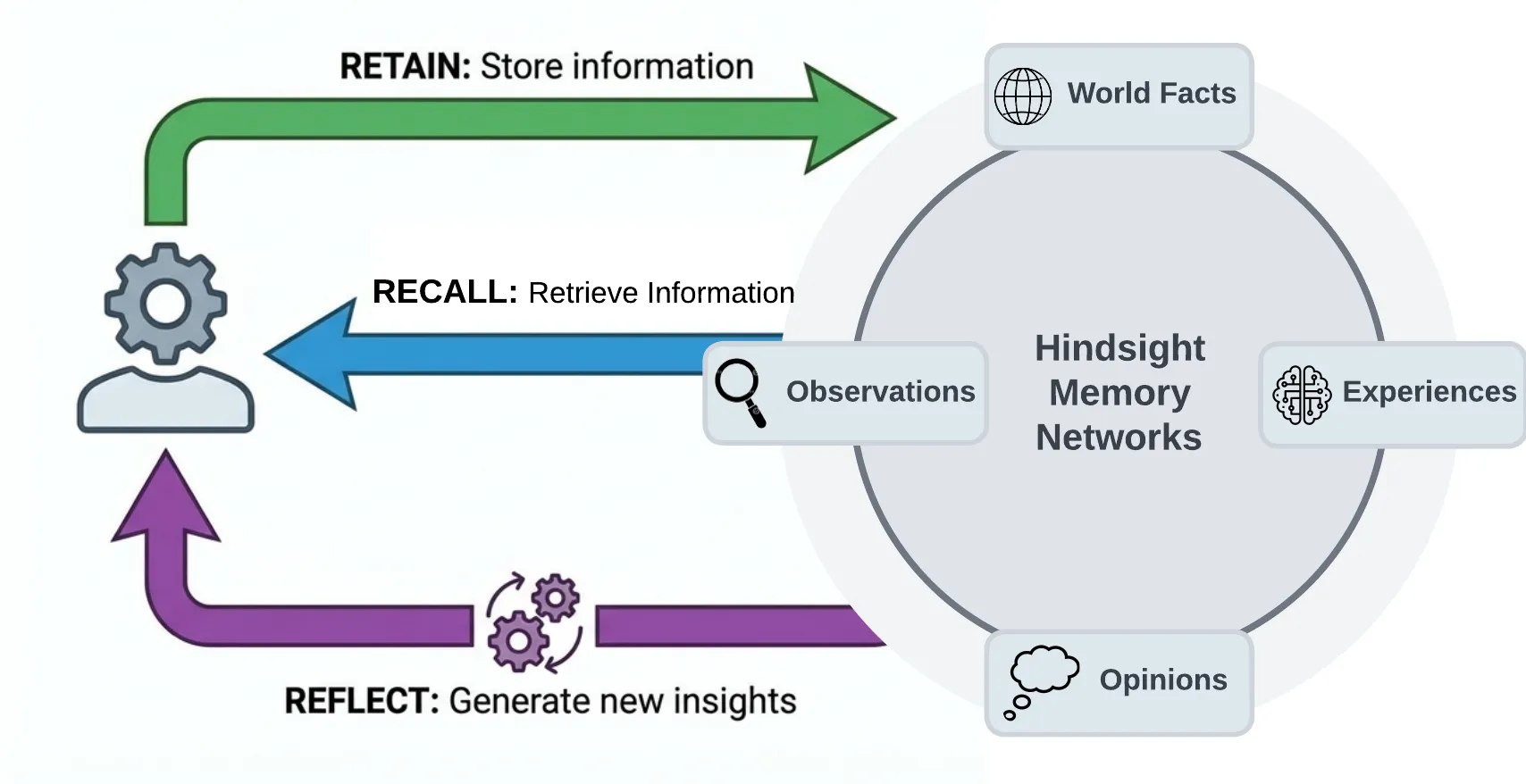
Hindsight organizes AI memory the way neuroscience says human memory works — through three core operations:
Retain — When an agent learns something new, Hindsight extracts the key facts, relationships, and timing, then stores them across organized memory categories. Think of it as the agent writing in its notebook.
Recall — When the agent needs information, Hindsight searches using four parallel strategies at once: meaning-based similarity, keyword matching, relationship graphs, and time-based filtering. It's like searching your memory from multiple angles simultaneously.
Reflect — This is the breakthrough. The agent periodically reviews its own memories to form new insights — connections it didn't see before. A customer support agent might reflect on a week of conversations and realize "customers asking about X usually also need help with Y."
Three types of memory, not one big pile
Most AI memory systems dump everything into one database. Hindsight separates memories into categories that mirror how humans organize knowledge:
World Facts — Objective information about the environment ("The company's fiscal year ends in March")
Experiences — What the agent has done and observed ("Last time I suggested option A, the user preferred option B")
Mental Models — Synthesized understanding built from reflection ("Users in the marketing team prefer visual explanations over technical ones")
State-of-the-art on memory benchmarks
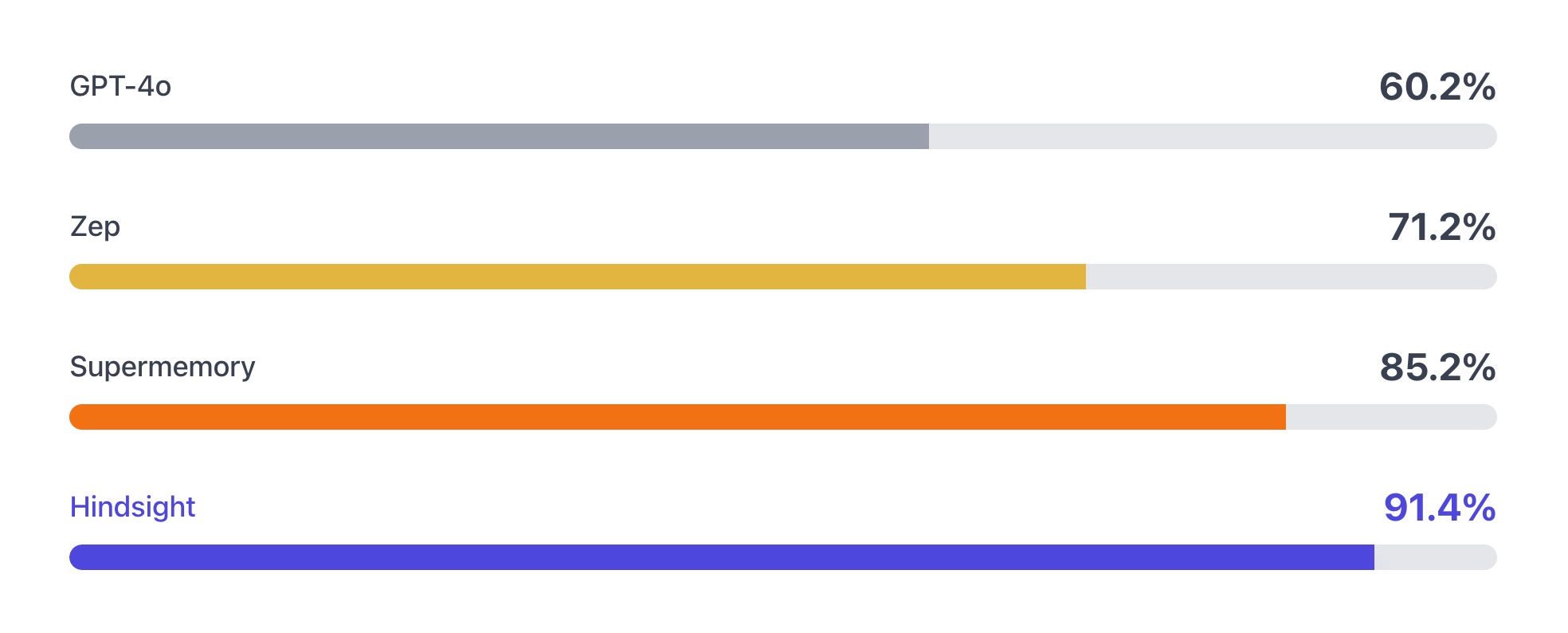
Hindsight achieved the top score on the LongMemEval benchmark — the standard test for evaluating how well AI systems remember things over long conversations. This was independently verified by Virginia Tech's Sanghani Center, adding academic credibility to the results.
Try it in 2 minutes
Hindsight offers multiple installation paths, from a simple Docker container to embedded Python:
# Docker (easiest)
docker run -d -p 8888:8888 -p 9999:9999 \
  -e OPENAI_API_KEY=your-key \
  vectorize/hindsight

# Python SDK
pip install hindsight-client

# Node.js SDK
npm install @vectorize-io/hindsight-client

# Embedded (no server needed)
pip install hindsight-all
It works with OpenAI, Anthropic (Claude), Google Gemini, Groq, Ollama, and LM Studio — so you can use whatever AI provider you prefer, including running models locally on your own machine.
Real-world applications
Customer support bots that remember each customer's history and preferences, getting better at helping them over time.
AI employees that learn from feedback — tell it once how you like reports formatted, and it remembers forever.
Personal AI assistants with per-user memory — each user gets their own memory bank, so the agent builds a unique relationship with every person it helps.
Hindsight integrates with popular agent frameworks including CrewAI, Pydantic AI, and LiteLLM. It's MIT-licensed (fully free for commercial use) and backed by a published research paper.
Related Content — Get Started with Easy Claude Code | Free Learning Guides | More AI News
Sources
Stay updated on AI news
Simple explanations of the latest AI developments