MiroFish simulates the future with AI swarms — 34K GitHub stars
MiroFish lets you upload news or data and watch thousands of AI agents simulate what happens next. 34K stars in one week on GitHub.
What if you could run a rehearsal of the future before making a big decision? That's exactly what MiroFish does — and it just exploded to 34,000 GitHub stars with nearly 19,000 gained in a single week.
A Digital Sandbox for the Future
MiroFish is an open-source swarm intelligence engine — a tool that creates thousands of AI characters, gives them personalities and knowledge, then lets them interact in a simulated world. You feed it real-world information (news articles, policy drafts, financial signals), describe what you want to predict, and it builds a parallel digital world where AI agents act out what might happen next.
Think of it like a flight simulator, but for decisions. Instead of testing how a plane handles turbulence, you're testing how a market reacts to a policy change, or how public opinion shifts after a scandal.
How It Actually Works
The process runs through five stages:
1. Knowledge graph construction — MiroFish reads your source material and maps out all the people, organizations, and relationships using GraphRAG (a technique that organizes information into connected webs rather than flat lists).
2. Character generation — It creates AI agents with distinct personalities, motivations, and behavioral patterns based on the real entities it found.
3. Parallel simulation — These agents interact on two simulated platforms simultaneously, with memories that update dynamically.
4. Report generation — A specialized ReportAgent watches the simulation and writes a detailed prediction report.
5. Deep interaction — You can chat with any simulated character or ask follow-up questions about the results.
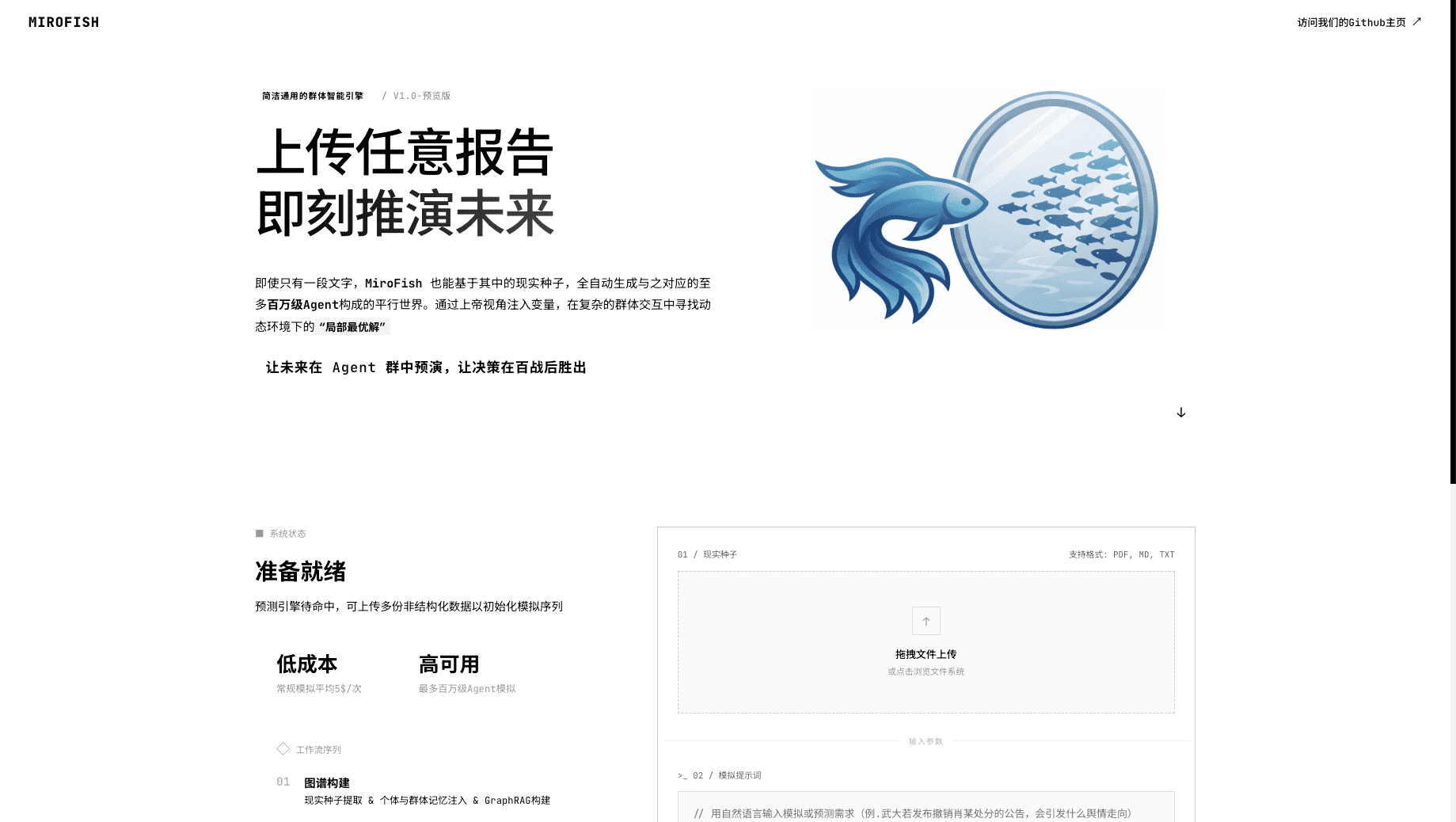
Two Demos That Show What's Possible
The team showcases two striking examples:
Public opinion simulation — Feed in a real controversy (they used Wuhan University opinion reports), and watch how AI agents representing different stakeholders react, argue, and shift positions over time.
Literary prediction — They fed in the existing chapters of Dream of the Red Chamber (a famous Chinese novel with a lost ending) and let AI agents reconstruct what the characters would have done next.
Who Should Pay Attention
If you work in strategy, marketing, or risk analysis, this is the kind of tool that could change how you prepare for big moves. Imagine simulating how customers react to a price change, or how competitors respond to your product launch — before you commit.
Researchers and analysts can use it to stress-test hypotheses with simulated populations instead of waiting for real-world data.
Content creators could even use it for worldbuilding — creating complex character interactions for stories, games, or screenplays.
Try It Yourself
MiroFish requires Node.js 18+, Python 3.11-3.12, and an API key from any OpenAI-compatible LLM provider (the team recommends Alibaba's Qwen model). A Docker option is also available:
git clone https://github.com/666ghj/MiroFish.git
cd MiroFish
cp .env.example .env
# Edit .env with your API keys
docker compose up -d
The project is open-source under AGPL-3.0 and received strategic support from Shanda Group. Its simulation engine is built on OASIS by CAMEL-AI, an established multi-agent simulation framework.
With nearly 19,000 stars gained in one week, MiroFish is clearly hitting a nerve. The ability to "rehearse the future" before committing to decisions is something every organization wants — and now there's an open-source tool to do it.
Related Content — Get Started with Easy Claude Code | Free Learning Guides | More AI News
Stay updated on AI news
Simple explanations of the latest AI developments