900 million people now use ChatGPT every week
a16z's 6th edition Top 100 AI Apps report reveals ChatGPT hit 900M weekly users, Midjourney collapsed from #1 to #46, and three separate AI ecosystems are forming worldwide.
ChatGPT now has 900 million weekly active users — up 500 million in a single year. That means more than 1 in 10 people on the planet use it every week. That's the headline from a16z's 6th edition of its Top 100 Gen AI Consumer Apps report, released in March 2026, and the numbers paint a picture of an industry that's consolidating faster than anyone expected.
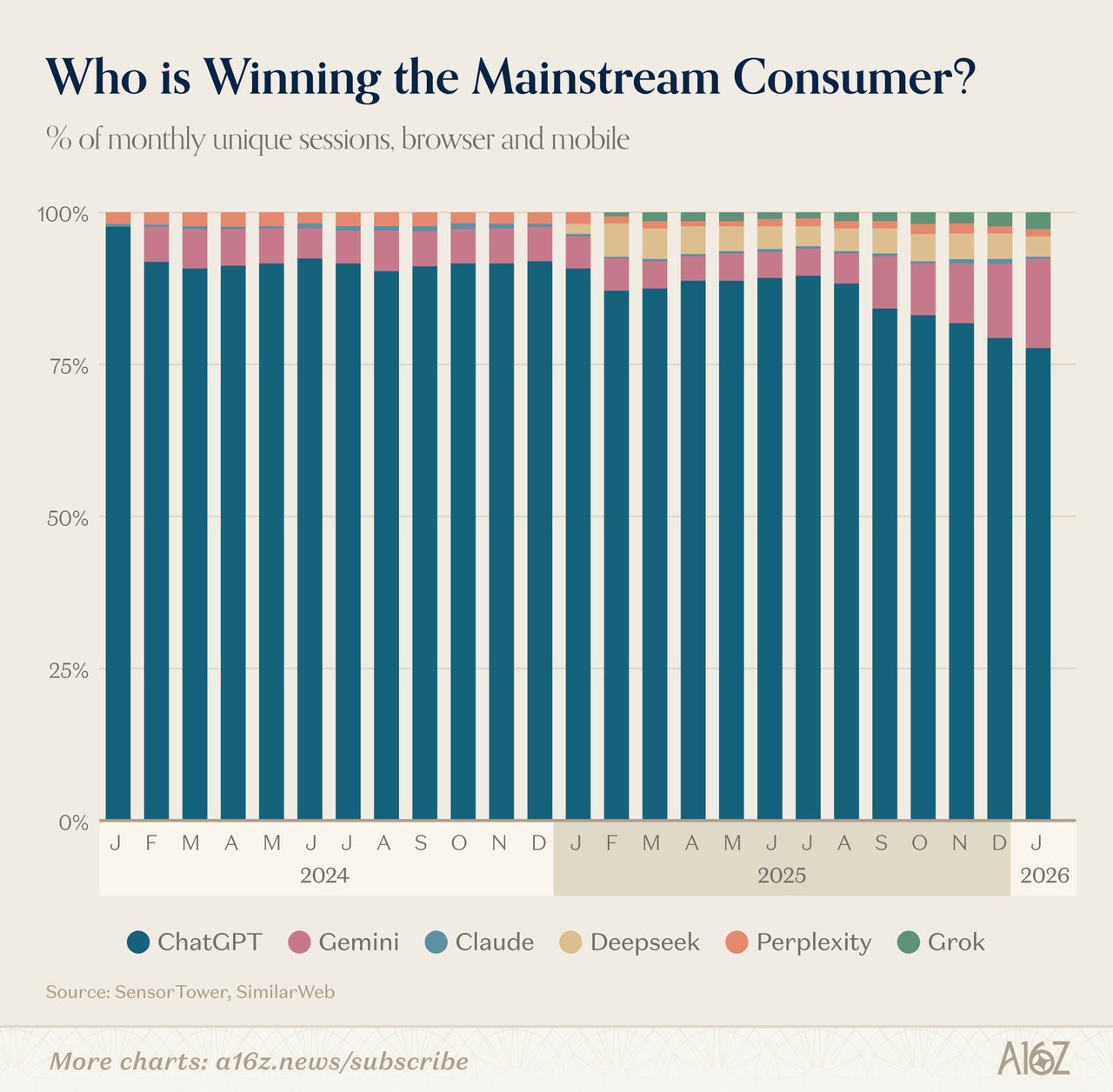
ChatGPT is pulling away from everyone
The gap between ChatGPT and everyone else is staggering. On the web, ChatGPT gets 2.7 times more traffic than the second-place Gemini. On mobile, it's 2.5 times larger. And when you look at how often people come back, ChatGPT users open the app 2.2 times more per month than Gemini users.
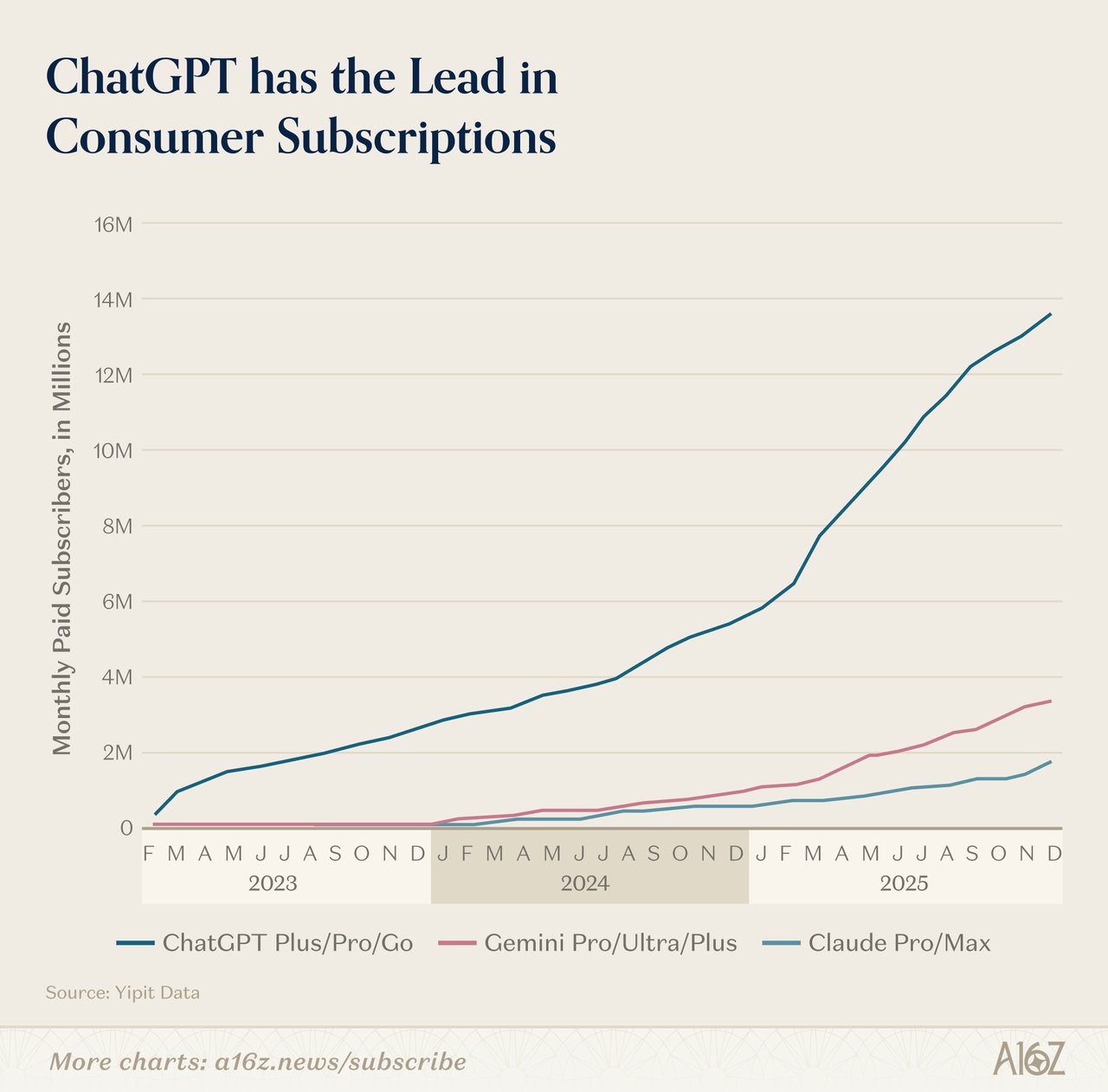
But the competition isn't standing still. Claude's paid subscribers grew 200% year-over-year, and Gemini's grew even faster at 258%. About 20% of weekly ChatGPT users also use Gemini — people are "shopping around" between AI assistants the way they might switch between streaming services.
The rise and fall of standalone AI image generators
Midjourney fell from the #1 creative tool to #46. In September 2023, when a16z first published this list, seven of the nine creative tools were AI image generators. Today, only three survive. What happened? ChatGPT and Gemini absorbed image generation as a built-in feature — a free checkbox that killed standalone products.
The survivors are niche players like Leonardo, Ideogram, and CivitAI, each serving specific communities. Meanwhile, AI video is surging — Chinese tools like Kling AI, Hailuo, and Pixverse lead in quality, with Google's Veo 3 being the first Western model to close the gap.
Music and voice remain the most defensible creative AI niche. Suno (AI music generation) held its #15 ranking, and ElevenLabs (voice cloning and dubbing) has appeared on every edition since the first. Their specialized features haven't been replicated as checkbox additions to larger platforms — yet.
Three separate AI worlds are forming
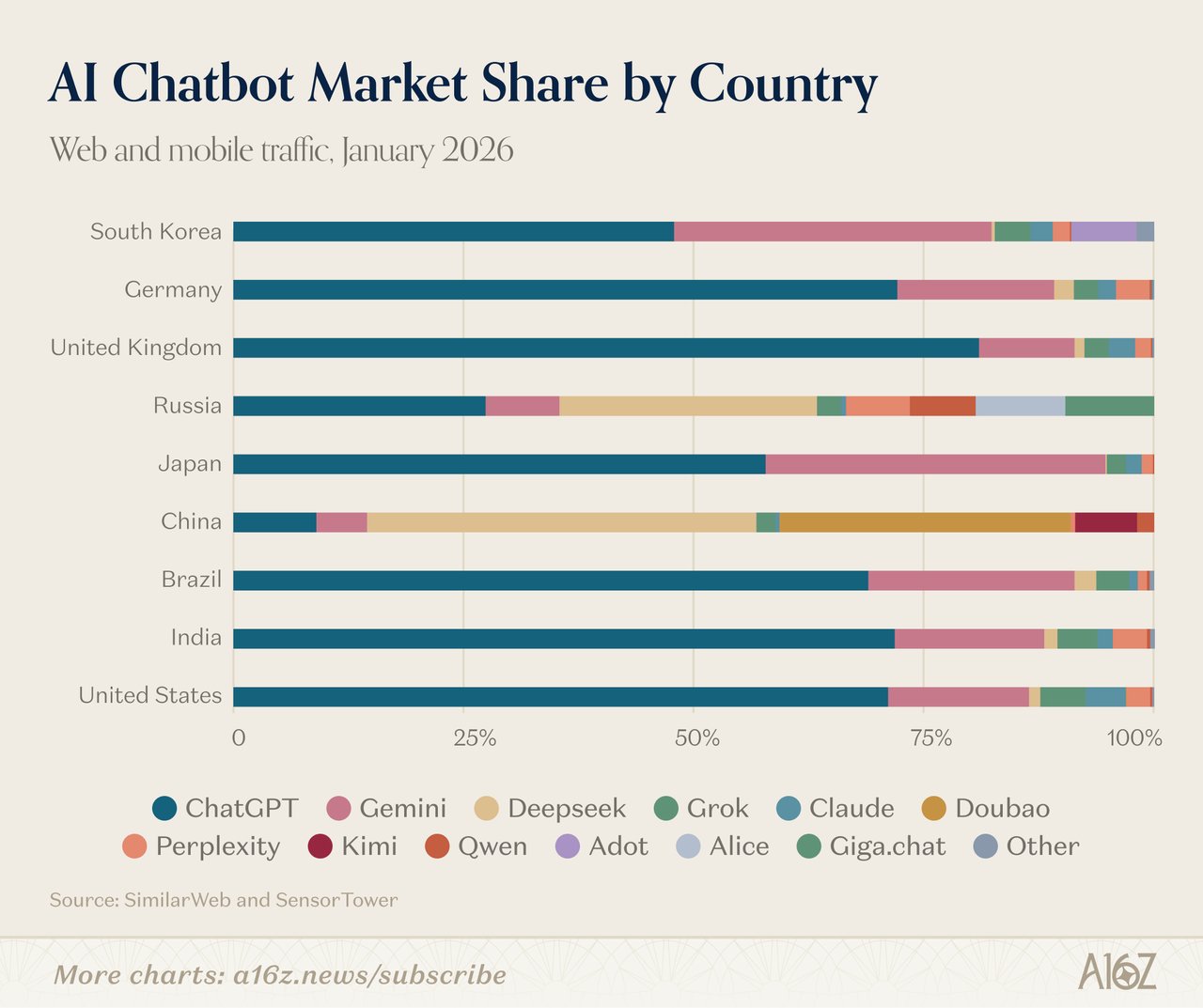
The report reveals something most people don't realize: the AI world is splitting into three separate ecosystems with minimal overlap.
Western ecosystem: ChatGPT, Claude, Gemini, Perplexity — dominant in the US, India, Brazil, UK
Chinese ecosystem: DeepSeek, Doubao, Kimi — DeepSeek splits its traffic: 33.5% China, 7.1% Russia, 6.6% US
Russian ecosystem: Yandex Browser with Alice AI (71 million monthly users), Sber's GigaChat — emerged after 2022 sanctions, roughly 2 years behind China's curve
And which country uses AI the most per person? Not the US — it ranks #20. Singapore, the UAE, and Hong Kong top the per-capita AI adoption index.
AI is disappearing into the apps you already use
The most important trend might be the hardest to measure. AI is increasingly embedded inside existing tools rather than sold as standalone products. Anthropic launched Claude inside Excel and PowerPoint. ChatGPT plugged into Excel. Google wove Gemini into Docs, Sheets, Gmail, and Meet.
The clearest example: Notion debuted on the list this edition. Its AI adoption rate among paying users jumped from 20% to 50% in a single year — and AI features now account for roughly half the company's revenue.
The report's authors flag this as a measurement problem: "Our rankings increasingly undercount the AI products people use most." People using Claude Code (which hit $1 billion in annualized revenue in just 6 months) or AI features in Google Sheets don't show up in website traffic or app download numbers.
AI agents are here — but not quite mainstream
AI agents (programs that autonomously complete tasks on your behalf) are the fastest-growing category, but they still require some technical knowledge. OpenClaw — an open-source personal AI assistant — went from a side project to the most-starred project on GitHub in early 2026, surpassing React and Linux. OpenAI acquired it in February.
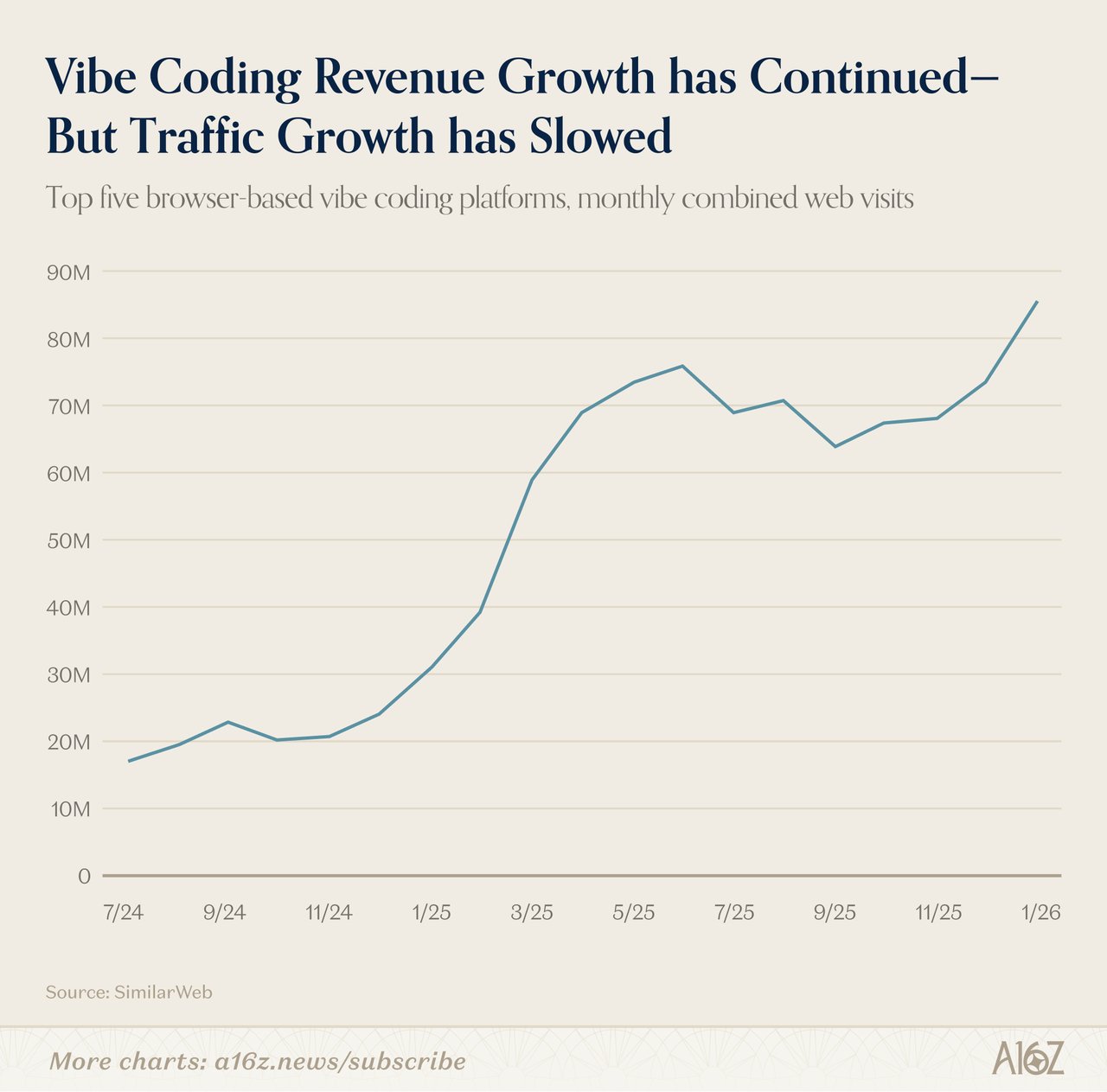
Vibe coding platforms (tools that let you build apps by describing what you want in plain English) like Lovable and Replit saw their traffic growth slow from the initial explosion, but revenue keeps climbing — suggesting fewer, more serious users who pay more.
ChatGPT vs Claude: two very different strategies
The report reveals a fascinating split in how the two biggest AI companies are building their platforms:
ChatGPT's strategy: become a super-app. It now has 220 apps across 13 categories — including Expedia for travel, Instacart for groceries, Zillow for housing. Sam Altman wants "Sign in with ChatGPT" to become a universal identity layer.
Claude's strategy: serve professionals. It has ~160 curated connectors plus ~50 community MCP servers, focused on financial terminals (PitchBook, FactSet, Moody's), developer tools (Sentry, Supabase), and scientific databases (PubMed, Clinical Trials).
Only 41 apps overlap between both platforms — that's just 11% of their combined catalogs. The two are building entirely different ecosystems.
What this means if you're choosing an AI assistant
If you need an AI that does a little of everything — shopping, booking, daily tasks — ChatGPT's super-app approach is pulling ahead. If you do specialized work in finance, development, or research, Claude's professional integrations may serve you better. And if you're in the creative space, standalone tools are losing ground fast to built-in features in the platforms you already pay for.
The bottom line from a16z's data: the AI market is no longer about which chatbot is smartest. It's about which one becomes the most useful part of your daily routine.
Related Content — Get Started with Easy Claude Code | Free Learning Guides | More AI News
Sources
Stay updated on AI news
Simple explanations of the latest AI developments