Cursor just built its own AI — it beats Claude at coding for 1/10th the price
Cursor released Composer 2, its first proprietary AI model that outperforms Claude Opus 4.6 on coding benchmarks at $0.50 per million tokens — 10x cheaper than Anthropic.
The company behind one of the most popular AI coding editors just made a bold move: Cursor released its own AI model called Composer 2, and it outperforms both Claude and GPT on key coding benchmarks — at a fraction of the cost.
Until now, Cursor relied entirely on models from Anthropic and OpenAI. That dependency came with a problem: Anthropic's Claude Code subscription costs users $200/month but reportedly consumes ~$5,000 in compute per user. Cursor couldn't match those margins while reselling someone else's AI.
So they built their own.
How Composer 2 stacks up against the giants
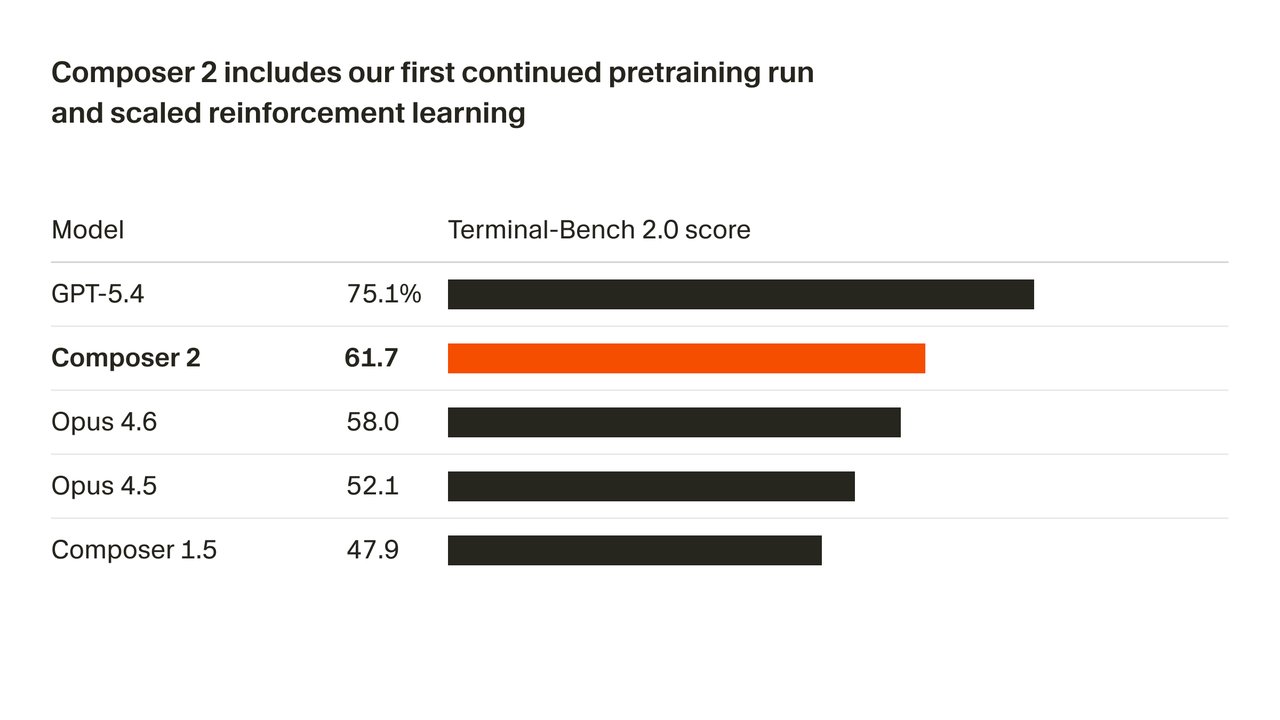
On Terminal-Bench 2.0 (a benchmark that tests how well AI handles real coding tasks in a terminal), Composer 2 scored 61.7% — beating Claude Opus 4.6's 58.0%. On SWE-bench Multilingual (which tests bug-fixing across multiple programming languages), it scored 73.7%.
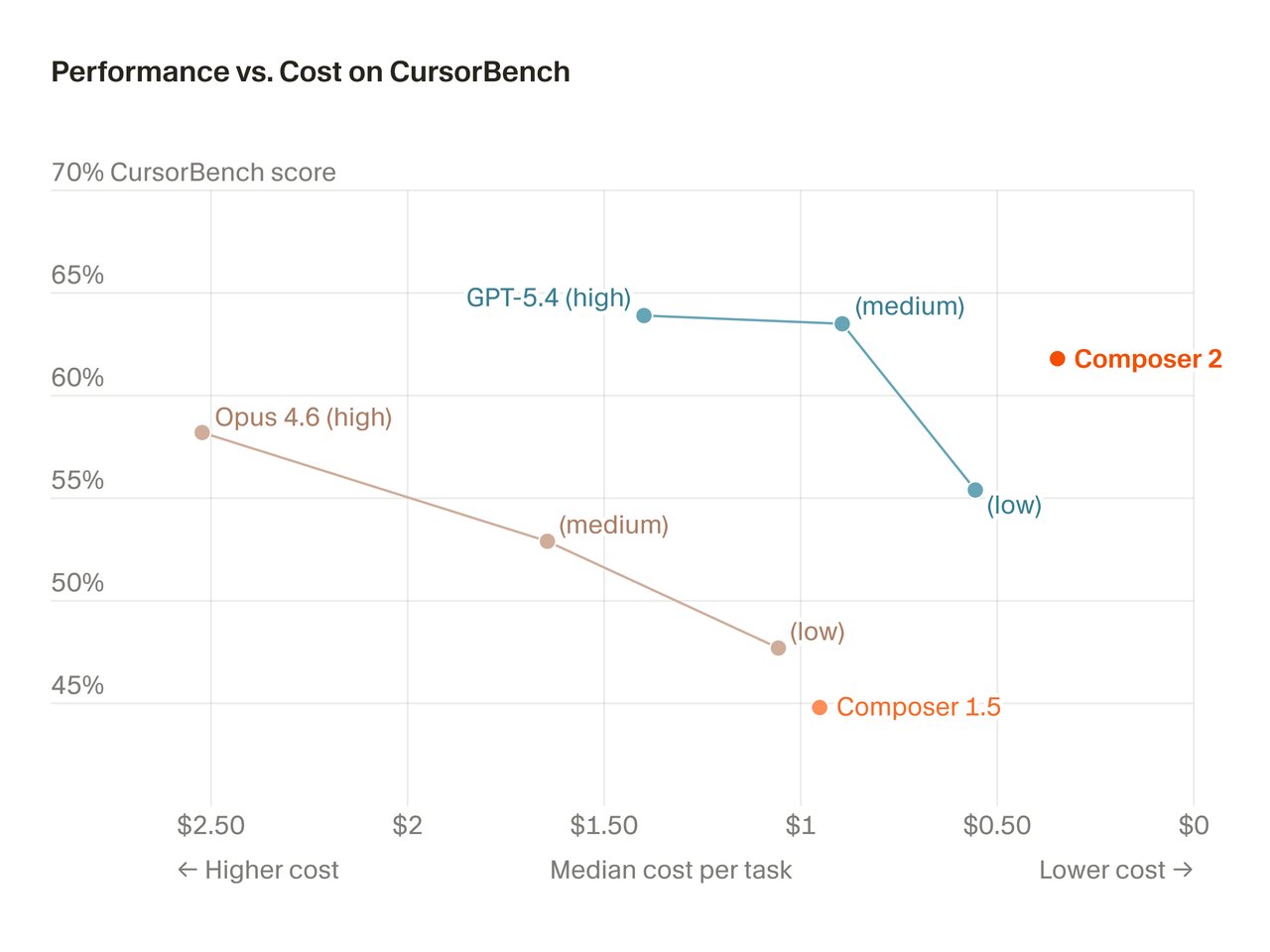
On CursorBench (Cursor's own internal test), Composer 2 scored 61.3 — up from 44.2 in the previous version. For context, Claude Opus 4.6 scored 58.2 and GPT-5.4 Thinking scored 63.9 on the same test.
• Composer 2: $0.50 input / $2.50 output per million tokens
• Claude Opus 4.6: $5.00 input / $25.00 output per million tokens
• GPT-5.4: $2.50 input / $15.00 output per million tokens
That makes Composer 2 roughly 10x cheaper than Claude and 5x cheaper than GPT for coding tasks.
What makes it different from ChatGPT or Claude
Composer 2 is not a general-purpose AI. Co-founder Aman Sanger put it bluntly: "It won't help you do your taxes. It won't be able to write poems."
Instead, it's trained specifically for coding — and for long, multi-step coding tasks that require hundreds of actions. Think: refactoring an entire codebase, fixing bugs across multiple files, or building a feature from scratch.
A key technical innovation is called "self-summarization" — a technique where the model learns to compress its own context during long coding sessions. This reduces errors by 50% compared to standard context compression, letting it handle tasks that span hundreds of steps without losing track of what it's doing.
A faster option for speed-sensitive work
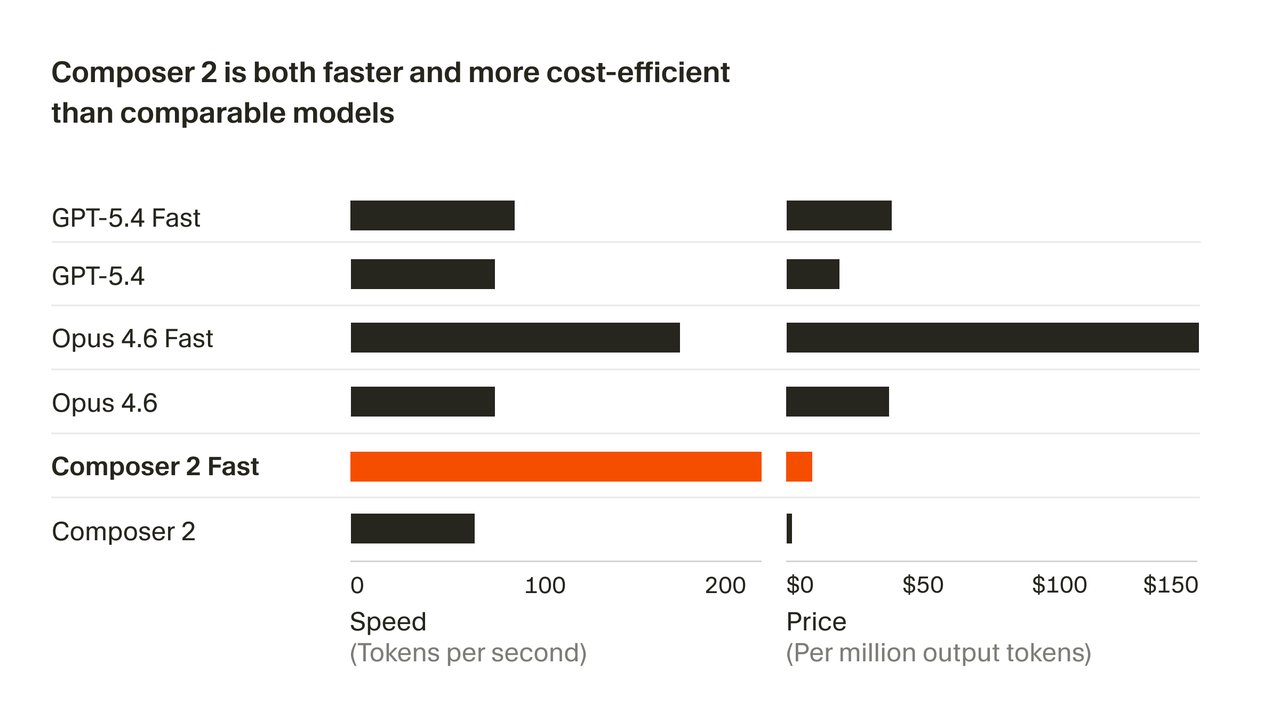
Cursor also released a "fast" variant at $1.50 input / $7.50 output per million tokens. Same intelligence, faster responses. Even this premium tier costs less than Claude's standard pricing.
For Cursor Pro subscribers, Composer 2 comes with generous included usage — no extra API fees needed for typical coding sessions.
Why this matters beyond just Cursor users
This is the first time a coding tool company has built a frontier-level AI model in-house. Until now, every AI code editor — Cursor, Windsurf, Cody, Copilot — depended on models from Anthropic, OpenAI, or Google.
Cursor is signaling a new era: specialized AI that beats general-purpose models at specific tasks, at dramatically lower cost. If Cursor can do this for coding, expect other vertical-specific AI models to follow in design, legal, finance, and more.
• Developers using Cursor — Composer 2 is available now in Cursor's model selector
• Vibe coders — faster, cheaper AI means more experiments per dollar
• AI builders — the API is open at $0.50/M input tokens, making it one of the cheapest frontier coding models available
• Anyone watching the AI industry — this shows tool companies can compete with model labs on specialized tasks
Cursor faces a unique structural challenge: it competes directly with OpenAI and Anthropic while still depending on their models for non-coding tasks. But with Composer 2, it's taken a meaningful step toward independence — and shown that bigger isn't always better when you know exactly what problem you're solving.
Related Content — Get Started with Easy Claude Code | Free Learning Guides | More AI News
Stay updated on AI news
Simple explanations of the latest AI developments