46 developers petition to ban AI from Node.js
Node.js core members launched a formal petition against AI-generated pull requests after a contributor used Claude to write 19,000 lines of code.
A group of 46 prominent developers — including the presidents of the Zig and Apache CouchDB foundations — just signed a petition asking Node.js to ban AI-generated code from its core codebase. The petition targets a specific incident: a 19,000-line pull request written largely by Claude Code, Anthropic's AI coding agent.
Node.js is the invisible engine behind millions of websites and servers. When someone says "the backend," there's a good chance it runs on Node.js. So when one of its founding engineers publicly challenges how code gets into the project, the entire developer world pays attention.
The Pull Request That Started It All
Over Christmas 2025, Matteo Collina — a longtime Node.js core contributor and co-founder of Platformatic — submitted PR #61478: a Virtual File System (node:vfs) spanning roughly 14,000–19,000 lines across 66 files. In his description, he openly stated he had used "a significant amount of Claude Code tokens" to create the PR.
The AI handled what Collina called the tedious parts: implementing every file-system method variant (synchronous, callback-based, and promise-based), wiring up test coverage, and generating documentation. Collina focused on architecture and API design, then manually reviewed all the output.
The PR went through three months of community scrutiny with hundreds of technical comments and eight named reviewers. But the controversy wasn't about what the code did — it was about how it was written.
"Hand-Written With Care" — The Petition
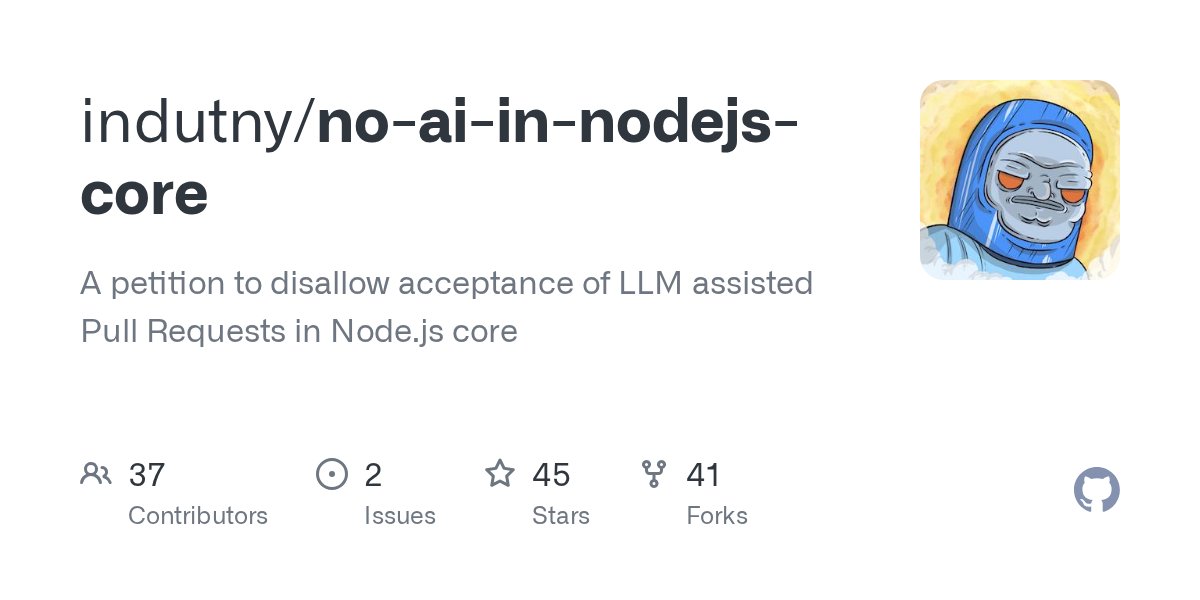
Fedor Indutny, a Node.js TSC (Technical Steering Committee) Emeritus Member and one of the project's earliest contributors, launched the petition on GitHub. Indutny is no minor figure — he previously led the io.js fork that reshaped Node.js governance.
The petition asks the Node.js TSC to vote "NO" on the question: "Is AI-assisted development allowed?"
The core argument: Node.js is critical infrastructure running on millions of servers. Its reputation was built on code "hand-written with care and diligence." Accepting AI-generated rewrites would "break the reputational bedrock of public contributions that have brought Node.js to its current public standing."
A key practical concern: "Submitted generated code should be reproducible by reviewers without having to go through the paywall of subscription-based LLM tooling." In other words, if a reviewer can't verify how the code was made without paying for Claude, the review process breaks down.
Who Signed — And Why It Matters
The 46+ signatories aren't random developers. They include:
Notable signatories:
- Jan Lehnardt — Apache CouchDB PMC Chair
- Andrew Kelley — President, Zig Software Foundation
- Bryan English — Node.js Core Collaborator
- Thomas Hunter II — Author of Distributed Systems with Node.js
These are people who maintain the infrastructure the internet runs on. When they collectively say "stop," it signals something deeper than a coding preference — it's a values statement about how critical software should be built.
Collina Fires Back: "I Created That Code"
Matteo Collina didn't back down. In a detailed blog post, he argued that responsibility — not methodology — is what matters.
"I created that VFS implementation. Saying I did not, just because I used Claude Code to assist, is not accurate."
His argument: AI shifts the bottleneck from writing code to reviewing it. The person who reviews, understands, and takes responsibility is doing the most important work. He compared it to how architects don't lay every brick but remain responsible for the building.
The OpenJS Foundation (the legal body behind Node.js) sided with Collina, confirming that AI-assisted contributions don't violate the DCO (Developer Certificate of Origin) — the legal document contributors sign to vouch for their code. Red Hat's legal team agreed, noting the DCO has never required every line to be "personal creative expression."
How the Linux Kernel Handles It Differently
The Linux kernel — which invented the DCO — takes a middle path. Its policy:
- Only humans can add the legal sign-off tag (not AI agents)
- AI assistance must be disclosed with an "Assisted-by" tag
- The human contributor bears full legal responsibility
This "disclose and take responsibility" approach differs sharply from the Node.js petition's harder line of banning AI contributions outright.
The Bigger Question Nobody Can Avoid
This isn't just about Node.js. Every open-source project — from the web frameworks behind your favorite apps to the security libraries protecting your bank account — will face this question.
The community on Hacker News was deeply split. Critics pointed out that 19,000 lines of AI output create an unfair burden on volunteer reviewers: "If code takes minimal time to generate but hours to review, reviewers bear unfair cognitive load." Some raised security concerns, warning that massive AI-generated PRs could hide "deniable exploits" that slip past exhausted reviewers.
Supporters countered: "If the PR does what it says and passes review, why does it matter if it took 2 weeks or 2 minutes?"
For now, the Node.js TSC hasn't formally responded to the petition. But the battle lines are drawn — and every major open-source project is watching.
What This Debate Means If You Use AI
If you use AI coding assistants like Claude Code, Cursor, or GitHub Copilot: this debate will shape what you can contribute to open-source projects. Some may follow Node.js petitioners and require purely human code. Others may follow the Linux kernel's "disclose and sign" model.
If you manage a team: the "reviewer burden" argument applies inside companies too. AI can generate code faster than teams can review it, creating a new bottleneck that's easy to overlook.
If you're learning to code: this controversy highlights that understanding code matters more than writing it. The ability to review, critique, and take responsibility for code — whether human or AI-written — is becoming the most valuable skill.
Related Content — Get Started with Easy Claude Code | Free Learning Guides | More AI News
Sources
Stay updated on AI news
Simple explanations of the latest AI developments