A leaked API call just exposed Cursor's biggest secret
Cursor's 'in-house' Composer 2 model is actually Moonshot AI's Kimi K2.5 with extra training. A leaked model ID triggered a license violation accusation and a $29B credibility crisis.
Cursor told the world it built its own AI coding model. A developer just proved it didn't.
On March 19, Cursor — the $29.3 billion AI coding editor — launched Composer 2, marketing it as a proprietary model that beats both Claude Opus 4.6 and GPT-5.4 at writing code. The announcement touted "continued pretraining" and "scaled reinforcement learning" (a technique where AI learns by trial and error, not memorization). Nowhere did it mention Kimi K2.5 — a free, openly available AI model built by Chinese startup Moonshot AI.
Then a developer named Fynn peeked behind the curtain.
The Model ID That Changed Everything
While testing Cursor's API (the connection point where apps talk to AI models), Fynn spotted the internal model identifier that Cursor never meant users to see:
accounts/anysphere/models/kimi-k2p5-rl-0317-s515-fastEvery piece of that ID tells a story:
anysphere — Cursor's parent company
kimi-k2p5 — Moonshot AI's Kimi K2.5 model
rl — reinforcement learning was applied on top
0317 — trained on March 17, 2026 (two days before launch)
fast — optimized for speed
In short: Cursor took an existing Chinese AI model, added extra training for coding tasks, and shipped it as its own creation.
Moonshot AI Fires Back
The revelation sparked an immediate response. Yulun Du, Moonshot AI's head of pretraining, publicly questioned Cursor's compliance. Two Moonshot employees initially confirmed on social media that Cursor lacked proper licensing — then deleted their posts.
The issue centers on Kimi K2.5's license. While the model is free to download and use, the license includes a clause specifically designed for situations like this:
The license rule: Any commercial product making more than $20 million per month must prominently display "Kimi K2.5" in its branding.
Cursor's monthly revenue: approximately $167 million — more than 8x the threshold.
Cursor's announcement blog post, release notes, and model documentation mention Kimi K2.5 exactly zero times.
The Numbers Behind the Controversy
Despite the controversy, Composer 2's performance is real. On coding benchmarks (standardized tests that measure how well AI writes and fixes code), Composer 2 shows significant gains:
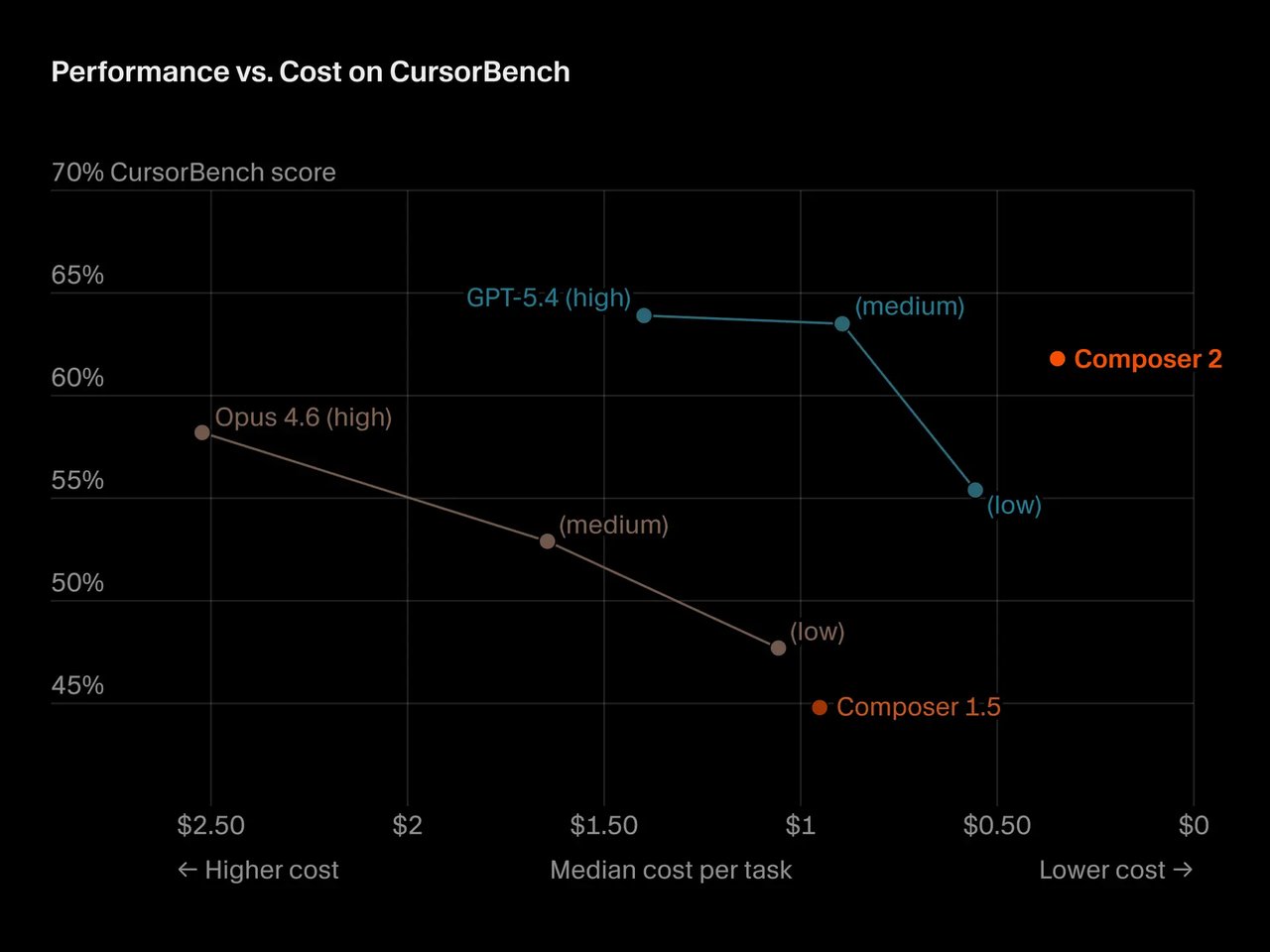
CursorBench: 61.3 (up from 44.2 with Composer 1.5)
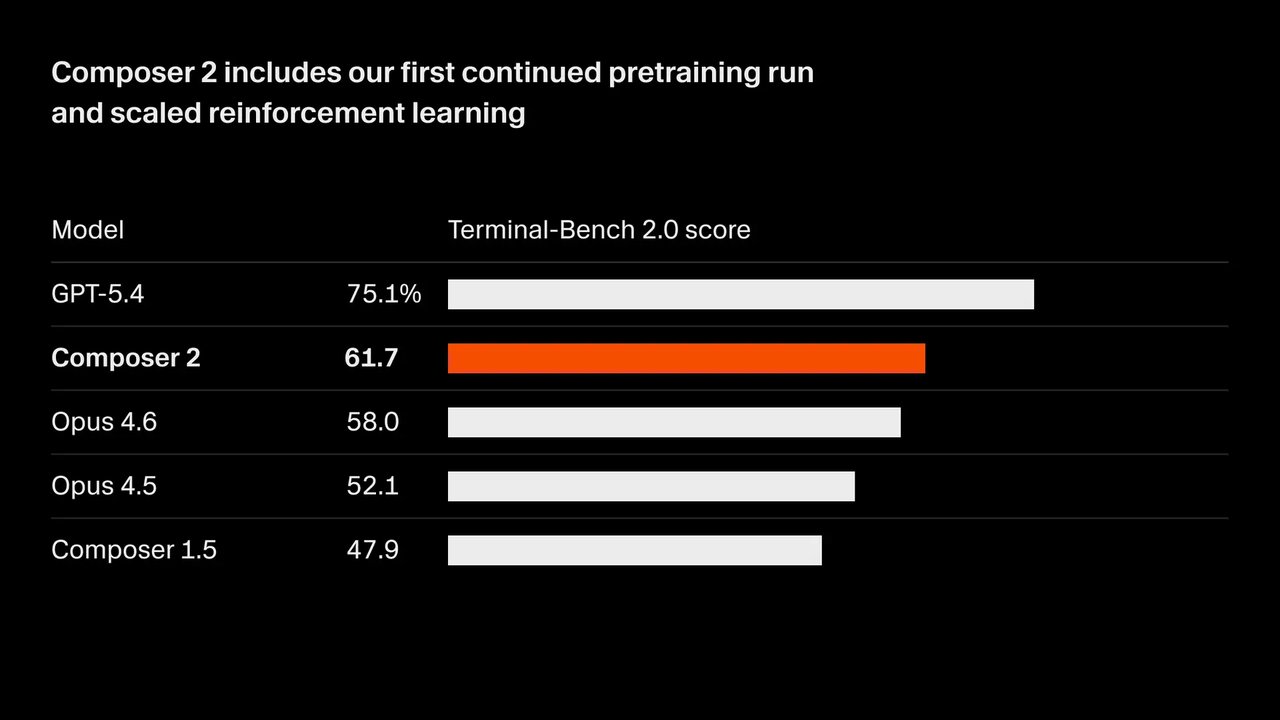
Terminal-Bench 2.0: 61.7 (up from 47.9)
SWE-bench Multilingual: 73.7 (up from 65.9)
Pricing: $0.50–$1.50 per million input tokens — significantly cheaper than using Claude or GPT directly
The quality isn't in question. The honesty is.
What Developers Are Saying
The Hacker News discussion (235+ points) split sharply. Some developers argued that "there is no 'just' in RL" — that the reinforcement learning work Cursor did on top of Kimi K2.5 represents genuine engineering effort. Others pointed out that Cursor's entire value proposition just shifted:
"Cursor is mostly an IDE harness company," one developer wrote. "Their moat looks pretty thin."
A Cursor representative referenced vague "inference partner terms" that might shield them from attribution requirements, but provided no specifics. Moonshot AI's license was specifically written to cover fine-tuned derivatives — models that are modified versions of the original.
Why This Matters Beyond Cursor
This case tests a question that affects every AI company: can open-source AI licenses actually be enforced?
Open-weight models (AI models whose internal workings are publicly shared) are the backbone of the AI industry. Companies like Moonshot, Meta, and Mistral release powerful models for free, trusting that commercial users will follow the license terms. If a $29.3 billion company can ignore those terms without consequence, the incentive for any AI lab to share its work openly shrinks dramatically.
For Cursor's 1 million+ daily users, the practical impact is minimal — Composer 2 works well regardless of its origins. But for the broader AI ecosystem, the answer to "does open-source licensing matter?" will shape what gets shared and what gets locked behind closed doors.
Related Content — Get Started with Easy Claude Code | Free Learning Guides | More AI News
Sources
Stay updated on AI news
Simple explanations of the latest AI developments