SoftBank just broke ground on a $500B AI campus — at a former nuclear weapons site
SoftBank is building the world's largest data center on a contaminated former uranium enrichment site in Ohio. The 10-gigawatt facility needs its own $33B gas plant — equivalent to nine nuclear reactors.
On March 20, SoftBank CEO Masayoshi Son stood in Piketon, Ohio — on land that once enriched uranium for nuclear weapons — and announced the single largest AI infrastructure project in history. The numbers are staggering: a 10-gigawatt data center campus that, at full capacity, would represent more than half of all currently operating data center power in the United States.

The site — rebranded as the PORTS Technology Campus — sits on the former Portsmouth Gaseous Diffusion Plant, where the U.S. enriched uranium from the 1950s through 2001. The ground is still being cleaned of radioactive contamination including uranium, technetium-99, and neptunium-237. Some residents report elevated cancer rates. And now, it's becoming the foundation of America's AI future.
The numbers behind the world's largest data center
To power a facility this size, SoftBank's subsidiary SB Energy will build the world's largest natural gas plant right alongside it — 9.2 gigawatts of generation capacity, funded by $33.3 billion in Japanese investment. That's roughly equivalent to the output of nine nuclear reactors.
• 10 GW total data center capacity — more than half of all US data centers combined
• $33.3 billion for the natural gas plant alone
• $10 billion first phase (800 megawatts, online by 2028)
• $4.2 billion in grid upgrades with AEP Ohio
• ~170 GE Vernova gas turbines ordered
• 35,000 construction jobs at peak, 2,500 permanent positions
• $40 million in community donations pledged
Son promised local residents their electricity bills won't go up: "I will commit right here, right now, that we will protect the electricity bill. We will not take electricity away from the grid. We will generate the entire electricity use by ourselves."
From Cold War uranium to AI — in one generation
The Portsmouth plant opened in 1954, producing enriched uranium for nuclear weapons and commercial reactors for nearly five decades. When it shut down in 2001, Pike County lost its economic engine. A multibillion-dollar cleanup operation has been running ever since — and it's still not finished.
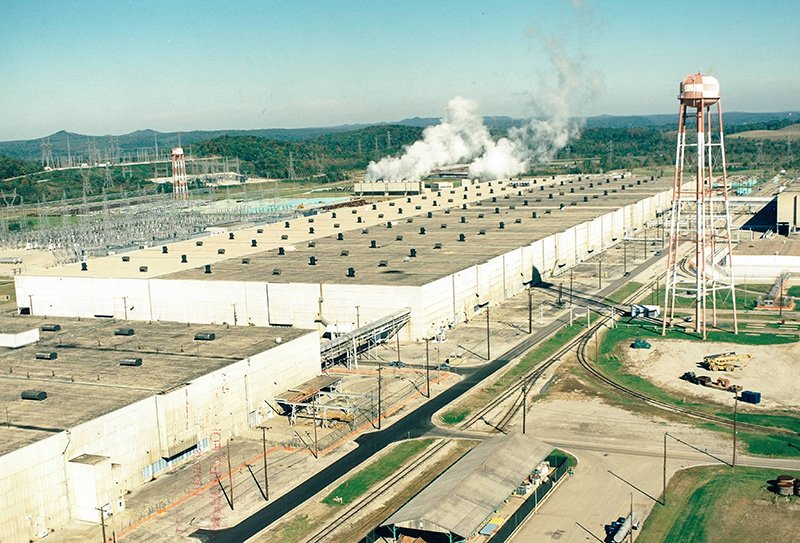
DOE Assistant Secretary Tim Walsh framed the transformation: "AI data centers are the factories of the modern digital age." State Senator Shane Wilkin called it "a generational change for this area."
The project is part of a $550 billion U.S.-Japan trade deal, and feeds into the broader Stargate AI infrastructure initiative — a collaboration between SoftBank, OpenAI, and Oracle that Son says could channel up to $500 billion into a single campus over time.
Not everyone is celebrating
While officials tout thousands of jobs, residents who've lived alongside radioactive contamination for decades are raising hard questions.
Neptunium-237 was detected near schools just two miles from the site in 2019. Pike County residents have been excluded from the Radiation Exposure Compensation Act despite documented contamination. No environmental impact assessments have been made public for the new project. No air quality permits have been filed.
As one local observer put it: "Washington is asking Pike County to become one of the most critical energy and technology nodes in the United States. Nobody has told the people who live there what that means for their safety."
Opposition groups are now pushing a constitutional ballot measure to ban mega data centers across Ohio entirely.
A nuclear-powered AI neighbor
SoftBank isn't the only company eyeing the site. The PORTS campus will also host a 1.2-gigawatt nuclear power facility built by Oklo Inc. in partnership with Meta, a hydrogen power plant from Trillium H2 Power, and expanded uranium enrichment operations from Centrus Energy. The former weapons site is transforming into one of the most concentrated energy-and-AI complexes on Earth.
Who benefits — and who pays?
If you work in AI or cloud infrastructure: This is the physical reality behind every API call. The compute powering tools like ChatGPT, Claude, and Gemini needs to live somewhere — and increasingly, "somewhere" means massive dedicated campuses with their own power plants.
If you're watching AI's environmental footprint: Burning 9.2 gigawatts of natural gas 24/7 carries enormous carbon implications. Renewable energy advocates point out that dedicated solar or wind could serve the same purpose without locking in decades of fossil fuel dependency.
If you're in Pike County: The promise is clear — 35,000 construction jobs and 2,500 permanent positions in a region that's been economically devastated since the plant closed. But the community is being asked to trust the same government that left radioactive contamination in their backyard for 25 years.
Construction begins this year. The first 800-megawatt phase is expected online by 2028.
Related Content — Get Started with Easy Claude Code | Free Learning Guides | More AI News
Sources
Stay updated on AI news
Simple explanations of the latest AI developments