He automated 90% of support with AI — his company killed it
Indeed job data shows customer service roles are bouncing back to pre-COVID levels — and one developer's story reveals why AI can't actually replace the work that matters most.
A former big-tech engineer built an AI system that handled 90% of customer support cases automatically. It connected a large language model to the company's knowledge base, answered questions, resolved tickets, and did it all without human help.
Then his company killed the entire project.
The reason? The remaining 10% of cases still required the full support team — and those were the cases that actually cost money. The AI had become, in the engineer's words, "an FAQ you can talk to."
The data nobody's talking about
This story comes from a new blog post by developer Martynas M. that just hit the front page of Hacker News — and the argument is backed by real numbers.
According to Indeed job posting data tracked by the Federal Reserve (FRED), customer service job postings in the United States have been bouncing back since mid-2025 and are now just below pre-COVID levels.
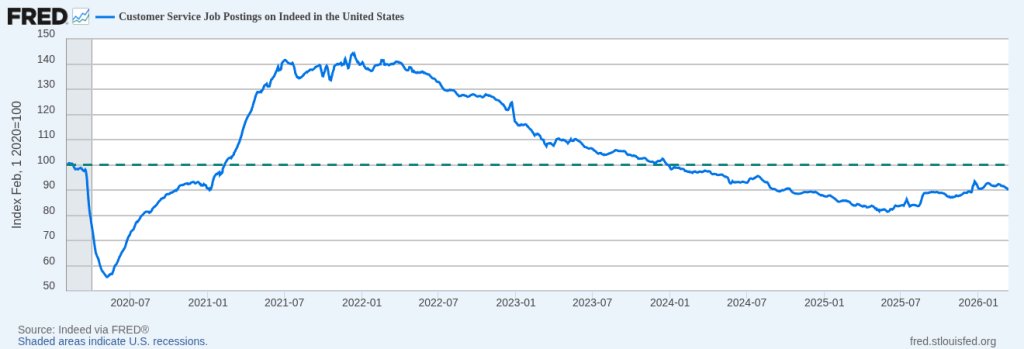
Think about that for a moment. AI is supposedly at "smart college student" level now (according to Anthropic CEO Dario Amodei). If a college-level AI could replace customer support workers — why are companies hiring them back?
The 80/20 trap that AI can't escape
The author introduces a concept that explains why most AI job replacement predictions fail: the 80/20 rule (also called the Pareto principle).
Here's how it works in plain English:
80% of any job is routine, predictable work. Filing reports, answering common questions, following standard procedures. AI handles this brilliantly.
20% of any job is the weird stuff — the edge cases, the judgment calls, the situations where no standard procedure exists. This is where all the real cost and complexity lives.
The blog post uses a vivid analogy: imagine sorting ribbons on a conveyor belt into "red" and "green" buckets. Most ribbons are obviously one color or the other — easy to automate. But a significant chunk falls somewhere in between. Some are orange. Some are teal. Some are colors that don't have a name yet.

For those ambiguous cases, you sometimes need to invent an entirely new category. No AI can do that — because the category doesn't exist yet in any training data.
Why automated support keeps failing
The article draws on widespread evidence beyond one anecdote. Reddit threads consistently show customer support departments surviving despite aggressive AI rollouts. The pattern is always the same:
"The company automates the easy stuff. The hard stuff doesn't go away. The team stays. The AI becomes a glorified search bar."
This matches what the Hacker News community observed. One commenter who works in the field noted that AI creates a triage system — sorting cases by complexity. But the expensive, time-consuming problems that justify having a support team in the first place? Those remain stubbornly human.
Another commenter drew on the radiologist example: when AI started reading medical images, many predicted radiologists would disappear. Instead, demand for radiologists actually increased because AI made imaging cheaper, which meant more people got scans, which meant more unusual findings needed human review.
The debate is far from settled
Not everyone on Hacker News agreed. Several commenters from India's IT sector reported real, ongoing layoffs tied directly to AI implementations. One noted that "thousands of Indian IT jobs are being lost daily" as executives explicitly plan staffing cuts around AI tools.
Another commenter invoked the "turkey parable" — the idea that workers feel safe right up until the moment they're suddenly let go, like a turkey that's fed every day until Thanksgiving.
The truth likely sits somewhere in between: AI is reshaping jobs rather than eliminating them wholesale. Routine tasks disappear, but the complex, judgment-heavy work that makes up the expensive 20% creates new demand for human expertise.
What this means if you're worried about your job
If your work is mostly routine — answering the same 50 questions, following scripts, processing standard forms — AI will likely handle a growing portion of it. But you probably won't be replaced. Your role will shift toward handling the hard cases AI can't solve.
If your work involves judgment calls, creative problem-solving, or navigating ambiguity — the 80/20 rule is working in your favor. These are exactly the skills AI struggles with most.
The smartest move right now: learn to work alongside AI on the routine 80%, so you can spend more time on the high-value 20% that makes you irreplaceable.
Related Content — Get Started with Easy Claude Code | Free Learning Guides | More AI News
Sources
Stay updated on AI news
Simple explanations of the latest AI developments