A beach chat 47 years ago just won computing's Nobel Prize
IBM physicist Charles Bennett wins the 2025 Turing Award for quantum cryptography — encryption that even future quantum computers can't crack.
In October 1979, IBM physicist Charles H. Bennett approached a stranger swimming off a beach in Puerto Rico and started describing a way to make unforgeable currency using quantum physics. That stranger was Gilles Brassard, a computer scientist from the Université de Montréal, who later recalled: "I was trapped, so I listened politely."
That conversation just won both men the 2025 A.M. Turing Award — computing's highest honor — along with a $1 million prize. It marks the first time the Turing Award has ever gone to quantum research.
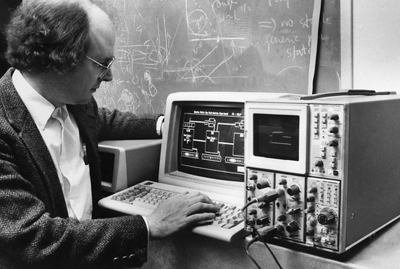
Charles Bennett with the first quantum cryptography device, built in his IBM office in 1989. Photo: IBM
Encryption that physics itself protects
Today's encryption — the kind that protects your bank account, emails, and AI conversations — relies on math problems that are really hard for computers to solve. But quantum computers (a new type of computer that uses the strange rules of physics at the tiniest scale) could eventually crack those problems in minutes.
Bennett and Brassard solved this before it even became a problem. In 1984, they published the BB84 protocol — a method that sends encryption keys (the secret codes that lock your data) using individual particles of light called photons.
Why it's unbreakable: Bennett describes quantum information like a dream — "As soon as you start trying to tell somebody about your dream, you begin to forget the dream." If anyone tries to intercept a quantum-encrypted message, the act of reading it destroys the information. The sender and receiver instantly know they've been spied on.
This isn't theoretical. In 1989, Bennett built the first working quantum cryptography device in his IBM office — a two-meter apparatus using mirrors, polarizers, and photon detectors.
Why this matters now more than ever
In 1994, mathematician Peter Shor proved that a quantum computer could crack the encryption protecting virtually every website, banking system, and AI service on the planet. Governments and banks have been racing to prepare ever since.
Bennett and Brassard's work is the answer. Their quantum encryption method offers security "guaranteed not by mathematical complexity but by the laws of physics itself" — making it safe even against attackers with unlimited computing power and superior technology.
The bigger picture: As AI systems handle increasingly sensitive data — medical records, financial transactions, personal conversations — quantum-safe encryption isn't optional. Every AI service you use today will eventually need what Bennett invented decades ago.
From reversible computation to quantum teleportation
Bennett's breakthroughs didn't stop at encryption:
- 1973 — Reversible computation: He proved that computers could theoretically run both forward and backward without wasting energy, revealing a deep connection between physics and information
- 1984 — BB84 protocol: The first practical method for quantum-secure key exchange
- 1989 — First device: Built a working quantum cryptography machine with mirrors and photon detectors
- 1993 — Quantum teleportation: Showed that quantum states (the information encoded in particles) could be transferred between locations using a phenomenon called entanglement — where two particles remain connected no matter the distance between them
Bennett's mentor at IBM was Rolf Landauer, who in 1961 published a foundational paper arguing that information is physical — it follows the same laws as heat and energy. That idea underpins everything from modern chip design to AI training efficiency.
Seventh IBM researcher to win
Bennett is the seventh IBM-affiliated scientist to receive the Turing Award. He's been at IBM Research for over 50 years — since Landauer recruited him in the early 1970s.
The Turing Award, named after British mathematician Alan Turing, is widely considered the Nobel Prize of computing. Previous winners have created the internet, built modern operating systems, and developed the foundations of AI itself. Bennett's award signals that the quantum era isn't coming — it's here.
Related Content — Get Started with Easy Claude Code | Free Learning Guides | More AI News
Stay updated on AI news
Simple explanations of the latest AI developments