A startup founder just made the best case AI won't kill coding
Val Town founder Steve Krouse argues AI makes code more precise, not obsolete — with a 50-line full-stack app built with Claude as proof.
Everyone from podcast hosts to tech CEOs has declared that AI is about to make coding obsolete. Steve Krouse, the founder of Val Town (a platform for deploying web apps), just published a rebuttal that's tearing through Hacker News — and his argument might change how you think about learning to code in the AI era.
His thesis is simple: AI won't kill coding. It will make code more precise, more elegant, and more important than ever.
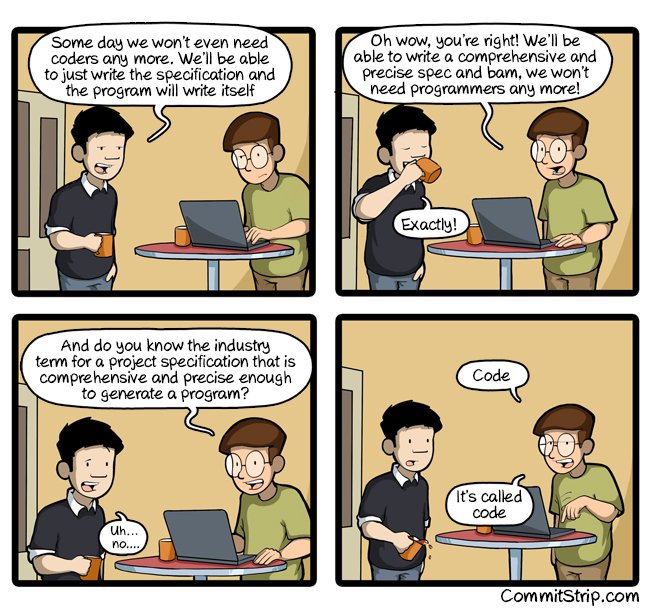
The vibe coding trap
Krouse starts with what he calls the 'vibe coding' illusion — the feeling that you can describe what you want in plain English and AI will just build it. It works beautifully for small projects. But when things get complex, it falls apart.
He points to a real-world disaster: Dan Shipper, the CEO of the AI writing company Every, built a text editor app using AI-assisted coding. It went viral. Then it crashed. The reason? Live collaboration (the technology that lets multiple people edit the same document at once) is 'just insanely hard,' Shipper admitted. The AI had hidden that complexity behind a thin layer of working-looking code.
Why abstraction is the answer — not abandonment
Here's where Krouse's argument gets interesting. He doesn't say AI coding is bad. He says the goal of AI + coding should be better abstractions — simpler ways to express complex ideas.
He uses the famous Slack notification flowchart as an example. Slack's internal diagram for deciding whether to send you a notification looks like a nightmare of branching logic:
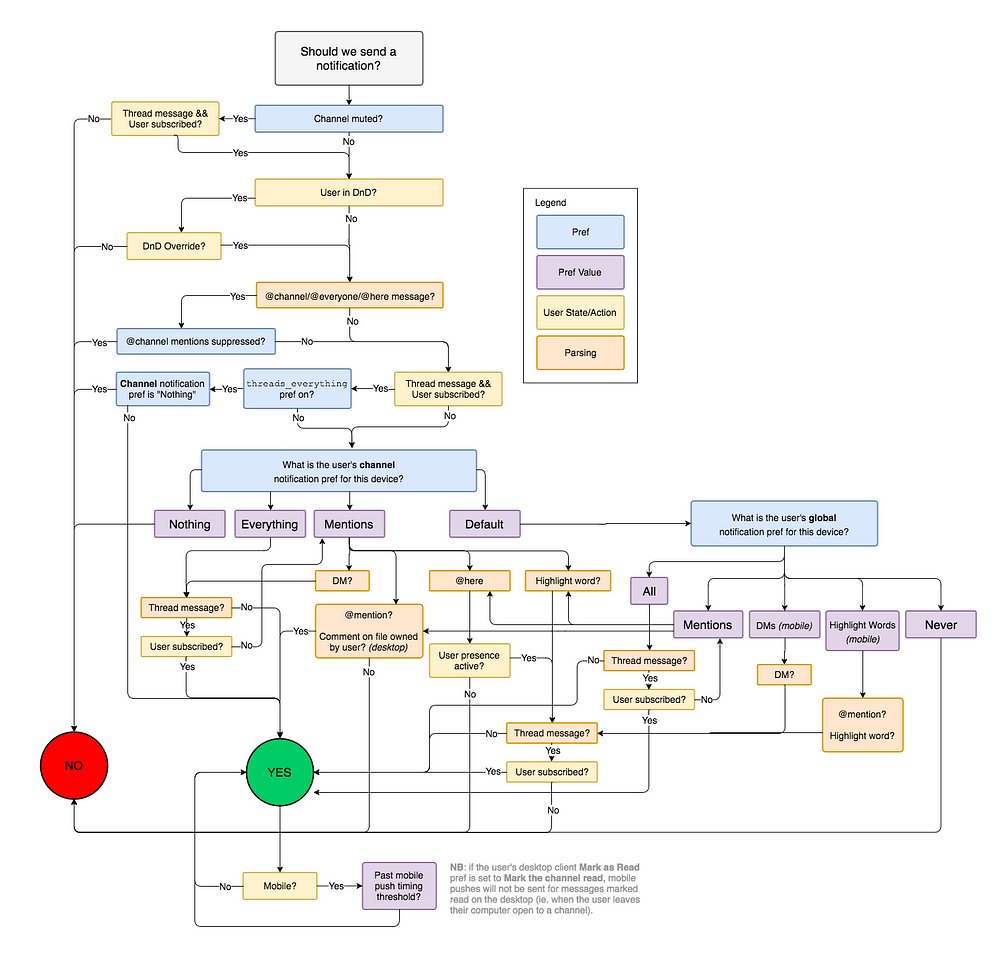
But engineer Sophie Alpert showed that with the right abstractions (basically, smarter ways of organizing the logic), you can compress that entire flowchart into something a human can actually read and verify. That's not AI replacing code — that's code getting better.
Krouse quotes computer scientist Edsger Dijkstra: "The purpose of abstraction is not to be vague, but to create a new semantic level in which one can be absolutely precise."
The Claude proof: a 50-line full-stack app
To prove his point, Krouse describes using Claude Opus 4.6 to solve a notoriously complex problem: integrating React Router 7 (a tool for handling page navigation in web apps) into Val Town's platform.
The result? A new framework called vtrr — a full-stack React application squeezed into roughly 50 lines of code. One file. Everything included.
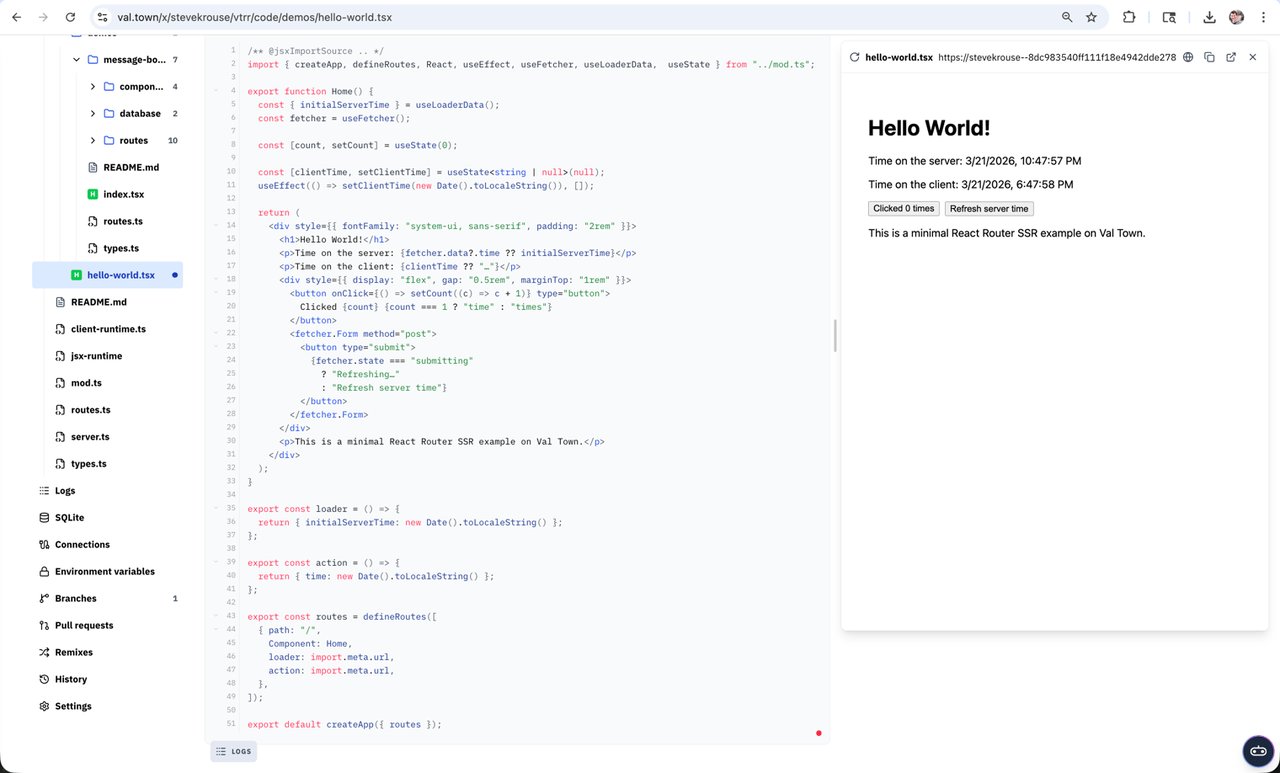
That's not AI replacing a programmer. That's a programmer using AI to achieve something that would have taken weeks of manual work — and the result is cleaner, simpler code that a human can actually understand and maintain.
The writing analogy nobody's talking about
Krouse makes one more observation that cuts through the noise: "Isn't it telling that nobody is talking about 'vibe writing'?"
ChatGPT and Claude can write essays, stories, and emails. But nobody seriously argues that writing is dead, or that authors are obsolete. Great writing still requires human judgment, taste, and craft. The same applies to code.
Declaring coding dead because AI can generate it, Krouse argues, is like declaring storytelling dead after the invention of the printing press. The medium changes. The need for precision and clarity never goes away.
What this means if you're learning AI tools
Three takeaways for anyone using AI to build things:
1. Don't stop learning the fundamentals. AI-generated code still needs someone who understands what it does. The people who thrive will be those who use AI as a power tool — not a replacement for understanding.
2. Vibe coding has a ceiling. Quick prototypes and demos work great with AI. Production apps that real people depend on? You'll still need to understand the code underneath.
3. AI makes good coders better, not bad coders good. Krouse's 50-line framework only worked because he understood the abstractions needed. Claude was the tool. His expertise was the blueprint.
The debate rages on
The full essay has already sparked 84+ comments on Hacker News, with developers weighing in on both sides. It arrives at a moment when the tech industry is split: some companies are laying off engineers citing AI, while others are hiring more developers specifically because AI lets them build faster.
Krouse closes with a line from Dijkstra that feels more relevant than ever: "Thanks to formal symbols, school children can learn to do what in earlier days only genius could achieve." AI, he suggests, is the next version of those formal symbols — making the hard parts accessible, not making humans unnecessary.
Related Content — Get Started with Easy Claude Code | Free Learning Guides | More AI News
Sources
Stay updated on AI news
Simple explanations of the latest AI developments