Stack Overflow just lost 99% of its questions — AI did it
Stack Overflow went from 200,000 questions a month to barely 300. AI tools replaced the world's biggest developer Q&A site in under 3 years.
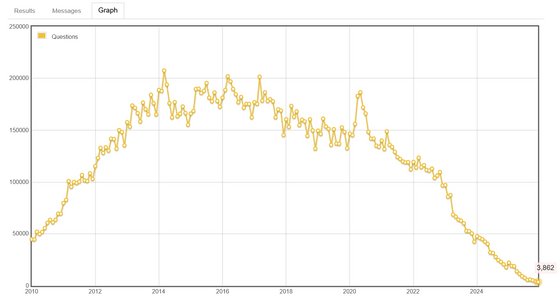
The site that taught an entire generation how to code is now quieter than the day it launched. Stack Overflow's monthly questions have collapsed from over 200,000 at their peak to roughly 300 — a 99% drop that erased 17 years of growth in under three years.
The cause? Developers stopped asking strangers on the internet and started asking AI instead.
From 200,000 questions a month to fewer than a college lecture hall
In early 2014, Stack Overflow was at its peak — more than 200,000 new programming questions every month, with answers written by millions of developers worldwide. It was the backbone of software development. If you Googled a coding problem, Stack Overflow was almost always the first result.
By December 2025, that number had fallen to 3,862 questions — a 78% year-over-year crash. The latest data from March 2026 shows the number has dropped even further, dipping below 300 per month — fewer questions than Stack Overflow received during its very first month in 2008.
Since ChatGPT launched in November 2022, question volume has fallen 76.5% — and the decline is accelerating, not stabilizing.
The numbers in context: In 2021, Prosus (a global tech investment company) bought Stack Overflow for $1.8 billion. The purchase happened just before the steepest decline began. Today, the platform's core Q&A product is approaching ghost-town status — though the company still reported $95 million in revenue from its enterprise and recruitment services.
Why developers stopped asking
Three forces drove the collapse — and only one of them is AI.
1. AI tools answered faster — and didn't judge you. Tools like Claude, ChatGPT, and GitHub Copilot now provide instant, personalized coding answers inside your editor. No waiting for a human response. No risk of your question being closed as a "duplicate." As one developer put it in the 1,000-comment Hacker News thread: "The LLM doesn't insult you."
2. The moderation culture pushed people away first. Stack Overflow's decline actually started in 2014 — years before AI. Aggressive duplicate-closing and harsh moderation created what users described as a "50/50 chance" of finding a useful answer vs. a locked question. A former Stack Overflow staff member, Shog9, noted the site "fundamentally relied on Google as its primary user interface" — and when Google started surfacing worse SO results, there was no backup plan.
3. Developers migrated to Reddit and Discord. Starting around 2016, programming communities on Reddit and Discord grew rapidly. By 2020, many developers were getting answers from these communities instead of Stack Overflow — especially for newer frameworks and tools.
Today, 84% of developers use AI tools in their workflow, and 81.4% specifically use ChatGPT-style models. The question isn't whether AI replaced Stack Overflow — it's whether anything can bring it back.
Stack Overflow's fight to survive
Stack Overflow isn't going quietly. In February 2026, the company launched a complete redesign with several major changes:
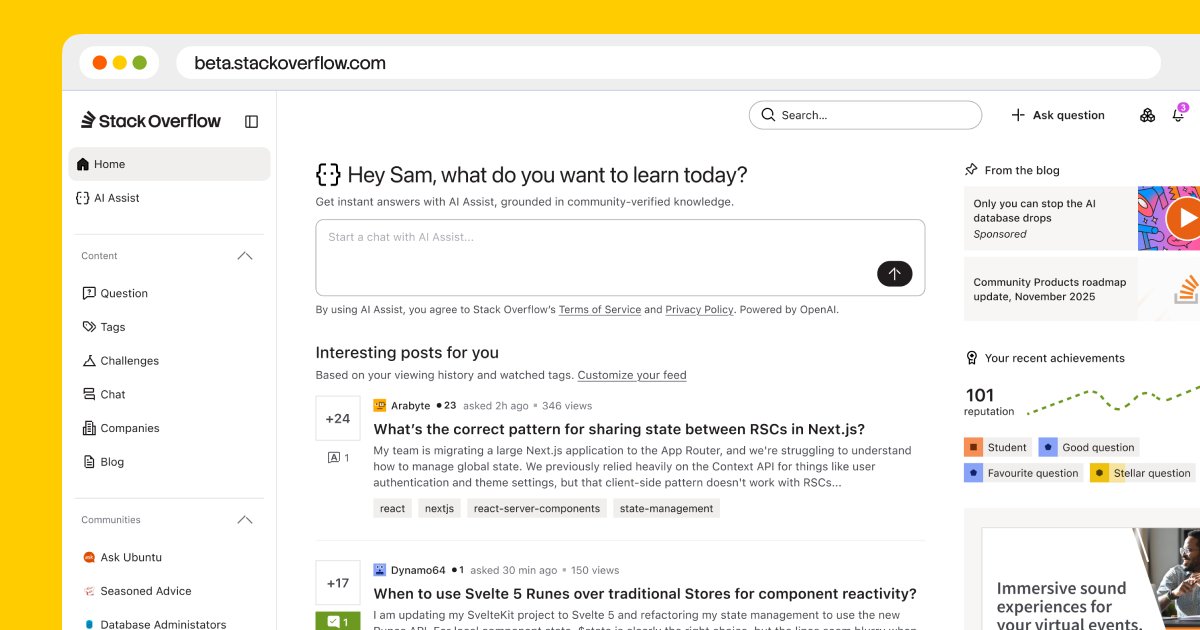
- AI Assist — an AI-powered answer tool built on the site's own archive of millions of answers, using agentic RAG (a method that searches verified sources before responding, rather than guessing)
- Open-ended questions — the platform now allows opinion-based and experience-based discussions, dropping its infamous "one right answer" rule
- A fresh interface — wider layouts, new navigation, and a modern design available at beta.stackoverflow.com
The irony is hard to miss: Stack Overflow banned AI-generated answers in 2022, then built its own AI feature in 2026. The same corpus of human-written answers that made the site great is now being fed back through AI — both Stack Overflow's own tool and the competing models that were trained on SO data in the first place.
The ripple effects nobody's talking about
Stack Overflow's collapse isn't just a platform story — it's an ecosystem problem.
Programming language rankings are breaking. The Redmonk Language Rankings — one of the industry's most cited measures of programming language popularity — uses Stack Overflow data for 50% of its calculation. Analyst Rachel Stephens warned that this data is now "increasingly stale and of questionable value."
AI training data is drying up. Developers are asking a critical question: if Stack Overflow was the primary source of high-quality coding answers, and AI models were trained on those answers, what happens when no new answers are being written? Future AI models may be trained on AI-generated answers to AI-generated questions — a feedback loop that could degrade quality over time.
New developers have nowhere to learn. For 17 years, Stack Overflow served as an open, searchable knowledge base where beginners could find solutions to real problems. AI tools can answer questions, but they don't create a permanent, public archive that others can discover. When a student finds a great Stack Overflow answer, they also see the discussion, the alternatives, and the context. ChatGPT gives you one answer and moves on.
What this means if you're learning to code
If you're a developer or someone learning to code, the practical impact is real:
- AI is your first stop now — tools like Claude Code, ChatGPT, and GitHub Copilot answer most coding questions instantly. But verify the answers against documentation, because AI can confidently give wrong code.
- Reddit and Discord are the new community hubs — for framework-specific questions, subreddits like r/webdev and r/python are where active discussions happen now.
- Stack Overflow's archive is still gold — 17 years of human-verified answers don't disappear. When searching for established patterns, older Stack Overflow answers remain some of the best resources online.
- Try Stack Overflow's beta — the redesign at beta.stackoverflow.com is trying to blend AI speed with human expertise. It's worth exploring.
The bigger picture: Stack Overflow is the canary in the coal mine. Every knowledge platform built on user-generated content — from forums to documentation wikis — faces the same question: why would someone write a public answer when AI can generate one instantly? The answer to that question will shape the internet for the next decade.
Related Content — Get Started with Easy Claude Code | Free Learning Guides | More AI News
Sources
Stay updated on AI news
Simple explanations of the latest AI developments