Supermemory gives AI a permanent memory — for free
Supermemory just hit 18K GitHub stars as the #1-ranked memory engine for AI tools. It gives Claude Code, Cursor, and ChatGPT persistent memory with a free tier.
Every time you start a new conversation with an AI assistant, it forgets everything you told it before. Your name, your project details, your preferences — all gone. Supermemory just became the most popular solution to this problem, hitting 18,000 GitHub stars and ranking #1 on every major memory benchmark.
The open-source project gives AI tools like Claude Code, Cursor, and ChatGPT something they've always lacked: a permanent memory that actually learns about you over time.
What Supermemory actually does
Think of Supermemory as a second brain for your AI tools. When you tell Claude Code "I prefer TypeScript over JavaScript" or "our company uses PostgreSQL," Supermemory saves that fact. Next time you ask for help — even in a completely new conversation — your AI already knows.
But it goes further than simple note-taking. The system is smart enough to handle contradictions and changes over time. If you say "I moved to San Francisco" after previously mentioning you live in New York, Supermemory updates the record automatically. Old information gets replaced, not duplicated.
Regular AI memory dumps store raw conversations. Supermemory extracts facts — your preferences, habits, project details — and organizes them into a profile that gets smarter over time. It separates stable facts ("works at Acme Corp") from dynamic context ("currently debugging the payment module").
Works with tools you already use
Supermemory plugs directly into the most popular AI coding and productivity tools:
It also connects to Google Drive, Gmail, Notion, Slack, OneDrive, and GitHub — automatically syncing information from these services so your AI assistant knows about your documents, emails, and projects without you having to explain everything manually.
The benchmark results speak for themselves
Supermemory isn't just popular — it's measurably the best. The project ranks #1 on three independent benchmarks that test how well AI memory systems actually work:
- LongMemEval (how well AI remembers facts across long conversations): 85.2% accuracy, first place
- LoCoMo (fact recall in extended conversations): first place
- ConvoMem (learning user preferences): first place
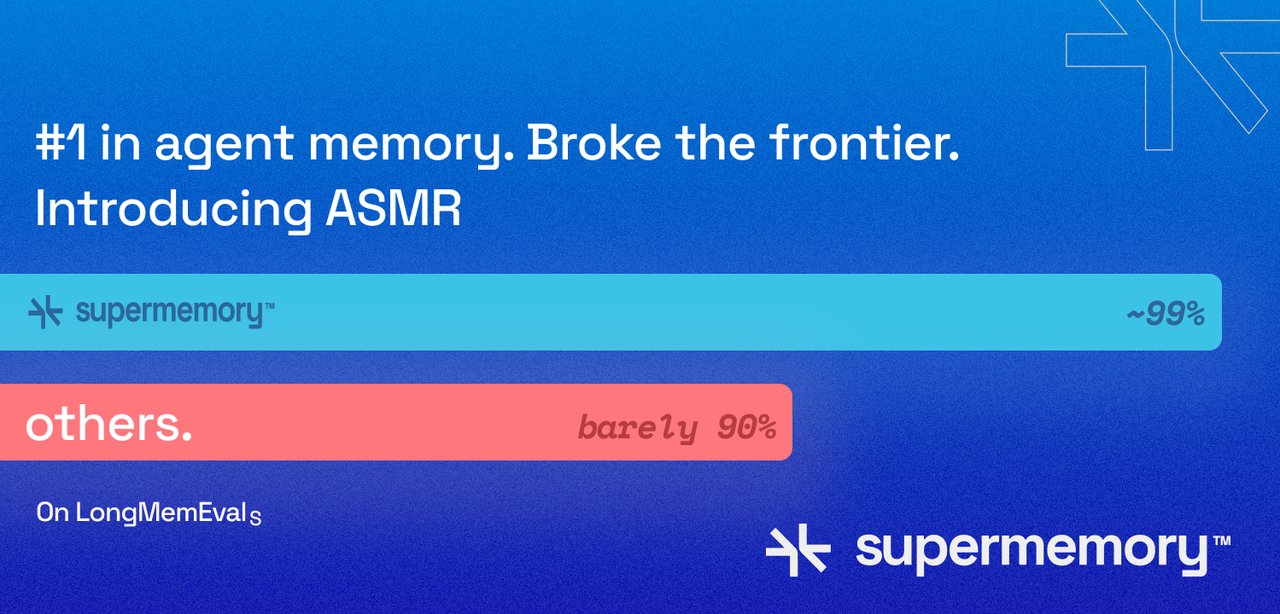
Their experimental research system, called ASMR (Agentic Search and Memory Retrieval), pushes accuracy to ~99% by replacing traditional database lookups with AI agents that reason about what information is relevant. As the team put it: "Ditching vector embeddings for active search agents was the single biggest unlock."
Enterprise clients already on board
BrowserStack, Nissan, and other enterprise customers are already using Supermemory. The platform is SOC 2, HIPAA, and GDPR compliant, and can be self-hosted for organizations that need full data control.
Users report dramatic improvements: one team saw response times drop from 40 seconds to 12 seconds after adding Supermemory, because the AI no longer wasted time asking for context it should already know.
Try it now — the free tier is generous
The free plan includes 1 million tokens per month and 10,000 queries — enough for most personal use. Paid plans start at $19/month for heavier usage.
For Claude Code users, the fastest setup is one command:
npx -y install-mcp@latest https://mcp.supermemory.ai/mcp --client claude --oauth=yesFor developers building their own AI apps:
# Python
pip install supermemory

# TypeScript
npm install supermemory
Or just visit app.supermemory.ai to try the personal app directly in your browser — no installation needed.
Why this matters right now
AI tools are getting better at writing code, answering questions, and completing tasks — but they still have the memory of a goldfish. Every new session starts from scratch, forcing users to re-explain their setup, preferences, and context over and over.
With 18,000 GitHub stars and climbing, Supermemory is the clearest signal yet that persistent AI memory is becoming standard infrastructure. If you've ever wished your AI assistant just knew you by now, this is the tool that makes it happen.
Related Content — Get Started with Easy Claude Code | Free Learning Guides | More AI News
Sources
Stay updated on AI news
Simple explanations of the latest AI developments