85% of Chinese workers fear AI will take their jobs
Nearly 1,000 people lined up at Tencent's HQ to learn AI tools. Employers cut 30% of staff who couldn't adapt. Workers call it 'playing Squid Game.'
"It feels like playing Squid Game. You can get eliminated anytime. How can you not be anxious?" That's Lambert Li, a software developer in Shanghai, describing what it's like to work in China's tech industry right now.
His employer laid off 30% of its workforce in 2025 — cutting everyone who couldn't adapt to AI fast enough. He's not alone. A survey of 11,814 Chinese workers found that 85.5% are worried AI will affect their employment. And a separate global study of 39,000 workers across 36 countries found that only 22% feel their job is safe.

A thousand people in line — just to install an app
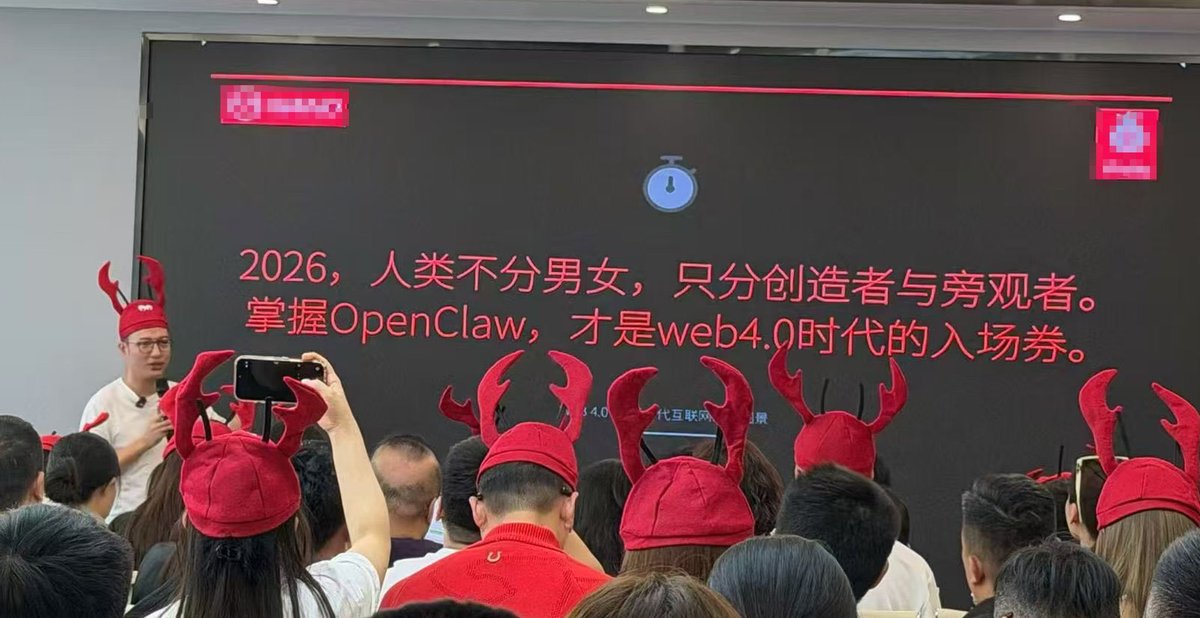
In early March, nearly 1,000 people showed up at Tencent's headquarters in Shenzhen for a free session where engineers would install OpenClaw (an open-source AI agent) on their laptops. The crowd wasn't just programmers — it included retirees, housewives, students, and office workers.
The Chinese call this phenomenon "raising a lobster" (a nod to OpenClaw's red lobster logo). Similar installation events have popped up across mainland China, where OpenClaw usage is now nearly double that of the United States.
On RedNote (China's version of Instagram), the hashtag #AIAnxiety has pulled 2.6 million views. On WeChat, the term "AI anxiety" spiked from a baseline of 20,000 to over 2 million mentions in mid-March alone.
"Either you ride it, or you get wiped out"
The anxiety isn't theoretical. Companies across China are actively pressuring employees to adopt AI — or face consequences:
One boss posted on RedNote: "I asked my team to write AI code to replace several staff members."
Betty Lai, a product marketing manager: "Either you ride it, or you get wiped out."
Frank Wang, a 28-year-old programmer in Chengdu: "If they fire me, they fire me. I will wait for some welfare handouts."
Some managers are issuing ultimatums: learn AI tools or be replaced immediately. The result is a workforce stuck between frantic upskilling and fatalistic resignation.
The jobs already disappearing
A Peking University study found that sectors with high AI exposure are already seeing recruitment decline:
• Computer programming — the most directly affected
• Accounting and finance — routine number work increasingly automated
• Editing and content — AI writing tools reducing headcount
• Sales — AI chatbots handling customer interactions
China faces 12.7 million university graduates entering the job market in 2026, while youth unemployment for ages 16-24 already sits at 15-19% — significantly higher than the 9-11% rate in the U.S.
The anxiety spiral nobody's talking about
One of the most telling quotes came from a frustrated user: "I haven't figured out Claude Code, and Skills is already out. I haven't understood Skills, and Clawdbot is out."
The sheer pace of AI releases creates a paradox: the very tools meant to make workers more productive are generating paralyzing anxiety about falling behind. Workers daily jump between ChatGPT, Gemini, OpenClaw, and other tools — not out of curiosity, but survival.
Li Chen, an analyst at Beijing think tank Anbound, warns this anxiety could backfire on China's entire economy. If workers increase savings and cut spending out of fear, it undermines the government's economic stimulus efforts. The thing designed to boost productivity might actually slow the economy down.
Not just a China problem
The global picture is equally concerning. The ADP Research 2026 survey of 39,000 workers across 36 countries reveals:
• Only 18% of frontline workers feel their job is safe from elimination
• Daily AI users are 4x more likely to feel less productive than non-users
• 62% of workers globally put in up to 5 hours of unpaid work weekly
• Japan: just 5% feel job-secure. United States: 28%.
And here's the twist: 69% of Chinese respondents still believe AI's benefits outweigh the risks — compared to only 35% of Americans. China's workers are terrified AND optimistic, simultaneously.
What you can do about it
Whether you're in Beijing or Baltimore, the practical advice is the same:
Don't learn every tool — learn the pattern. The specific tools will change. Understanding how to work WITH AI (prompting, reviewing output, iterating) is the durable skill.
Pick one tool and go deep. Workers frantically jumping between 5 AI tools learn none of them well. Start with one — Claude Code, ChatGPT, or whatever your industry uses — and get genuinely good.
Focus on what AI can't do. Judgment calls, relationship building, creative direction, understanding context — these remain human advantages.
Related Content — Get Started with Easy Claude Code | Free Learning Guides | More AI News
Stay updated on AI news
Simple explanations of the latest AI developments