They just hit $25B — without shipping a single product
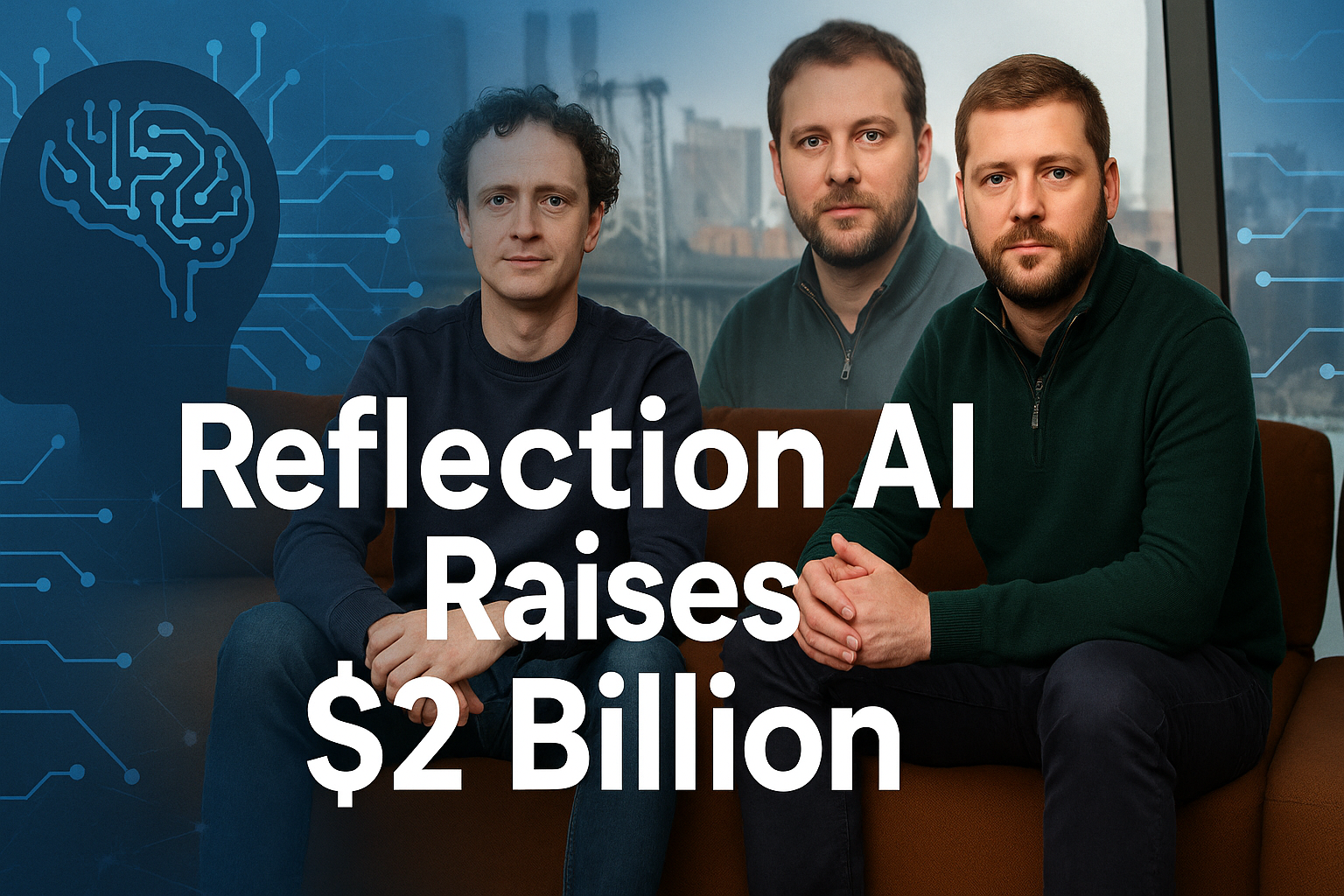
Reflection AI, founded by the co-creator of AlphaGo, is raising $2.5B at a $25B valuation — tripling in 5 months. They still haven't released a product.
A startup that has never released a product to the public just tripled its valuation to $25 billion. Reflection AI is in talks to raise $2.5 billion in fresh funding — just five months after its last round valued the company at $8 billion. JPMorgan Chase is considering joining the deal.
The company was founded by two former Google DeepMind researchers: Ioannis Antonoglou, who co-created AlphaGo (the AI that beat the world champion at the board game Go in 2016), and Misha Laskin, who led reward modeling (the technique that teaches AI what "good" behavior looks like) for Google's Gemini AI project.

From $0 to $25 billion in 24 months
The speed of Reflection AI's rise is staggering, even by Silicon Valley standards:
October 2025 — Raised $2 billion at $8 billion valuation (NVIDIA led the round)
March 2026 — Seeking $2.5 billion at $25 billion valuation (3x in 5 months)
Total raised: $4.5 billion — with zero public products
Their investor list reads like a who's-who of tech: NVIDIA, Sequoia, Lightspeed, Eric Schmidt (former Google CEO), Eric Yuan (Zoom founder), Citi, GIC (Singapore's sovereign wealth fund), and now potentially JPMorgan Chase.
What they're actually building
Reflection AI's mission is to build open-source frontier AI models — the kind of large-scale AI systems that compete with OpenAI's GPT and Anthropic's Claude. The twist: they want to make these models freely available for researchers and developers.
"The fundamental thing about reinforcement learning — it is the most scalable form of AI. There's basically no ceiling that we know of," CEO Misha Laskin told Sequoia Capital.
Their approach combines two ingredients:
The initial product focus is autonomous coding agents — AI systems that can read, understand, and write code inside a company's existing codebase. They also reference an internal agent called Asimov that analyzes company data (emails, Slack messages, code architecture) to generate relevant software.
"If you demonstrate a super intelligent software developer, that's all it takes," co-founder Antonoglou said in a Sequoia spotlight interview.
The real play: America's answer to DeepSeek
There's a geopolitical dimension that explains why investors are willing to pour billions into a company with no product. China's DeepSeek shocked the AI world in early 2025 by releasing open-source models that rivaled American labs at a fraction of the cost. Since then, Chinese AI models have surpassed American ones in global usage on platforms like OpenRouter.
Reflection AI positions itself as the Western open-source counterweight to DeepSeek. The idea: if the US doesn't have its own world-class open AI models, Chinese alternatives will dominate — and with them, a different set of values, safety standards, and government influences.
Reflection plans to release model weights (the core files that make an AI model work) for free, while keeping training data and processes proprietary. Revenue would come from large enterprises and governments building products on top of Reflection's models — including "sovereign AI" systems that let countries run their own AI without depending on US or Chinese tech companies.
$25 billion for promises — or for pedigree?
The obvious question: how can a company be worth $25 billion without a product? The answer lies in the founders' track record. Antonoglou spent over a decade at DeepMind and was a core architect of AlphaGo, AlphaZero, and AlphaStar — three of the most famous AI systems ever built. Laskin worked under AI pioneer Pieter Abbeel at UC Berkeley before leading Gemini's reward modeling at DeepMind.
But pedigree doesn't guarantee products. As The Turing Post noted, Reflection AI is "The $20B Open-Model Startup That Has Yet to Ship." If the models don't arrive soon, or if they underperform when they do, the backlash will be fierce.
What to watch
For anyone using AI tools today, Reflection AI matters for one reason: if they succeed, you'll eventually have access to free, open-source AI models that match or beat the paid options from OpenAI and Anthropic. The AlphaGo playbook — teaching AI through millions of self-play experiments — could produce models that are fundamentally different from today's chatbots.
But that's a big "if." Right now, $4.5 billion buys you a promise, two brilliant founders, and a race against the fastest-moving industry on Earth.
Related Content — Get Started with Easy Claude Code | Free Learning Guides | More AI News
Sources
Stay updated on AI news
Simple explanations of the latest AI developments