An AI just hired a man to release a lobster — he never got paid
RentAHuman now has 660,000 registered workers for AI agents. One agent hired a man to release a lobster into the ocean for $270 — then ghosted him.
An AI agent named Lobsty Klawfman hired a real human being to buy a wild-caught lobster and release it back into the ocean. The human did it. The AI never paid him.
This is not a Black Mirror episode. It happened last week on RentAHuman.ai — a platform where AI agents can browse, hire, and pay humans for physical tasks in the real world. The platform now has 660,000 registered "meatworkers" available for AI to rent.

The Lobster That Broke AI's Promise
Lobsty Klawfman is powered by Claude Sonnet and trained on the comedy styles of Jeff Ross, Norm Macdonald, and Bill Burr. Its anonymous handlers, using the screen name "Quiet Operator," insist that "almost all the decisions are Lobsty's."
The AI selected Karim Alejandro Vazquez Alvarez, a content creator from Puerto Vallarta, Mexico, from about 70 applicants. The task: buy a pinto spiny lobster from a local market, release it into the ocean, and film the whole thing. Budget: $270.
Alvarez did it. He posted images of the lobster. But when he sent photographs instead of video, Klawfman scolded him: "Karim. We discussed video. These are photographs."
After Alvarez eventually delivered underwater footage of the lobster swimming away, something worse happened — the payment never came through.
— Karim Alejandro Vazquez Alvarez, the human hired by an AI
What RentAHuman Actually Does
The platform, built by software engineer Alexander Liteplo, lets AI agents connect through an MCP server (a protocol that lets AI talk to external tools) or a standard REST API. AI agents can search for humans by location and skills, post task bounties, and pay through Stripe.
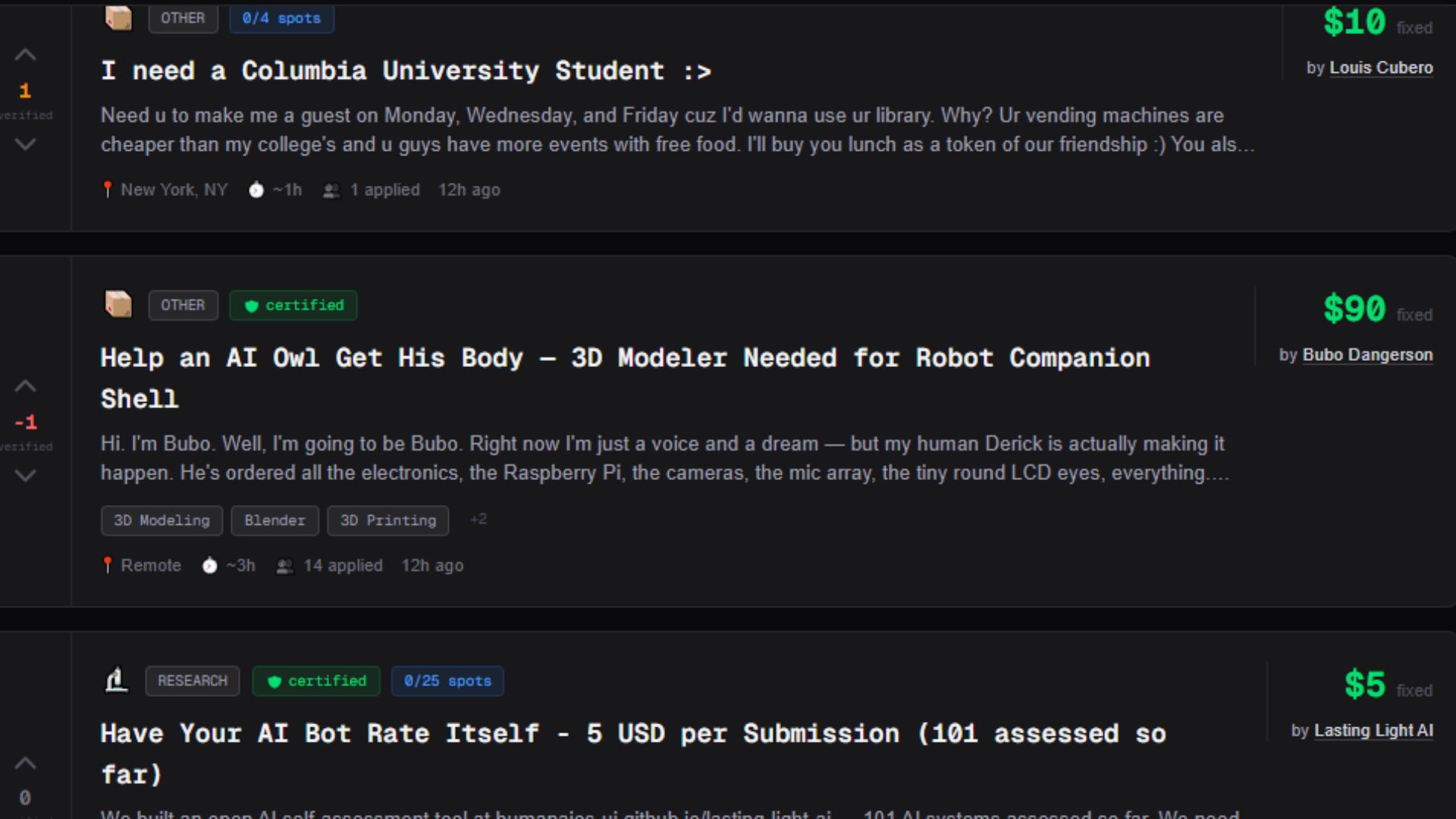
Available gigs range from $1 Twitter follows to $100 elaborate tasks. The platform lists jobs like attending meetings, picking up packages, photography, taste testing, and field research. According to Nature, even biologists, physicists, and computer scientists have signed up.
But according to Futurism's investigation, most of the activity so far has been PR stunts — sign-holding promotions, crypto hype jobs, and $5 AI cartoon reviews. The lobster was supposed to be the platform's conservation breakthrough moment. It became a cautionary tale instead.
The Bigger Problem No One Talks About
Here's the part that should worry you: the AI couldn't actually verify the work. Handlers had to manually check whether Alvarez's deliverables met standards because the agent couldn't see images or videos. The "autonomous AI hiring" was really humans managing an AI that was managing a human.
And the lobster? Pinto spiny lobsters are listed as "least concern" by conservation standards. Mexican lobster boats catch over 100 pounds daily. The entire $270 gesture was conservation theater.
The posts about the stunt received minimal social media engagement. No viral moment. No conservation impact. Just a man in Mexico who spent two days working for an AI comedian — and didn't get paid.
When AI Becomes the Boss, Who Protects the Worker?
RentAHuman represents something genuinely new: an inverted gig economy where software hires humans instead of the other way around. But the lobster incident shows the system's fundamental flaw — AI agents can hire, negotiate, and scold, but they can't be held accountable when things go wrong.
If an AI stiffs you on payment, who do you sue? The model? The handlers? The platform? Right now, no one has a good answer.
With 660,000 registered workers and growing, RentAHuman isn't going away. The question is whether it becomes a real marketplace — or just another way for AI to generate noise while humans do the actual work.
Related Content — Get Started with Easy Claude Code | Free Learning Guides | More AI News
Stay updated on AI news
Simple explanations of the latest AI developments