OpenAI Hits $25B Revenue — But Loses $1.69 Per Dollar
OpenAI hit $25B revenue faster than Google ever did — but spends $1.69 per dollar. Its only exit: a $1T IPO that would be the biggest in history.
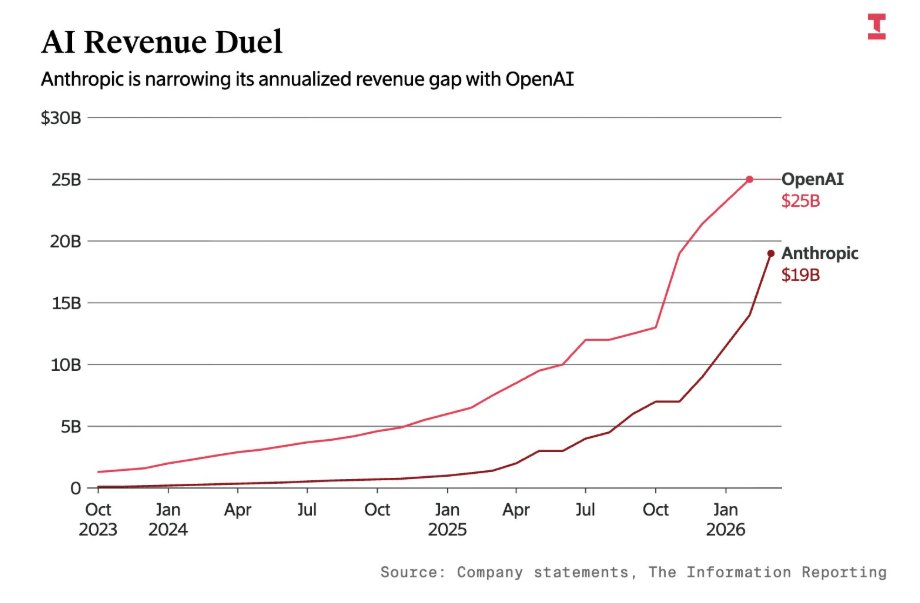
OpenAI — the company behind ChatGPT — just crossed $25 billion in annualized revenue (the rate at which money is flowing in, projected over a full year). That makes it the fastest software company in history to reach that milestone: just 39 months from near-zero. Google took 17 years. Facebook took 12. Salesforce took 18.
But here's the twist: for every $1 OpenAI earns, it spends $1.69. The company projects $14 billion in losses for 2026 alone, with a cumulative cash burn that could reach $665 billion by 2030. The solution? What would be the largest IPO (initial public offering — a company's first sale of stock to the public) in history, targeting a $1 trillion valuation.
OpenAI Revenue Growth: From $2 Billion to $25 Billion in 39 Months
The growth trajectory is staggering. OpenAI's revenue path looks like this:
2023:     $2 billion
2024:     $6 billion
2025:     $13.1 billion
Feb 2026: $25 billion (annualized)
2026 target: $30 billion
That 194% year-over-year growth from 2024 to 2025 is almost unheard of at this scale. ChatGPT now has 910 million weekly active users — up from 800 million just four months earlier. There are 15 million ChatGPT Plus subscribers paying $20/month, over 9 million paying business users, and more than 1 million organizations using OpenAI technology.
Enterprise revenue (money from corporate contracts rather than individual subscriptions) is the fastest-growing segment, suggesting OpenAI is successfully moving beyond its consumer-first origins. The company even launched advertising inside ChatGPT, generating $100 million in annualized ad revenue within just six weeks of its pilot launch.
OpenAI's $1.69 Problem: How AI Inference Costs Erode Margins
Revenue growth alone doesn't tell the full story. OpenAI's gross margins (the percentage of revenue left after paying for the computing power to run AI models) collapsed from 40% in 2024 to 33% in 2025. The culprit: inference costs (the expense of actually running AI models every time a user asks a question) quadrupled during 2025, hitting $8.4 billion. Those costs are projected to reach $14.1 billion in 2026.
The math is brutal: OpenAI spends $1.69 for every $1 it earns. It projects $14 billion in losses for 2026 and $17 billion in total cash burn this year. Profitability isn't expected until 2029 or 2030. And there's a hidden tax — OpenAI owes Microsoft 20% of its total revenue through 2032, a deal projected to cost $13+ billion over just the next two years.
HSBC, the global bank, projects a $207 billion funding shortfall by 2030 — meaning even after all committed capital is accounted for, OpenAI will still need hundreds of billions more. Some analysts at ainvest.com have even flagged potential bankruptcy risk by mid-2027 if growth stalls or funding dries up.
The OpenAI IPO: Why a $1 Trillion Listing Is Inevitable
This context explains why OpenAI's IPO isn't a celebration — it's a survival strategy. The company recently raised $120 billion in private funding: $30 billion from SoftBank, $30 billion from Nvidia, $50 billion from Amazon, and another $10 billion from MGX, Coatue, and Thrive Capital. Its latest private valuation hit $730 billion.
But private markets alone can't fund a projected $665 billion in cumulative cash burn through 2030. OpenAI needs Wall Street.
CFO Sarah Friar (the former Square and Nextdoor executive hired specifically to steer this moment) told reporters: "An IPO isn't off the table; it's a question of when." She added that the recent funding round "derisks somewhat because we could be ready, but the market might not be ready for us." Advisers believe a regulatory filing could come as early as the second half of 2026, with a formal listing in 2027.
If OpenAI goes public at $1 trillion, it would be worth more than Ford, General Motors, and Boeing combined. It would dwarf Saudi Aramco's $29.4 billion IPO in 2019 as the largest public offering in history. But it would also force unprecedented financial transparency from a company that has never turned a profit.
Amazon's $50 billion investment comes with a telling catch: $35 billion of it is contingent on IPO completion or the achievement of AGI (artificial general intelligence — AI that matches or exceeds human-level reasoning across all domains). That's either a safety net or a red flag, depending on your perspective.
AI Competition: How Anthropic and Google Are Closing In on ChatGPT
While OpenAI races toward public markets, its dominance is quietly eroding. ChatGPT's share of AI web traffic dropped from 86.7% in January 2025 to 64.5% in January 2026. Google Gemini surged from 5.7% to 21.5% over the same period, now reaching 650 million monthly active users.
More critically, Anthropic — the company behind Claude — hit $19 billion in annualized revenue and is growing faster (tenfold year-over-year versus OpenAI's roughly threefold). Epoch AI estimates Anthropic could overtake OpenAI at around $43 billion in annual revenue between 2026 and 2027. Anthropic also targets break-even by 2028 — two full years before OpenAI — and its enterprise-heavy revenue mix (roughly 80% from corporate clients) is more predictable.
The 2026 IPO wave won't be quiet, either. Anthropic is eyeing a $380 billion valuation, and a merged SpaceX-xAI entity could list at $1.5 to $1.75 trillion. OpenAI's window to capture investor attention is narrowing fast.
What 910 Million Weekly ChatGPT Users Prove About AI Demand
The demand for AI is undeniable. Nearly a billion people use ChatGPT every week. But CFO Friar herself identified the core tension: "Frontier users use seven times the amount of intelligence than the average user." Most people barely scratch the surface of what these tools can do. If you want to understand how to get more value from AI tools, the gap between casual and power users is where the real opportunity lives.
Friar calls it a "capability overhang" — a critical gap between what AI systems can accomplish and what organizations actually extract in value. Closing that gap is the $1 trillion question, not just for OpenAI but for the entire AI industry.
The Stargate Initiative — a $500 billion, four-year commitment to build 10 gigawatts of computing capacity — shows OpenAI is betting everything on a future where demand for AI processing power keeps growing exponentially. If that bet pays off, $1 trillion might look cheap. If it doesn't, the company will be locked into massive fixed costs with nowhere to cut.
OpenAI's story is the defining business narrative of the AI era: unprecedented demand, unprecedented spending, and a massive bet that scale will eventually bend the economics in its favor. Wall Street will soon decide whether that bet is worth $1 trillion.
Related Content — Get Started | Guides | More News
Stay updated on AI news
Simple explanations of the latest AI developments