Seminole Nation Bans AI Data Centers: Unanimous 24-0 Vote
The Seminole Nation voted 24-0 to ban AI data centers on tribal land — the first Indigenous government in the US to formally reject the AI infrastructure boom.
An unnamed tech startup showed up at the Seminole Nation of Oklahoma with a stack of paperwork: sign this NDA (non-disclosure agreement — a contract that prevents sharing information), then sign a letter of intent for an AI data center on tribal land. Four days after an emergency town hall, 24 tribal council members voted to ban it. Zero voted against.

On March 7, 2026, the Seminole Nation became the first Indigenous tribal government in the United States to impose a formal moratorium (a complete legal pause that blocks all activity) on AI data center construction. But the ban goes further than construction — it prohibits any inquiries, discussions, or developments concerning data centers of any size within Seminole territory.
AI data center pitch triggers an emergency town hall
Glen Chebon Kernell, a representative of the Mekusukey Band — one of the Seminole Nation's 14 matrilineal bands (family groups traced through the mother's lineage) — discovered the corporate approach and refused to stay quiet. On March 3, he organized an emergency town hall where dozens of tribal members and their non-Indigenous neighbors packed the room to voice alarm about water contamination, energy costs, and cultural disruption.
"This is the threshold. There's no turning back," Kernell said. "Once we've used up and contaminated all of our water sources, this is it."
The response was swift. The Seminole Nation's General Council — composed of two elected representatives from each of the 14 bands — passed the moratorium unanimously, 24-0. Monique Carpitcher, a General Council Representative, explained her vote: "Voting in favor meant protecting both present and future community health, our nation's ethical character, and the health of our land, children, and families."
The Seminole Nation of Oklahoma has approximately 18,800 enrolled tribal citizens, with 13,533 living in Oklahoma across roughly 633 square miles. Descendants of roughly 3,000 people who survived forced removal from Florida in the 1830s, they framed this vote as the same centuries-old fight in a new form: corporations arriving to extract resources while locals absorb the costs.
This ban goes further than any US city or state
Florida's Senate unanimously passed SB 484 on February 26, 2026, imposing disclosure requirements and ratepayer protections on large data centers. The Sanders/AOC federal bill proposes a moratorium on all new data center construction. But the Seminole Nation's resolution bans even conversations about data centers — prohibiting "any inquiries, discussions and/or developments concerning any entity seeking to develop a data center of any size."
Chey Morgan, an organizer from the United Keetoowah Band, called corporate use of NDAs "a subversion of informed consent for the community." She added that hyperscale data centers (massive facilities that power AI cloud services) "don't serve the purpose of preserving our data. In fact, they put our data and our languages at risk."
This kind of decisive action is possible because tribal nations operate as sovereign governments (governments with their own legal authority, separate from state or federal control). Unlike a city council that might face state pre-emption (when a state law overrides local decisions), the Seminole Nation could vote on Monday and have a moratorium in place by Friday.
5 million gallons a day — why water became the breaking point
A single large data center can consume up to 5 million gallons of water per day — equivalent to the daily usage of a city of 50,000 people. The cooling systems that keep thousands of AI servers from overheating require enormous amounts of water, and the numbers only get worse at scale:
- Google's Council Bluffs, Iowa facility alone uses approximately 980 million gallons of water per year — equivalent to 4 million homes' annual consumption
- Project Clydesdale, a proposed data center near Owasso on Cherokee Nation land, would span roughly 500 acres and consume an estimated 7 million gallons per day
- Data centers consumed over 4% of total US electricity in 2023, with projections reaching 12% by 2028
- Electricity costs have increased 267% near AI data centers compared to five years ago
Meanwhile, 30% of Navajo Nation residents lacked running water as of 2019. The Supreme Court ruled in 2023 that the US has no legal duty to secure water for them. As Jordan Harmon of the Indigenous Environmental Network put it, tech companies are targeting tribal communities "specifically because there's a lot of space and a lot of resources available."
37 data centers near Indigenous land — and a growing coalition
Honor the Earth, an Indigenous-led climate nonprofit, tracks data center proposals across the country. Their Data Center Tracker identifies at least 37 proposed data centers situated on or near Indigenous land in the United States. Over 80% of the world's natural resources are contained within Indigenous lands globally — making these communities a recurring target for resource extraction.
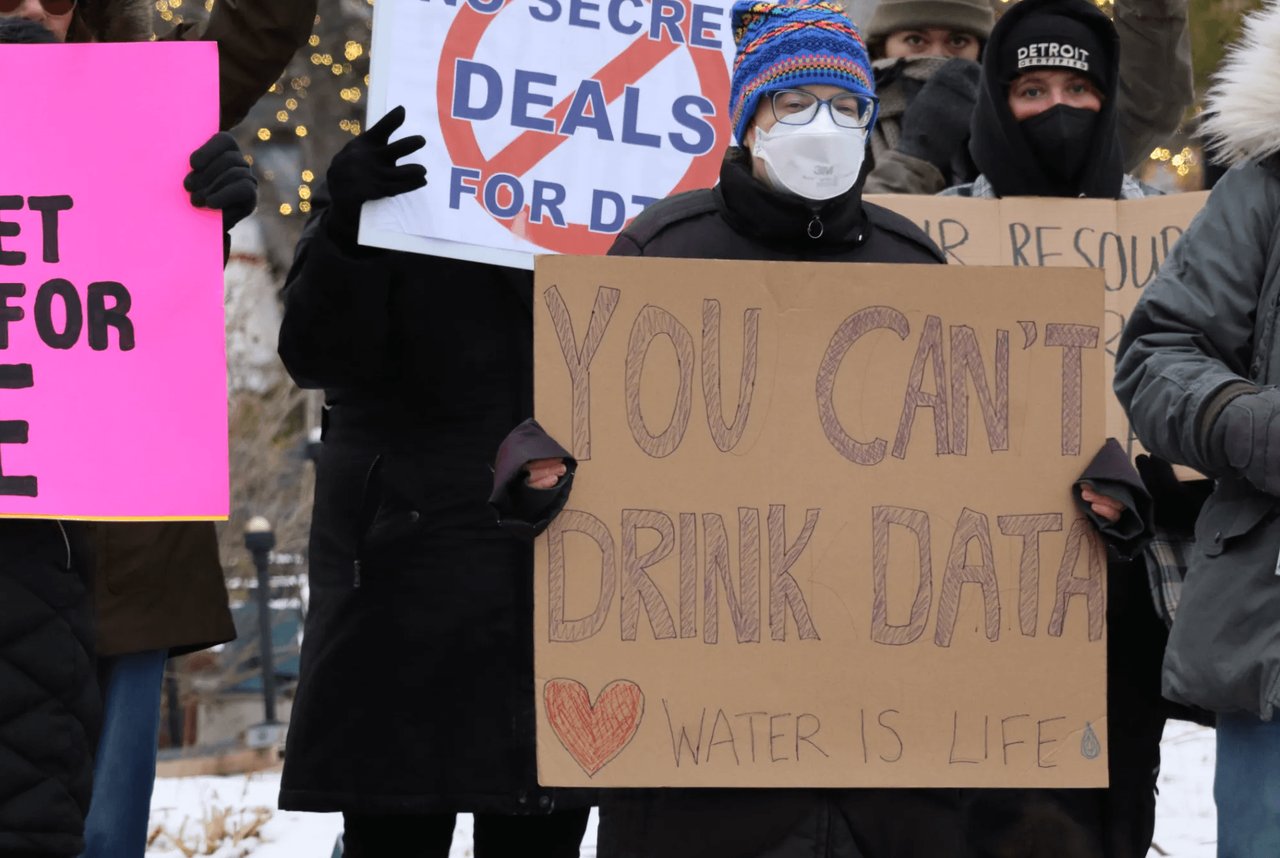
In December 2025, roughly 100 people protested at DTE Energy headquarters in Detroit against a proposed data center in Saline Township, carrying signs that read "You Can't Drink Data." Honor the Earth launched the No Data Centers Coalition in 2025 to unify Indigenous resistance from the Southwest to the Great Lakes.
Krystal Two Bulls, Honor the Earth's executive director, framed the stakes bluntly: "As Sovereign Nations, we need not participate in the extractive colonial systems of generative AI and hyperscale data centers or their false, predatory economic promises."
The digital divide makes the contrast especially stark: only 31% of tribal households have broadband (high-speed internet access), and 18% of tribal lands lack any broadband infrastructure — compared to just 4% for non-tribal areas. These communities bear the environmental costs of AI infrastructure that primarily serves populations far away. If you're curious about how AI systems work and what resources they require, our AI automation guides break it down in plain language.
Two tribal nations, two very different paths on AI data centers
Not every tribal government has reached the same conclusion. The nearby Cherokee Nation took a different route — Chief Chuck Hoskin Jr. signed an executive order creating a 9-member Data Center Task Force, due to deliver its report by June 30, 2026. The Cherokee Nation is studying the issue; the Seminole Nation closed the door entirely.
At the National Congress of American Indians (NCAI), advocates managed to table a pro-generative-AI resolution — but the debate revealed a genuine split. Some tribal leaders argue data centers could bring jobs, revenue, and digital infrastructure to communities that desperately need economic development.
Matthew Rantanen, a Cree descendant and tribal tech director, has proposed a middle path: tribally-owned underground data centers that use natural cooling, keeping both the economic benefits and environmental control within Indigenous governance. It's a reminder that outright bans aren't the only framework — but for the Seminole Nation, the calculus was clear.
AI data center moratorium: first domino or one-time stand?
The Seminole Nation's moratorium applies to roughly 633 square miles of jurisdiction. It's a small footprint on the national data center map — but it carries outsized symbolic weight as the first formal "no" from an Indigenous government to the AI infrastructure boom.
With 39% of Americans now viewing data centers as "mostly bad" for the environment, the political ground is shifting fast. Twelve states are considering data center restrictions. The Sanders/AOC bill is advancing at the federal level. And Honor the Earth's coalition continues to grow.
As Kernell told reporters: "We're just one voice of a growing tidal wave of concerns. Our fight is just one small piece of a collective puzzle."
The moratorium's legal durability is untested — future tribal councils could reverse it. Data centers can still be built on adjacent non-tribal land. But for now, 24 leaders from 14 bands looked at the AI industry's demand for water, electricity, and secrecy, and gave a unanimous answer: no. Check the latest AI news for more stories on how AI expansion is reshaping communities.
Related Content — Get Started | Guides | More News
Stay updated on AI news
Simple explanations of the latest AI developments