ChatGPT Drops Ads on 800M Free Users — Altman's Last Resort
ChatGPT ads are live for 800M free users — the 'last resort' Sam Altman once feared. Opt out and your daily message limit drops immediately.
Sam Altman once described ad-funded AI as “uniquely unsettling” and called advertising a “last resort.” As of February 9, 2026, that last resort is live — and if you’re one of the 800 million people on ChatGPT’s free tier, you’re already seeing sponsored cards appear below your very first message.
What Just Landed in ChatGPT: Ads for Free Tier Users
OpenAI launched ads in the US on February 9, 2026, targeting users on two tiers: the Free plan and the Go plan (a $8/month subscription designed for users who need more daily access than the free tier allows). By February 21, ads weren’t waiting a few exchanges in — they were showing up after the user’s very first prompt.
The format: a scrollable sponsored card positioned below ChatGPT’s response, clearly labeled “Sponsored” and visually separated from the actual answer. Each card includes:
- A company logo and brand name
- A headline under 40 characters
- A product description up to 150 characters
- A price and availability detail
- A direct link or “Install” button for mobile apps
One real-world example from the first days: a user asked about dinner recipes and saw a card for Heirloom Groceries' “La Mesa Roja Enchilada Kit” — $14.99, estimated prep time 25–35 minutes. Early confirmed advertisers include Target, Ford, Adobe, Mrs. Meyer’s, and Expedia.
OpenAI’s stated rules: ads are always labeled, only appear for contextually relevant products (meaning the ad topic matches what you’re discussing), and — critically — “ads will not influence ChatGPT’s answers.” Conversations are kept private from advertisers.
The Trade-Off: Watch Ads or Ask Fewer Questions
Here’s the part buried in OpenAI’s fine print: opting out of ads doesn’t give you a clean, unlimited experience. It directly cuts into your daily message budget.
Free-tier users currently get 10 messages every 5 hours using GPT-5.2 Instant (OpenAI’s current full-capability model, capable of complex coding, research, and multi-step analysis). Hit that cap, and the system automatically downgrades you to GPT-5.2 Mini — a lighter, less capable model that handles basic questions but struggles with anything detailed. Turn off ads? That 10-message window shrinks further.
Your options, compared:
| Plan | Monthly Cost | Ads? | Daily Message Access |
|---|---|---|---|
| Free | $0 | Yes | 10 per 5 hrs (full model) |
| Free (ads off) | $0 | No | Fewer than 10 |
| Go | $8/mo | Yes | ~10x free tier |
| Plus | $20/mo | No | Generous limits, no cap drops |
| Pro | $200/mo | No | Highest access |
The $1 Trillion Reason Altman Changed His Mind on AI Ads
The irony circulating in tech circles: Sam Altman previously described ads combined with AI as “uniquely unsettling” and categorized advertising as a “last resort” for monetizing a chatbot. The numbers explain what changed.
- 800 million total ChatGPT users worldwide
- Only 5% hold paid subscriptions — roughly 40 million paying users
- $12 billion in annualized revenue (current earnings pace projected over a full year) — not yet profitable
- $115 billion projected burn rate through 2029
- $1 trillion+ in AI infrastructure spending planned over the coming years
Every ChatGPT conversation costs OpenAI real compute money (the expense of running powerful AI processors to generate each response). Multiply that by 760 million free users sending queries daily, and the infrastructure bill becomes unsustainable without new revenue. Ads are the mechanism keeping free access alive while OpenAI scales its data centers.
Altman’s current framing: “We believe everyone deserves to use AI and are committed to free access.” Translation: ads fund the free tier.
OpenAI’s First Attempt Failed Badly — Here’s Why This One Is Different
This isn’t OpenAI’s first attempt at embedding promotions in ChatGPT. In December 2025, the company quietly launched “partner app promotions” — product suggestions embedded inside conversations. The result was chaos.
Users discussing AI competitor xAI suddenly received Peloton fitness ads. People asking about cybersecurity got promotions for completely unrelated products. The worst part: even paying Plus and Pro subscribers — people paying $20–$200/month specifically for an ad-free premium experience — were seeing these promotions.
Screenshots spread across Reddit and social media. OpenAI Chief Research Officer Mark Chen issued a public statement: “I agree that anything that feels like an ad needs to be handled with care, and we fell short.” The promotions were disabled within days.
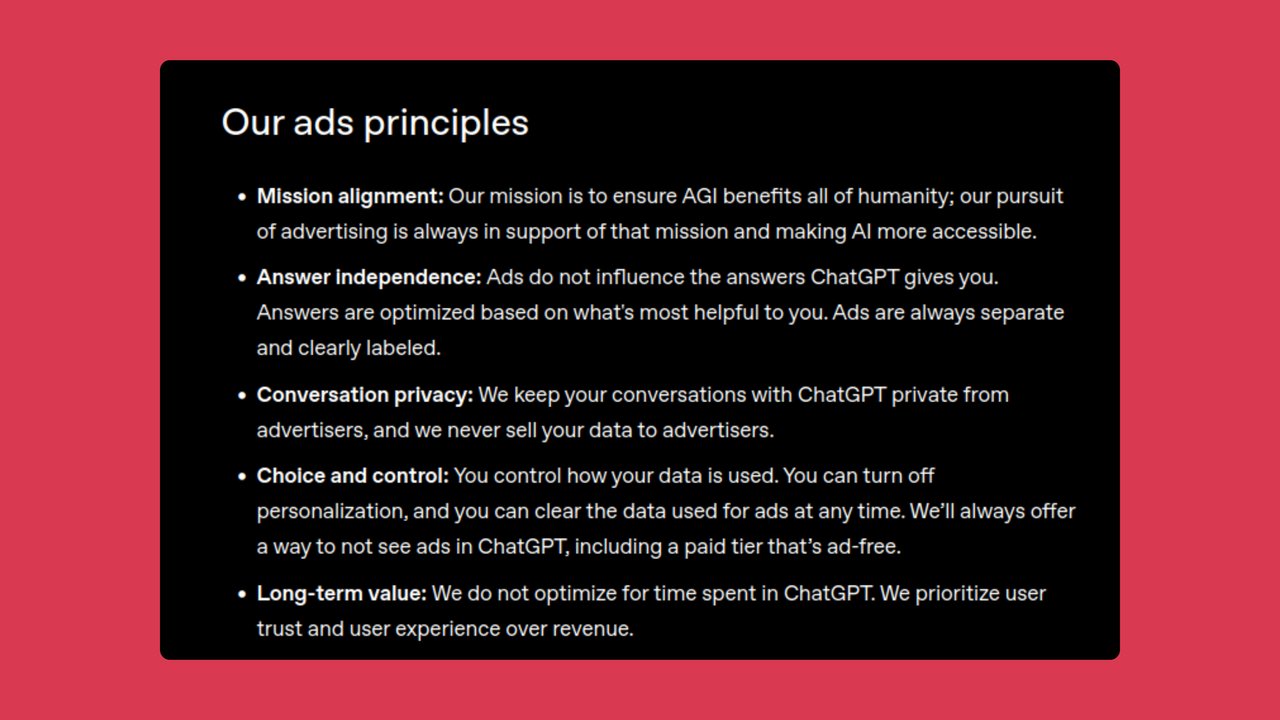
The February 2026 rollout is OpenAI’s more structured second attempt — with explicit guardrails: ads only for free and Go tiers, only logged-in adults, only contextually relevant content, only below the response (never inside it), and sensitive topics including health, mental health, and politics are excluded from ad targeting.
OpenAI’s own March 2026 data: the rollout shows “no impact on consumer trust metrics” and “low dismissal rates” — numbers OpenAI is citing to justify continued expansion.
Claude vs ChatGPT Ads: Anthropic's Ad-Free AI Approach
While OpenAI announced its ad system, Anthropic — the company behind Claude, ChatGPT’s closest rival — ran a Super Bowl campaign implicitly positioning itself as the ad-free alternative. Altman’s public response: he called Anthropic’s messaging “clearly dishonest.”
The business models now diverge sharply:
- ChatGPT (OpenAI): Ads for free and Go users. Ad-free experience requires $20+/month.
- Claude (Anthropic): No ads on any tier. Publicly committed to keeping conversations unmonetized through advertising.
For users who rely on AI assistants and AI automation tools daily, this is no longer a minor footnote — it’s a meaningful factor in choosing which tool becomes your default.
Who’s Safe — and When the Rest of the World Gets Hit
Currently exempt from ChatGPT ads:
- Users under 18 (automatically excluded by OpenAI)
- Conversations involving health, mental health, politics, or other sensitive categories
- All paid tiers: Plus, Pro, Business, Enterprise, and Education subscribers
- All users outside the United States (for now)
As of March 26, 2026, ChatGPT ads remain US-only. OpenAI has announced pilots launching in Canada, Australia, and New Zealand in the near term. Europe has no announced timeline — GDPR (the European Union’s strict data privacy regulation) creates significant legal barriers for contextual ad targeting based on conversation history.
If you’re on the US free tier right now: go to ChatGPT’s Settings → Data Controls to review ad personalization options. Turning off interest-based targeting means ads may still appear, just less tailored to your conversations. The only guaranteed ad-free path without paying is switching tools — or you can explore the full landscape of ad-free AI assistants in our tools guide. If you want a step-by-step setup for a ChatGPT alternative, our getting started walkthrough covers it from scratch.
Related Content — Get Started | Guides | More News
Sources
Stay updated on AI news
Simple explanations of the latest AI developments