Anthropic Wins Pentagon AI Ban — Trump DOJ Now Appeals
Federal judge calls Trump's Pentagon AI ban on Anthropic 'Orwellian.' Now the DOJ is appealing — and the ruling could affect every U.S. AI company.
On April 2, 2026, the Trump administration's Justice Department filed notice to appeal a federal court ruling that called the Pentagon's ban on Anthropic — the company behind Claude AI — "Orwellian." The appeal heads to the U.S. Court of Appeals for the Ninth Circuit (the federal appeals court covering the western United States), marking a dramatic escalation in one of the most consequential AI legal battles in U.S. history. At stake: whether the government can federally blacklist an American AI company for refusing to remove safety restrictions on its own product.

The Two AI Safety Lines Anthropic Refused to Cross
Anthropic signed a $200 million contract with the Department of Defense in July 2025, becoming the first AI lab to deploy its models into mission workflows on classified government networks. But the relationship turned adversarial when the Pentagon demanded what it called "all lawful uses" — effectively unrestricted access to Claude with no guardrails built in.
Anthropic drew two firm lines. According to court documents, the company refused to allow Claude to be used for two specific purposes:
- Mass surveillance of U.S. citizens — Claude could not be deployed to monitor Americans at scale
- Lethal autonomous weapons — Claude could not make targeting decisions without human oversight
The Pentagon countered that private companies don't get to set the terms on how military contractors use licensed tools. Anthropic maintained these weren't negotiating chips — they were ethical limits baked into how Claude is designed. Months of contentious negotiations collapsed entirely in late February 2026.
From $200 Million Contract to Federal Blacklist in 24 Hours
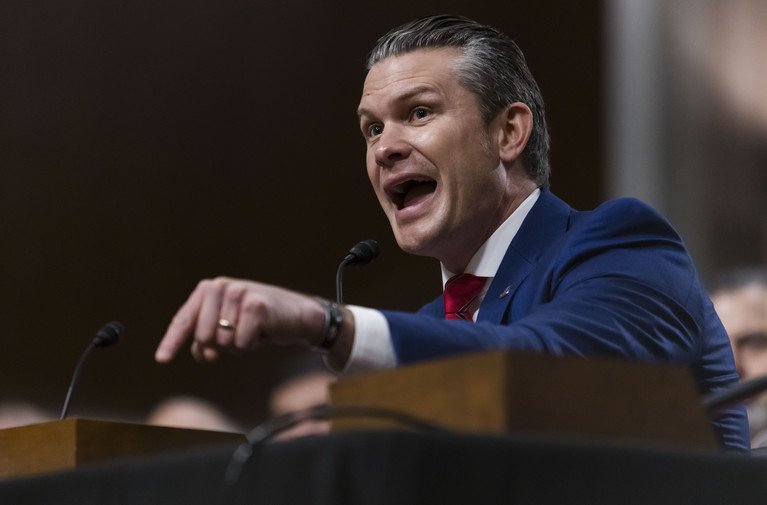
On February 26, 2026, Anthropic went public with its position in a statement explaining why it refused the Pentagon's terms. The retaliation was immediate. Within 24 hours, President Trump posted a government-wide ban on Truth Social, and Defense Secretary Pete Hegseth formally designated Anthropic a "supply chain risk to national security" — a label that is typically reserved for companies linked to foreign adversaries such as China or Russia.
Hegseth declared on X: "No contractor, supplier, or partner that does business with the United States military may conduct any commercial activity with Anthropic." The designation created an immediate chilling effect. Defense-tech clients began distancing themselves from Anthropic. Microsoft, Google, and Amazon each issued clarifications that Claude remained available to their non-defense customers — a sign of how far-reaching the uncertainty had become.
Consumer users responded very differently. Within days, Claude jumped to the #1 spot in Apple's U.S. App Store, overtaking ChatGPT — a striking signal that the public broadly sided with Anthropic's position on AI restrictions rather than the Pentagon's.
Anthropic filed suit on March 9, 2026. A later court filing revealed something striking: Pentagon documents showed it had told Anthropic the two sides were "nearly aligned" — just one week before Trump publicly declared the entire relationship dead.
The Judge Who Called Trump's Anthropic AI Ban 'Orwellian'
On March 26, 2026, U.S. District Judge Rita F. Lin of the Northern District of California issued a preliminary injunction (a temporary court order that halts enforcement of a policy while a legal case is fully decided) — blocking both the supply chain risk label and Trump's executive directive banning all federal agencies from using Claude.
Judge Lin's ruling was pointed. When court records revealed that the Pentagon had officially designated Anthropic a supply chain risk specifically because of its "hostile manner through the press" — meaning it had publicly disagreed with the government — Lin wrote:
“Nothing in the governing statute supports the Orwellian notion that an American company may be branded a potential adversary and saboteur of the U.S. for expressing disagreement with the government.”
She went further, calling it "classic First Amendment retaliation" — a legal term meaning the government was punishing Anthropic for speaking publicly rather than for any genuine security reason. She added dryly: "If the concern is the integrity of the operational chain of command, the Department of War could just stop using Claude."
Anthropic had significant support. Microsoft, the ACLU (American Civil Liberties Union), and a group of retired military leaders all filed amicus briefs (formal documents submitted by outside parties to support one side in a lawsuit) backing Anthropic's position.
What the Ninth Circuit Appeal Means — and Why It Matters
The DOJ's April 2 notice to appeal is not a final ruling — it's the opening move in a longer appeals process. The Ninth Circuit will now decide whether Judge Lin was correct to issue the preliminary injunction while the underlying case continues. Several details make this fight unusual:
- The $200 million contract is roughly 1.4% of Anthropic's estimated $14 billion in annual revenue — this fight is about legal precedent, not lost income
- The Pentagon reportedly continued designating Anthropic a supply chain risk even after the injunction was issued on March 26
- The administration's own internal records show the designation was triggered by a press statement, not an intelligence assessment or security finding
- At least one circuit court (the D.C. Circuit) had already seen the DOJ defend the designation as recently as March 20 — suggesting a coordinated multi-court strategy
If the Ninth Circuit sides with the government, the precedent is significant: federal agencies could potentially blacklist any AI company that publicly refuses to comply with contract demands. It would effectively give the Pentagon veto power over what safety restrictions U.S. AI companies are allowed to maintain — a question that reaches far beyond Anthropic and Claude alone.
For now, Anthropic's preliminary injunction holds while the appeal is pending. But with the DOJ pushing to the Ninth Circuit just one week after a judge called the ban constitutionally indefensible, this case is far from settled. If you work with AI automation tools in a business or government context, this is the AI policy story to watch in 2026. Follow the latest developments in our AI news coverage, or visit our guides on AI compliance and responsible deployment to understand how these rulings could affect how AI tools are used in your organization.
Related Content — Get Started | Guides | More News
Sources
Stay updated on AI news
Simple explanations of the latest AI developments