Claude's AI Coding Reliability Threshold: Burnout by 11 AM
Claude Opus 4.5 crossed the AI coding reliability threshold. A 25-year dev now generates 10,000 lines/day—but burns out by 11 AM. What this means for you.
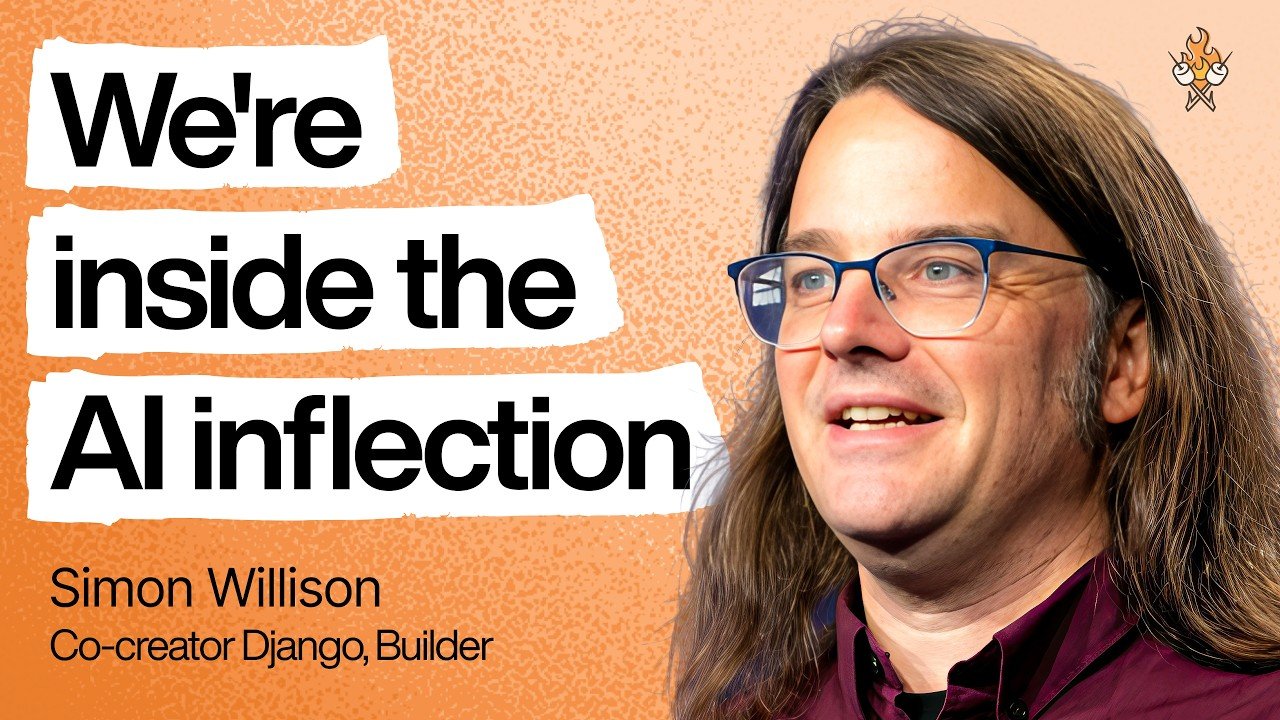
Something fundamental shifted in November 2025. Simon Willison, a 25-year software engineering veteran, now generates 10,000 lines of code per day — and 95% of it he never typed himself. GPT 5.1 and Claude Opus 4.5 crossed a reliability threshold that turned AI automation from a promising tool into a career-altering one. Willison joined Lenny Rachitsky's podcast in April 2026 to explain exactly what changed — and why every knowledge worker, not just developers, should be paying close attention.
The November AI Coding Inflection Point Nobody Announced
Willison calls it the "November inflection point" — the moment AI coding agents (autonomous AI systems that write, run, and iterate on code without constant human direction) crossed from unreliable to trustworthy. The trigger was the simultaneous launch of GPT 5.1 and Claude Opus 4.5. Neither was a dramatic leap on paper. Together, they crossed a threshold.
"Previously the code would mostly work, but you had to pay very close attention to it. And suddenly we went from that to... almost all of the time it does what you told it to do, which makes all of the difference in the world."
Before November 2025, AI-generated code required close supervision. You would prompt (give text instructions to) Claude or ChatGPT, review each output line by line, catch hallucinations (invented function names, fabricated library references, or incorrect logic the AI presents with false confidence), and patch errors by hand. A 20-minute task could balloon into two hours.
After the inflection point, the calculus flipped. Engineering tasks Willison's team previously delivered in 3 weeks now take 3 hours. Routine work he once estimated at 2 weeks completes in 20 minutes. His estimation ability — built over 25 years in software — is, in his own words, "completely broken."
That last part is not a boast. It is a warning.
What 10,000 Lines a Day Actually Costs You
Willison now writes most of his code on his iPhone, using the Claude app — sometimes while walking his dog. The volume is difficult to comprehend: 10,000 lines per day, with 95% never typed by a human hand. He runs 4 parallel agents (separate AI sessions each independently solving a different problem at the same time) simultaneously.
The productivity numbers look remarkable until you hit the last one:
- 10,000 lines of code generated per day
- 95% never manually typed by Willison
- 4 parallel agents running at the same time
- 2 minutes to re-engage an agent after any interruption (down from 2–4 hours of unbroken focus previously required)
- 2 weeks → 20 minutes for tasks that once anchored a sprint
- 11 AM — the time he is completely wiped out for the rest of the day
"I'm finding that using coding agents well is taking every inch of my 25 years of experience as a software engineer, and it is mentally exhausting. I can fire up four agents in parallel and have them work on four different problems. And by like 11 AM, I am wiped out for the day."
There is also an addiction pattern emerging. Some users report losing sleep to keep their agents running — a compulsion resembling gambling, chasing the next successful output. "There's an element of sort of gambling and addiction to how we're using some of these tools," Willison said. The dopamine hit when a hard problem solves itself turns out to be powerful enough to override sleep.
The Superpower That Disappeared Overnight
For 25 years, Willison's career edge was rapid prototyping — arriving at meetings with a working demonstration before most engineers had finished planning. He was the person who could translate a fuzzy idea into something you could click on, same day, every time. That skill is gone.
"Throughout my entire career, my superpower has been prototyping... And that was kind of my unique selling point. And that's gone. Anyone can do what I could do."
UI prototyping (building visual mockups of app interfaces to test ideas before committing to full development) is, in his words, "free now." ChatGPT and Claude generate convincing interfaces in minutes. Where Willison once had a decisive advantage — showing instead of describing — any product manager with a laptop can now do the same in an afternoon meeting.
Friends of his are clearing decade-long side-project backlogs in weekends. The sense of finally finishing things is real. So, Willison notes, is the sense of loss when the backlog runs out.
Who Gets Disrupted Next — and Why 1,228 Cases Matter
Software engineers are, Willison argues, bellwethers (early indicators that signal what is coming for a broader population) for how AI disrupts knowledge-intensive professions. Code has a property most knowledge work does not: it is objectively verifiable. Either it runs correctly, or it does not. That makes software an ideal proving ground for AI accuracy — and an early warning for what follows.
"Code is easier than almost every other problem that you pose these agents because code is obviously right or wrong — either it works or it doesn't work. If it writes you an essay, if it prepares a lawsuit for you, it's so much harder to derive if it's actually done a good job. But it's happening to us as software engineers. It came for us first."
The AI hallucination cases database now tracks 1,228 documented instances of AI producing false legal content — fabricated case citations, invented statutes, arguments assembled from nothing. Legal professionals who relied on AI without verification have faced sanctions, dismissed cases, and bar complaints.
The crucial difference: there is no compiler (a program that instantly tells you your code fails) for a legal brief. A hallucinated statute looks identical to a real one. This is why the November inflection point is a warning shot for law, medicine, and investigative journalism — not a permission slip. The verification infrastructure that makes software a relatively safe AI testing ground simply does not yet exist for those fields.
If you work in one of those professions, understanding how AI verification works now — before relying on it — is exactly the kind of preparation that separates informed users from cautionary tales. Start with the fundamentals of AI accuracy.
AI Automation Dark Factories and the New Bottleneck
Willison also discusses a concept pioneered by the company StrongDM: the "dark factory" — a fully automated software development pipeline (a connected sequence of steps from writing to testing to deployment) that requires no human presence. The term comes from manufacturing, where lights-out production lines run overnight with no staff on the floor. StrongDM's engineering team reportedly shipped in 3 hours what previously took 3 weeks.
That is not an improvement in productivity. That is a structural change in what software development is.
But the dark factory creates a new problem. When writing code stops being the bottleneck (the single step that limits overall throughput), testing becomes the bottleneck. Willison asks it plainly: "I can churn out 10,000 lines of code in a day. And most of it works. Is that good? Like, how do we get from most of it works to all of it works?"
Automated testing frameworks exist, but verifying 10,000 AI-generated lines per day requires rethinking QA (quality assurance — the systematic process of checking software for defects before it reaches users) from first principles. The production line is now faster than the inspection line. That gap will matter.
Vibe Coding: The One Line You Should Not Cross
"Vibe coding" — generating code quickly by feel, without deep review or structured testing, trusting the AI because the demo looked right — has become popular with non-technical users who want to build personal tools fast. Willison has a precise and direct position on this:
"If you're vibe coding something for yourself, where the only person who gets hurt if it has bugs is you, go wild. That's completely fine. The moment you ship your vibe coding code for other people to use, where your bugs might actually harm somebody else, that's when you need to take a step back."
Personal automation tools, private scripts, and solo experiments: safe territory for fast AI-assisted coding. Anything that touches other people's data, financial decisions, health records, or professional outputs needs a verification layer — testing, review, and someone who understands what the code actually does before it ships.
The tools that empower non-technical users to build and deploy overnight are the same tools removing the traditional gatekeeping that caught dangerous bugs before they reached anyone. That asymmetry is the central tension of this moment.
You can start testing this right now: Use Claude or ChatGPT for one repetitive task this week. Keep a log of where the output surprised you — both positively and negatively. That log becomes your real-world map of AI reliability before you ever need to depend on it for something that matters.
Related Content — Get Started | Guides | More News
Sources
Stay updated on AI news
Simple explanations of the latest AI developments