Claude Code costs $200/month — Goose does it entirely free
Goose by Block matches Claude Code's AI coding features at $0/month, runs on your machine. Railway just raised $100M to deploy apps 180x faster than AWS.
Two tools just made the most expensive parts of AI development significantly cheaper — and one of them is entirely free. Block (the company behind Square and Cash App) open-sourced Goose, a coding AI agent that does everything Claude Code does at $0/month. Meanwhile, Railway just closed a $100 million funding round by solving a problem hyperscalers like AWS created: AI writes code in 3 seconds, but traditional cloud infrastructure takes 3 minutes to deploy it.
The $200/Month Problem With Paid AI Coding Agents
Anthropic's Claude Code — an AI agent (a program that can write, edit, and run code autonomously on your behalf) — costs between $20 and $200 per month depending on usage. For individual developers, that bill adds up fast. For enterprises, it multiplies across entire engineering organizations.
The core function: you describe a coding task in plain English, and the agent reads your codebase, writes the code, runs tests, and fixes errors — without you touching an editor. It is a powerful workflow shift that moved from experimental to mainstream in 2025–2026.
The problem is not just the price. Every prompt you send to Claude Code travels to Anthropic's servers. Your source code, your business logic, your unreleased product features — all of it leaves your machine. And the meter runs the entire time.
Goose: The Free, Local Alternative With 26,100 GitHub Stars
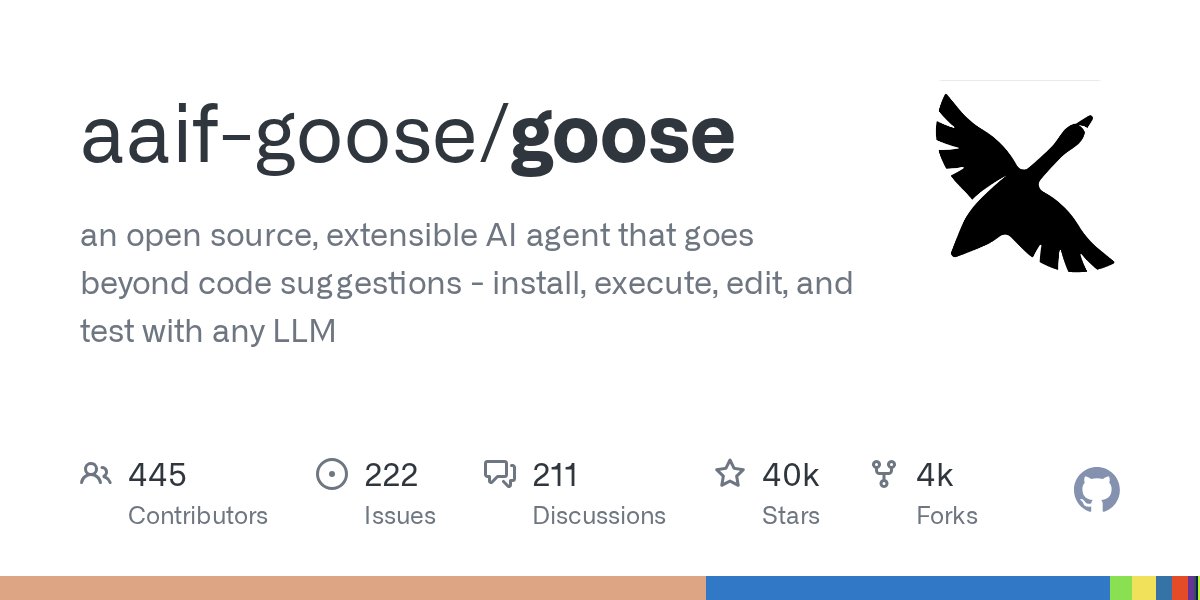
Block released Goose (github.com/block/goose) as a fully open-source AI coding agent that runs entirely on your local machine. No cloud dependency. No subscription fees. No rate limits. Your code never leaves your hardware.
The adoption numbers speak clearly: 26,100+ GitHub stars, 362 contributors, and 102 releases since launch. Goose supports multiple AI model backends (meaning you can plug in any AI model you choose — not just one company's product), runs offline, and handles the same autonomous coding tasks as Claude Code: writing files, running shell commands, browsing documentation, and iterating on errors until the code works.
- Cost: $0/month — completely free, no trial limits or hidden fees
- Data privacy: Runs entirely on your machine — code is never sent to external servers
- Flexibility: Works with multiple AI backends, not locked to a single vendor
- Community: 362 contributors, 102 releases — actively maintained open-source project
- Offline capable: No cloud dependency — works without internet once installed
Parth Sareen, a Goose developer and demonstrator, summarized its core appeal in one sentence: "Your data stays with you, period."
# Install Goose locally — no subscription required
git clone https://github.com/block/goose.git
cd goose
pip install -e .
# Run locally — your code never leaves your machine
For developers handling sensitive codebases — financial software, healthcare platforms, proprietary algorithms — local-only operation is often a compliance requirement (a legal or company rule mandating where code and data can be processed). Goose meets that bar by design. Claude Code cannot.
When Does Paying for Claude Code Still Make Sense?
Claude Code has genuine advantages: multi-modal reasoning (the ability to process images, screenshots, and diagrams alongside code), fine-tuned agent optimization, and tight integration with Anthropic's Claude model family. At the $20/month entry tier it is defensible if you are already deep in the Anthropic ecosystem. At $200/month for heavy usage, you need concrete productivity numbers to justify it.
For most developers, Goose is the smarter starting point — free, local, and fully capable. Build your AI coding workflow without spending anything, then upgrade only if you identify specific gaps Goose cannot fill. Our AI automation guides walk through setting up both tools step by step.
Railway: When Your Deployment Pipeline Becomes the Bottleneck

While the Goose vs. Claude Code comparison is about tooling costs, Railway's $100 million Series B (a second major round of venture funding — led by TQ Ventures, with Redpoint and FPV Ventures also participating) addresses a different AI-era problem: deployment speed.
Jake Cooper, 28, built Railway around a single observation. AI now generates production-ready code in roughly 3 seconds. Deploying that code to traditional cloud platforms like AWS using Terraform (an industry-standard tool for describing and managing cloud infrastructure as code) takes 2–3 minutes. When AI agents produce hundreds of code changes per day, that 180x time gap becomes a serious bottleneck in your entire development cycle.
Cooper framed the tension bluntly: "When godly intelligence is on tap and can solve any problem in three seconds, those amalgamations of systems become bottlenecks."
- Deployments complete in under 1 second — vs. 2–3 minutes with industry-standard Terraform
- Customers report 10x increase in developer velocity (how fast teams ship working software to production)
- Cost savings of up to 65% compared to equivalent AWS or Google Cloud workloads
- 31% of Fortune 500 companies use Railway for at least some of their infrastructure
- 10 million+ deployments monthly across 2 million active developers
Real Infrastructure Bills That Tell the Real Story
G2X, a federal contractor platform, migrated to Railway and cut its monthly infrastructure cost from $15,000 to roughly $1,000 — an 87% reduction. CTO Daniel Lobaton described the day-to-day impact directly: "The work that used to take me a week on our previous infrastructure, I can do in Railway in like a day."
Kernel's CTO Rafael Garcia ran a starker comparison: "At my previous company Clever, which sold for $500 million, I had six full-time engineers just managing AWS. Now I have six engineers total, and they all focus on product." Kernel's current Railway bill: $444/month. Railway's own revenue has grown 3.5x year-over-year with 15% month-over-month expansion — generated by just 30 employees with zero marketing spend. Its edge network (a distributed system of servers positioned close to end-users globally to cut response times) handles over 1 trillion requests per month.
# Get started with Railway CLI
npm install -g @railway/cli
railway login
railway init    # Set up a new project in seconds
railway deploy  # Deploy to production in under 1 second
The Cost Floor for AI Development Just Dropped
Goose and Railway are surface-level different stories — free coding agent vs. fast cloud deployment. But both point to the same underlying shift: every tool priced and designed for human-speed development is now being challenged by something faster, cheaper, or locally controlled.
Paid SaaS at $200/month. Three-minute deploy cycles. Hyperscaler pricing built on provisioned capacity (paying for reserved cloud compute even when it sits idle). All of it was designed around humans working at human speed — 8 hours a day, one task at a time. Cooper's projection for what replaces it: "The amount of software that's going to come online over the next five years is unfathomable compared to what existed before — we're talking a thousand times more software."
Here is what you can act on today:
- Paying for Claude Code and have not tried Goose yet? Download it from GitHub — setup takes under 5 minutes and costs nothing.
- AWS or GCP bill above $5,000/month? Run a parallel Railway deployment on one service and benchmark the cost directly.
- Building AI agents that generate and deploy code automatically? Railway's sub-second deployment pipeline is built for this; AWS tooling still assumes humans operating at human pace.
The developers who adjust their stack now — swapping a $200/month subscription for a free local tool, or cutting an $87% cloud bill — will have more budget, more velocity, and less infrastructure maintenance standing between them and the work that actually matters.
Related Content — Get Started | Guides | More News
Stay updated on AI news
Simple explanations of the latest AI developments