hermes-agent just fixed Claude Code — entirely with 1 file
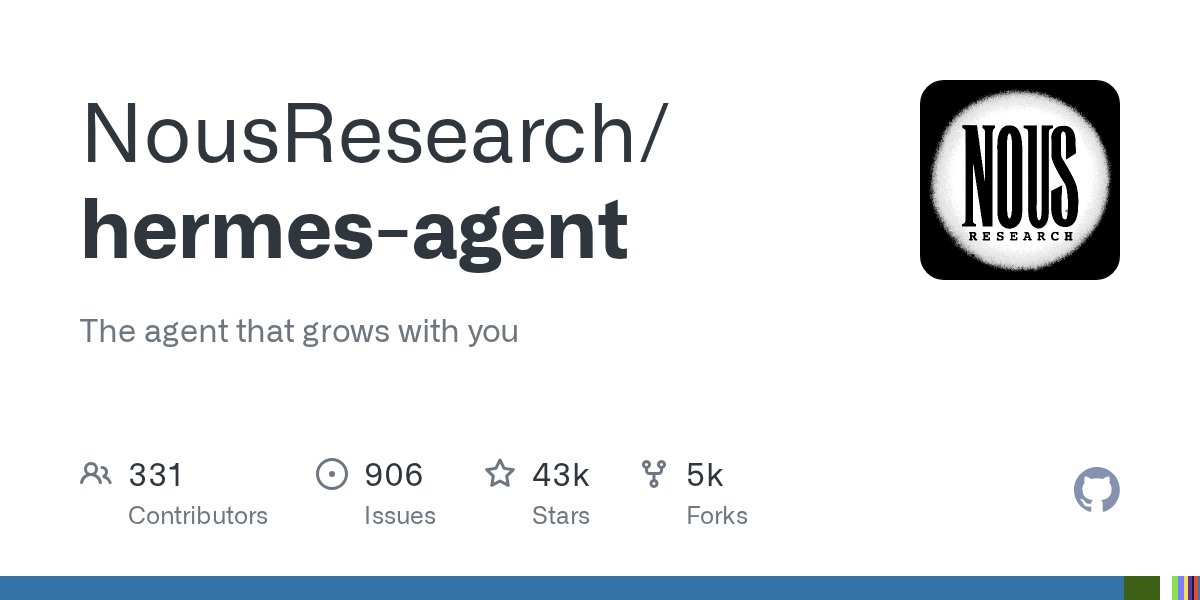
hermes-agent just hit GitHub Trending — one CLAUDE.md config file that fixes Claude Code's pitfalls, entirely free and open-source.
NousResearch's hermes-agent just landed on GitHub Trending — and its premise is almost embarrassingly simple: a single CLAUDE.md configuration file (a plain text instruction set that Claude Code reads on startup to adjust its behavior) that rewires how Claude Code operates during coding sessions. No new model. No expensive subscription. No 7,500-tool framework to install. Just 1 file.
That simplicity is the point. As AI coding assistants matured through early 2026, so did complaints about their behavior: lazy shortcuts, context drift (when the AI quietly forgets earlier decisions mid-task and contradicts itself), and decision patterns that don't match how experienced engineers actually think. hermes-agent treats these as configuration problems, not model problems — and that framing shift is exactly why it hit GitHub Trending this week.
Claude Code's Known Pitfalls — The Problem 1 Config File Targets
By April 2026, frustration with AI coding agents had become a documented pattern. AMD's engineering team publicly described Claude Code as "dumber and lazier" on complex multi-step tasks. Independent researchers catalogued specific failure modes: the AI takes shortcut paths that pass obvious tests but break in edge cases, loses architectural context mid-session, and applies patterns from unrelated codebases when instructions aren't tightly controlled.
These aren't model failures — they're behavioral defaults. Claude Code, like most large language models (AI systems trained on massive text and code datasets to predict and generate outputs), ships with broad, general-purpose instructions baked in. Those defaults work well for short, self-contained tasks. On longer sessions with complex requirements, they degrade in predictable and — crucially — fixable ways.
The standard community response to this problem: build a better replacement. Block released a free tool. LangChain shipped a 7,500-tool framework. hermes-agent proposes a different answer entirely — fix the defaults you already have.
What hermes-agent Actually Does
The tool centers on CLAUDE.md, a project-level configuration file that Claude Code (Anthropic's terminal and VS Code coding assistant) automatically reads when it starts a session. Think of it as a "house rules" document: a set of explicit behavioral guidelines that override Claude's general defaults specifically for your project.
NousResearch derived these behavioral rules directly from Andrej Karpathy (former Tesla AI director and one of the most-cited researchers on the practical limitations of LLM-based coding) documented observations about where large language models predictably fail during coding tasks. The specific failure modes the configuration addresses:
- Pattern-over-architecture bias — the model applies the most statistically likely solution instead of the architecturally correct one for your specific codebase
- Context bleed — assumptions from early in a session subtly corrupt decisions made much later, with no visible warning signal
- Shortcut drift — under ambiguous instructions, the model defaults to the shortest path that passes obvious tests, not the most robust long-term solution
- Authority confusion — the model treats all instructions with equal weight regardless of their source or recency in the conversation
- "Good enough" anchoring — once a partial solution exists, the model resists revisiting it even when explicitly asked to reconsider
NousResearch describes the project philosophy as "growth" — the configuration is designed to adapt over time, improving as the agent encounters new patterns in your projects. The official tagline: "The agent that grows with you."
Getting started takes under 60 seconds:
git clone https://github.com/NousResearch/hermes-agent
# Copy the config file into your project root
cp hermes-agent/CLAUDE.md ./CLAUDE.md
Because Claude Code automatically reads any CLAUDE.md present in a project directory, the change takes effect immediately — no plugin installation, no API key, no configuration dashboard required. And if you don't like the results, deleting 1 file reverts everything in under 10 seconds.
hermes-agent vs. April 2026's Wave of Claude Code Alternatives
The timing of hermes-agent's GitHub Trending run isn't coincidental. The week of April 7–10, 2026 saw a cluster of releases all targeting the same underlying problem: making AI coding agents more predictable and reliable on complex, multi-step tasks.
- Block's Goose — a fully free local alternative to Claude Code at $0/month, for developers who want to replace the tool entirely
- Cursor — shipped auto-update features addressing months of missing functionality requests from users
- LangChain — released a self-healing agent framework with 7,500+ available tools, the maximum-complexity end of the spectrum
- hermes-agent — 1 file, 0 new tools, 0 new subscriptions — the minimum-friction option for existing Claude Code users

For developers already embedded in the Claude Code ecosystem — with existing workflows, team conventions, and months of muscle memory built around the tool — hermes-agent's approach is the lowest-friction option available. You don't abandon your tools. You tune them.
The Bigger Signal: Behavioral Engineering Is Now a Discipline
What makes hermes-agent significant beyond its immediate utility is what it implies about how AI tooling is maturing in 2026.
For the first 2 years of AI coding assistant adoption (roughly 2023–2024), the dominant answer to behavioral problems was "wait for the next model." GPT-4 inconsistencies? GPT-4o will fix it. Claude 2 shortcomings? Claude 3 is coming. The underlying assumption across the industry: behavioral problems are model problems, solvable only through retraining at massive compute cost.
hermes-agent, alongside a growing wave of configuration-first projects, challenges that assumption directly. If a single-file prompt intervention — prompt engineering (the practice of writing precise behavioral instructions that guide how AI systems respond to inputs) — can measurably improve the reliability of a frontier model (a top-tier AI like Claude Sonnet, trained on trillions of tokens) on real-world coding tasks, then the behavioral optimization layer sitting above the model itself is still massively underbuilt.
The gap between what these models are capable of and what they actually do by default isn't just addressable. It's addressable without retraining a single model weight.
Andrej Karpathy made this point implicitly in his LLM coding analysis: the failure modes aren't random — they're systematic. Systematic failures have systematic fixes. NousResearch — the team behind the Hermes series of open-source language models and a consistent presence in the open AI research community — is applying that insight directly to the tool developers use every day.
Try It in Your Next Coding Session
If you're using Claude Code for anything beyond simple one-off queries — multi-file refactors, long debugging sessions, architectural reviews — hermes-agent is worth a 5-minute test. The install is entirely free, requires no account or API key, and is reversible in under 10 seconds.
After adding the config, watch specifically for these behavioral changes:
- Whether the model maintains architectural context (the overall structure and key decisions of your codebase) consistently across long sessions without drifting
- Whether it resists the shortcut solution when you've explicitly asked for thoroughness
- Whether it surfaces tradeoffs and asks clarifying questions instead of choosing silently on your behalf
The project is live on GitHub right now — entirely open-source, no subscription required, trending today. Check out the AI coding tools guide for more context on getting the most out of Claude Code. If you use it regularly, this is the fastest single improvement you can make to your setup this week — and it costs nothing to try.
Related Content — Get Started | Guides | More News
Stay updated on AI news
Simple explanations of the latest AI developments