Trump AI Jesus Image Backfires — Late-Night Hosts Respond
Trump posted an AI Jesus image on Truth Social, then deleted it — but Colbert, Kimmel, and Stewart had already roasted it within 53 minutes.
On Sunday, April 13, Donald Trump posted an AI-generated image (a picture created by artificial intelligence software, not a real photograph) to his Truth Social account. It depicted him in a white robe, one hand raised with a glowing orb, the other resting on a man's forehead in a scene reminiscent of religious healing paintings. Surrounding him: eagles, fireworks, the Statue of Liberty — and, as Stephen Colbert would later catalogue in forensic detail, "cloud soldiers, an astronaut with a shiv, and a winged man-beast with spikes where his head should be."
The image was deleted by Monday morning. Three late-night hosts had already seen it. Within 53 minutes of each other, all three responded on air — and what followed was one of the fastest, most coordinated comedy pile-ons that AI-generated political imagery has ever produced.
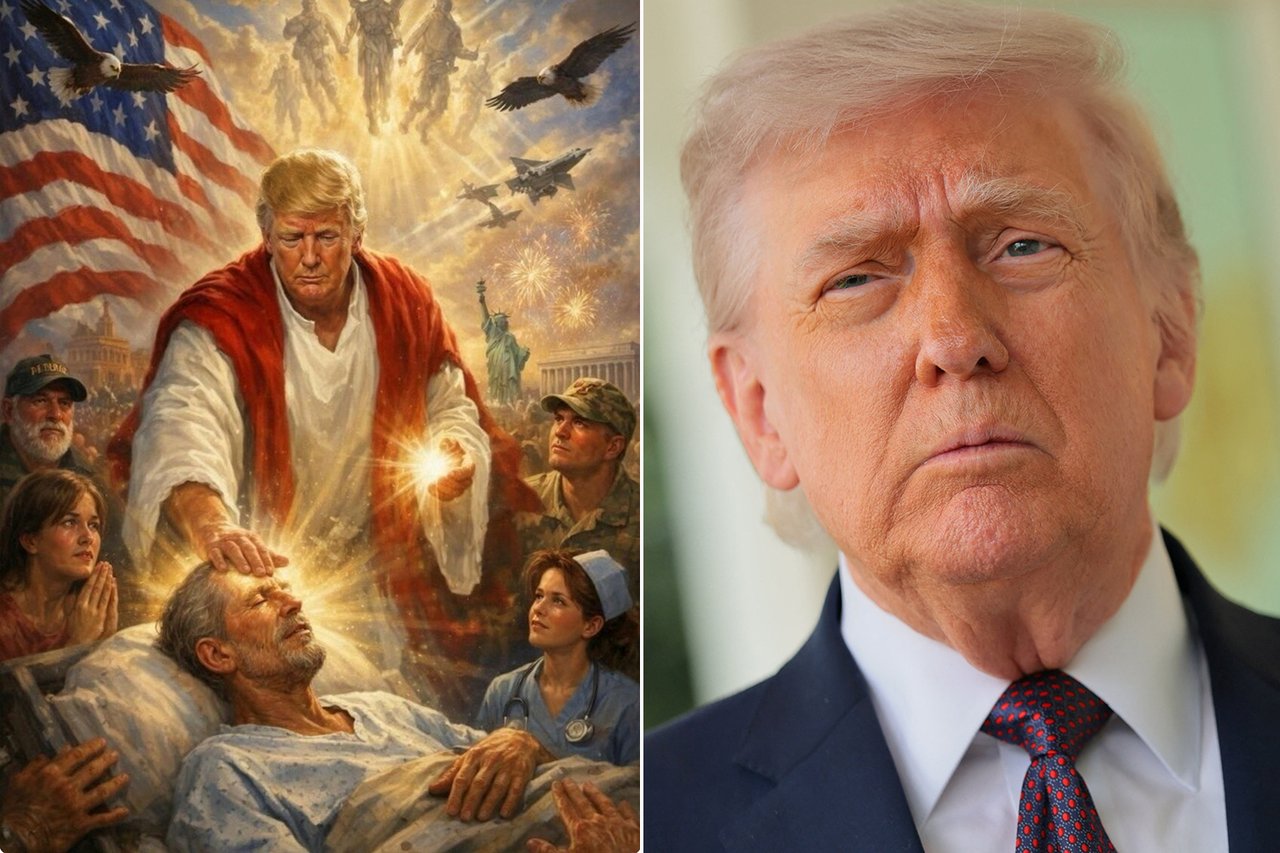
Inside Trump's AI Jesus Image: What It Actually Showed
The AI image was hagiographic (meaning: designed to portray a figure as saintly or divine, in the manner of religious iconography) in its apparent intent. Trump was cast as a Christ-like healer reaching out to the sick. But the surrounding imagery — the dreamlike chaos of patriotic symbols fused with figures that struck most viewers as demonic — transformed what may have been intended as flattery into something else entirely.
Stephen Colbert, host of The Late Show on CBS, offered the most systematic breakdown on April 14, roughly 43 minutes after the image was removed:
"It's worth taking a moment to break down what's going on here," Colbert said — describing what he observed as "cloud soldiers, an astronaut with a shiv, and a winged man-beast with spikes where his head should be, looking like a bootleg Transformers action figure your grandma got you at the dollar store."
Jimmy Kimmel, on Jimmy Kimmel Live (ABC), added the line that landed hardest: "The man Donald Jesus Trump is healing looks a whole lot like Jeffrey Epstein."
Trump's explanation — offered to reporters after the deletion — was that he thought the image depicted him "as a doctor" and "had to do with the Red Cross as a Red Cross worker, which we support." The explanation suggested he either hadn't examined the image carefully before posting it or simply couldn't square his stated intent with what the image visually communicated. Either way, it gave the hosts three days of material to work with.
Notably, it wasn't just late-night TV that pushed back. Even some conservative voices criticized the post. "This is gross blasphemy," one wrote. "Faith is not a prop. You don't need to portray yourself as a saviour when your record should speak for itself." Another added: "A little humility would serve him well."
Three Late-Night Hosts, Three Networks, 53 Minutes
What made this incident stand apart was the speed. Three major programs — airing on three competing networks — all responded within a single 60-minute broadcast window on April 14:
- 43 minutes: Stephen Colbert dissected the image on The Late Show (CBS)
- 53 minutes: Jimmy Kimmel covered it on Jimmy Kimmel Live (ABC)
- 60 minutes: Jon Stewart addressed it on The Daily Show (Comedy Central)
Each host brought a completely distinct comedic strategy. Together, uncoordinated, they produced something like a synchronized three-network roast.
Colbert: The Art Critic
Colbert's approach was forensic — he treated the AI image as a text to be parsed, element by element, in the tradition of close visual reading. Rather than one broad joke, his segment made the absurdity cumulative: each catalogued detail funnier than the last. The framing was pitch-perfect: "He posted this AI image depicting himself as Jesus, presumably trying to heal Jon Stewart." By connecting the image to his own long-running comedic relationship with Trump, Colbert made it personal and specific — never a generic political attack.
Stewart: The Presidential Sigh
Jon Stewart's response was more raw. "I am really starting to sour on this president," he said — a line functioning simultaneously as joke and genuine exhaustion. But Stewart extended beyond the image itself. Over the same weekend, Trump had posted to Truth Social attacking Pope Leo XIV (the newly elected head of the Catholic Church, chosen just weeks earlier), calling the Pope "WEAK on Crime, and terrible for Foreign Policy." The Pope had recently issued public calls for international peace. Stewart treated both incidents — the AI Jesus image and the papal attack — as a single portrait of a president whose internal logic he could no longer trace.
Kimmel: Pure Absurdism
Kimmel leaned hardest into absurdism (comedy built on treating impossible or contradictory things as entirely routine). "We have a fight between the president and the Pope," he told his audience. "The world has become a real life episode of South Park." The Epstein line — connecting the face of the man Trump was healing to the late financier Jeffrey Epstein — was the night's most viral single observation. Kimmel ended on a theological note: "This is what happens when you sell bibles instead of reading them."
The Pope Subplot That Made Everything Stranger
The AI Jesus image did not exist in isolation. Within the same 48-hour window, Trump had separately attacked Pope Leo XIV on Truth Social — a pope who had been in office for weeks and had already made headlines with calls for international peace. Trump's post called him "WEAK on Crime, and terrible for Foreign Policy."
Kimmel's response to that angle captured the entire story's absurdity in one sentence: "What does the Pope have to do with crime? He's not Batman, he's the Pope."
Church officials responded more formally. "Pope Leo is not his rival; nor is the Pope a politician," one statement read. "He is the Vicar of Christ who speaks from the truth of the Gospel and for the care of souls."
The juxtaposition — a president simultaneously posting AI imagery depicting himself as Christ while publicly attacking the actual head of the Catholic Church for insufficient toughness on crime — created something that no comedy writers' room could have scripted. Stewart's segment treated both incidents as a single story: not two separate news items, but one coherent portrait of presidential behavior in April 2026.
What Deleted AI Images Mean for Political Messaging in 2026
Beyond the comedy, this incident marks something genuinely new in American political communication: a sitting president sharing AI-generated imagery (produced by tools like Midjourney, DALL-E, or Stable Diffusion — software that creates photorealistic images from a short text description, in seconds, for free or near-free) that so thoroughly failed to match its apparent intent that it required both deletion and a bewildered public explanation.
AI image generators have become dramatically easier to use over the past 3 years. Anyone can type a prompt like "Donald Trump as a Jesus figure healing the sick, with patriotic imagery" and receive a polished, shareable result within seconds. The core problem is that these tools frequently produce results that are internally inconsistent: the central subject renders correctly, while background elements drift into unintended — sometimes surreal, sometimes disturbing — territory. That appears to be exactly what happened here.
For observers of AI ethics (the study of how artificial intelligence should be used responsibly in public life), the incident illustrates three concrete lessons:
- Deletion doesn't work anymore. The image was removed within hours. Screenshots circulated for days, and all 3 major late-night programs broadcast it to millions of viewers — making the deleted image more widely seen than it ever was on Truth Social.
- AI authorship is hard to verify quickly. We still don't know which specific AI tool generated this image, or whether Trump himself posted it. That ambiguity is now standard for AI-generated political content, and it complicates accountability.
- Intent and reception can diverge completely — and publicly. The probable intent was flattery. The actual reception was ridicule, cross-party criticism, and three late-night segments. AI tools produce output, not judgment, and that gap is now a measurable political liability.
If you want to understand how AI-generated imagery is reshaping political communication in 2026, this is the year's clearest case study so far. Watch the full Colbert, Kimmel, and Stewart segments via the Mashable sources linked below. And if you're building or using AI tools yourself — for work, content, or communication — our AI automation guides cover the landscape of responsible, effective AI use.
Related Content — Get Started | Guides | More News
Sources
Stay updated on AI news
Simple explanations of the latest AI developments