OpenAI Codex Free Desktop vs Claude Code $200/mo
OpenAI Codex desktop is now free for ChatGPT users — taking on Claude Code's $200/mo plan. Factory raises $150M at $1.5B. See which AI coding tool wins.
OpenAI released a significantly upgraded version of Codex as a free desktop application this week — directly targeting developers paying $200 per month for Anthropic's Claude Code. The timing is deliberate: on the same day, enterprise AI coding startup Factory closed a $150 million funding round at a $1.5 billion valuation, confirming that AI automation in software development is now a full-scale battlefield worth billions of investor dollars.
Free Desktop App vs. $200/Month: What OpenAI Codex Can Do Now
The original Codex was primarily a background model — useful for autocomplete and code suggestions, but not a head-to-head challenger to Claude Code's full development environment. The upgraded version changes the competitive picture significantly. OpenAI's new Codex desktop application gives users greater control over their local machine: access to files, terminal, and browser — the exact capabilities that made Claude Code popular with working developers.
Claude Code, Anthropic's AI coding assistant, is available through the Claude Max plan at $200 per month. For individual developers or small teams, that's a significant monthly commitment. The new Codex desktop is positioned as a free (or lower-cost) alternative for users already in the OpenAI ecosystem — those on ChatGPT Plus ($20/month) or Pro ($200/month) plans get the upgraded Codex included.
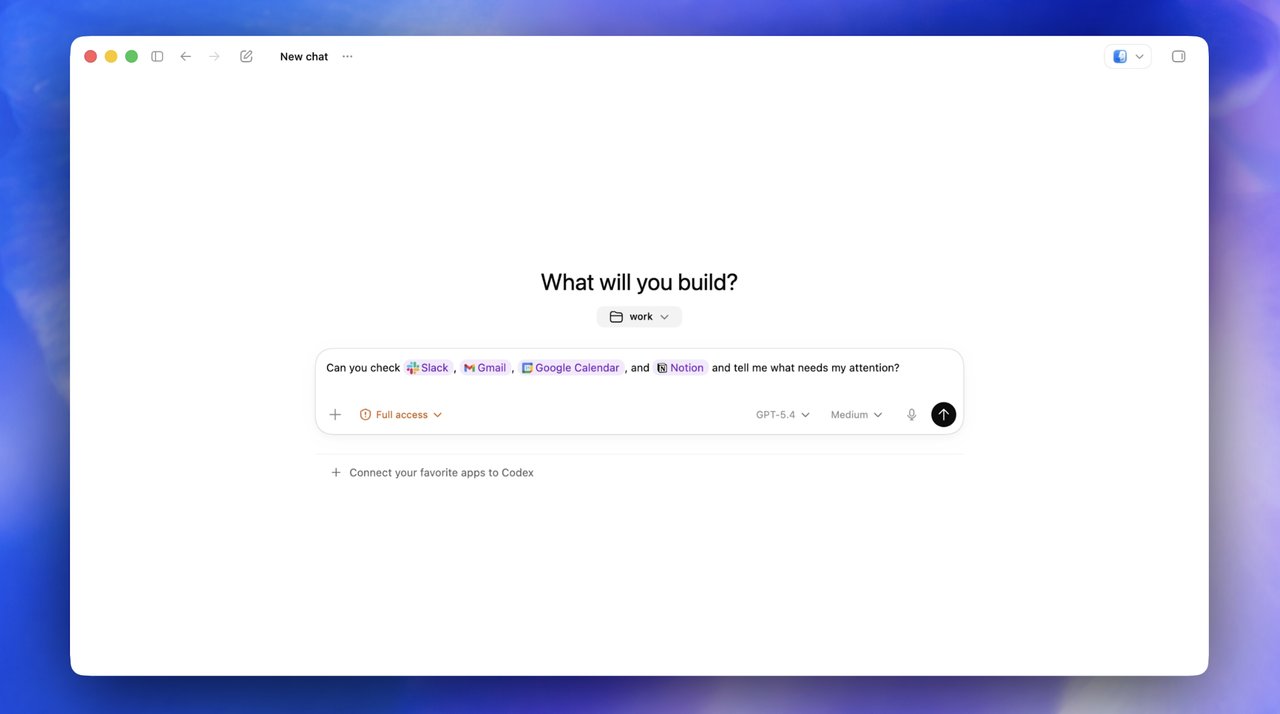
That price differential is a powerful distribution mechanism. When a comparable tool costs $0 vs. $200/month for existing subscribers, adoption follows quickly — the same logic that drove early adoption of Block's Goose (a free, local AI coding tool) earlier in 2026. OpenAI is betting that developers already paying for ChatGPT Pro won't justify a separate $200/month Anthropic subscription once Codex desktop closes the capability gap.
What "desktop access" actually means for your workflow
A desktop AI coding application differs from a cloud-only tool in one critical way: it reads and modifies files on your computer directly (local file access — no uploading code to a remote server and waiting for results). This matters for developers working with proprietary code, large codebases, or environments with security restrictions on cloud uploads. OpenAI positioning Codex as a desktop-native tool means it now competes on the exact dimension where Claude Code has been strongest: local, agentic (capable of completing multi-step tasks without constant human prompting) development workflows — including vibe coding sessions where developers describe intent in plain language and let the AI execute the implementation.
Factory's $150M Raise: Why Enterprises Won't Just Use the Free AI Coding Tool
While the free-vs-paid battle plays out for individual developers, enterprises are betting large sums on a fundamentally different value proposition.
Factory, a three-year-old startup building AI coding solutions specifically for large software organizations, closed a $150 million round led by Khosla Ventures, with Sequoia also participating — valuing the company at $1.5 billion (the threshold that earns a startup the "unicorn" label in private markets). Enterprise AI coding is a different problem from consumer coding tools:
- Scale: Enterprise codebases often contain millions of lines of code across dozens of repositories. AI tools must navigate that context without hallucinating (confidently generating incorrect output that looks plausible but is wrong).
- Compliance: Regulated industries — finance, healthcare, defense — require code generation with audit trails, security certifications, and IP ownership guarantees that free tools cannot provide.
- Integration: Enterprise teams use Jira for project tracking, GitHub or GitLab for code review, and CI/CD pipelines (automated systems that test and deploy code after each commit). Factory builds into these workflows so AI coding becomes a team process, not a solo shortcut.

Separately, Upscale AI is reportedly in talks to raise at a $2 billion valuation. Two AI coding startups approaching or exceeding $2 billion within the same week signals that investors view enterprise software development as one of AI's most defensible business models — not commoditized away by free tools, but made more valuable by the complexity that free tools cannot address.
The Statistic That Justifies Every AI Automation Investment Right Now: 393%
If there's one data point from this week that explains why hundreds of millions of dollars are flowing into AI tools across every sector, it's this: AI-driven traffic to U.S. retail websites surged 393% in Q1 2026 compared to Q1 2025 — and it's directly increasing revenue for those retailers, not just generating empty clicks.
AI-assisted shopping encompasses conversational product search ("find me a waterproof hiking boot under $150 that fits wide feet"), intelligent product recommendations based on real purchase patterns, and AI support agents that resolve returns without human escalation. These aren't experimental features anymore — they're driving measurable conversion lifts at scale.
For e-commerce teams still running traditional keyword search and manual product curation: the 393% gap represents real competitive exposure. The retailers deploying AI discovery tools aren't just generating more traffic — they're capturing purchase intent at the moment of highest conversion probability. The window for "evaluating AI" in commerce has effectively closed.
Voice, Design, Games: AI Expands Into Every Creative Professional's Toolbox
Beyond coding and commerce, several meaningful AI expansions happened in parallel this week:
DeepL entered voice translation. DeepL, the translation service that consistently outperforms Google Translate on linguistic nuance and accuracy, launched a voice translation product — competing directly with ElevenLabs (the voice AI company known for hyper-realistic speech synthesis and multilingual dubbing). DeepL's competitive edge: deep trust with European enterprises already using its text translation API (application programming interface — the connection layer that lets software send text and receive translations), plus GDPR-compliant (meeting Europe's strict data privacy law) data handling that large organizations require.
Canva's AI assistant got tool-calling. Canva's built-in AI — used by approximately 185 million people monthly — can now execute design changes autonomously rather than just suggesting them. Tool-calling (the ability for an AI to trigger actions inside software, not just produce text responses) converts Canva's AI from a suggestion engine into a design co-pilot. Describe the change, and the AI executes each step in sequence.
Roblox AI became agentic. Roblox's assistant gained the ability to plan, build, and test games — not just answer questions. "Agentic" means the AI can pursue a multi-step goal without waiting for a human prompt at each stage. For Roblox's 88 million daily active users and its creator community, this shifts the tool from "AI tutor" to "AI co-developer."
Physical Intelligence announced a new robot brain. The robotics startup published a model capable of learning tasks it was never explicitly programmed for. Most industrial robots follow rigid pre-programmed routines — a single unexpected object on an assembly line can halt production entirely. A robot that can reason through novel situations represents the difference between "automation" and genuine "autonomous operation." No independent benchmarks were released, but the direction is clear: robot adaptability is now a funded commercial priority, not an academic experiment.
Your Concrete Next Step Before the Next AI Coding Billing Cycle
If you're currently paying $200/month for Claude Code, download the Codex desktop app before your next renewal. The goal isn't to replace one tool wholesale — it's to map your actual usage pattern. If the majority of your AI coding time involves autocomplete, single-file edits, and quick function generation, a free Codex setup may cover 70–80% of that workload. If you rely on Claude Code for complex multi-agent refactoring, deep codebase analysis, or research-heavy debugging sessions, the $200/month remains justified. You won't know until you run the comparison for two weeks.
If you lead an enterprise software team, Factory's $1.5 billion valuation backed by Khosla Ventures and Sequoia is a signal — not a reason to buy Factory specifically, but a prompt to run a structured 30-day AI coding pilot now. Define a real but isolated codebase, set a concrete metric (bugs caught before merge, tickets resolved per sprint), and measure it. Teams that build institutional knowledge today will be ahead when their boards demand a formal AI automation strategy in 2027. You can explore how AI coding tools are evaluated in our practical guides.
Related Content — Get Started | Guides | More News
Sources
Stay updated on AI news
Simple explanations of the latest AI developments