Google Antigravity: Free AI IDE That Beats Cursor in 2026
Google Antigravity is free in public preview — 40% faster than Cursor, 94% refactoring accuracy, runs 5 AI agents in parallel. Mac, Windows, Linux. No...
Cursor, the most popular AI code editor, costs $20 a month — $240 a year. Google Antigravity, a new AI-powered IDE (integrated development environment: a software workspace where you write, test, and run your code) is now completely free in public preview. In independent tests, Antigravity built a standard Next.js web application with a Supabase database backend in 42 seconds, versus Cursor's 68 seconds. For developers paying a subscription they have never questioned, that gap is worth a closer look.
Cursor Costs $240/Year: Google Antigravity Free AI IDE Changes the Math
Google Antigravity launched in public preview in November 2025, built on a heavily modified fork of Visual Studio Code — the code editor used by over 70% of professional developers globally. If you have ever opened VS Code, the interface will feel immediately familiar.
Here is how pricing stacks up across the four major AI coding tools right now:
- Google Antigravity: Free (public preview active) · Pro ~$20/month expected later in 2026
- Cursor: Free tier (2,000 completions/month) · Pro $20/month · Ultra $200/month
- Windsurf: Free tier (25 credits/month) · Pro $15/month · Enterprise $60/user/month
- GitHub Copilot: Free tier (2,000 completions/month) · Pro $10/month
The free preview includes full access to Gemini 3 Pro — Google's flagship AI model in 2026 — plus the ability to switch to Claude Sonnet 4.5 or GPT-OSS-120B (an open-source language model derived from OpenAI's architecture) mid-session without restarting. No other free tool currently bundles three top-tier models at zero cost.
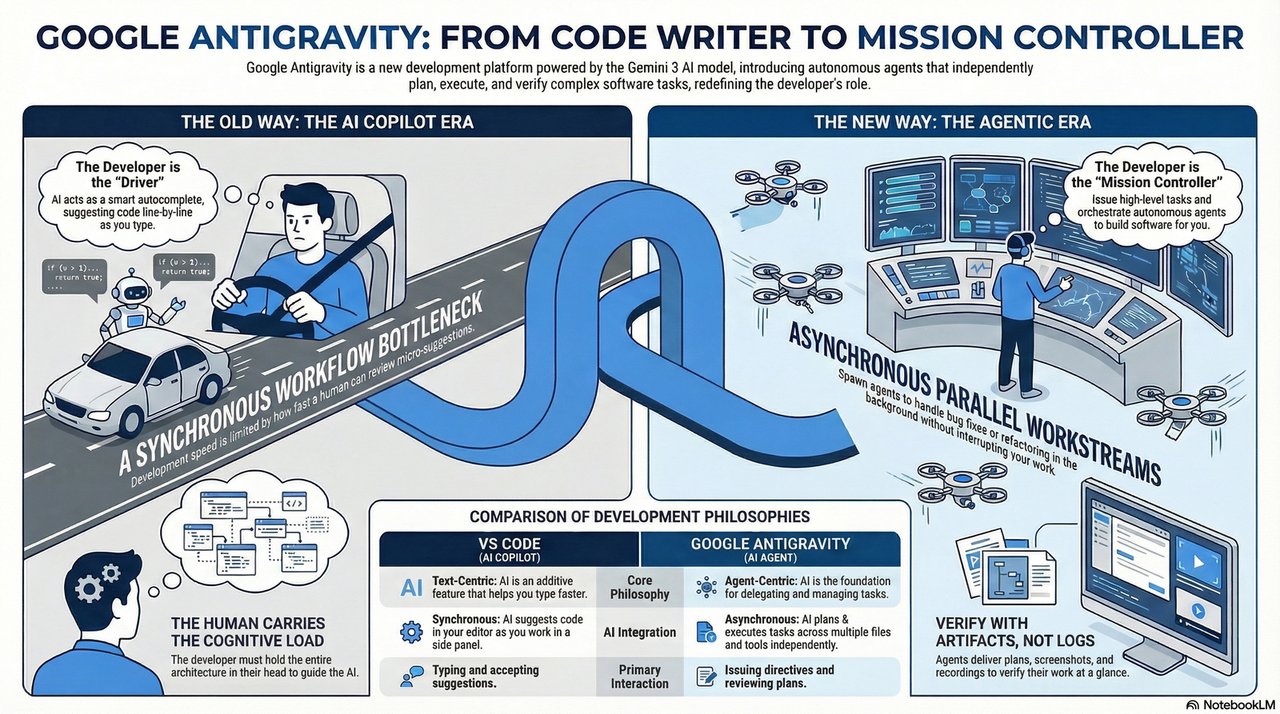
The institutional backing behind these results matters. In July 2025, Google acquired Windsurf's entire leadership team in a $2.4 billion deal, bringing approximately 40 senior engineers on board — the same people who had already built Windsurf's agentic (multi-step, autonomous task execution) architecture. That deep expertise now lives inside Antigravity, which explains how a product launched in late 2025 already posts benchmark numbers that rival tools with three years of development behind them.
AI Automation in Practice: Five AI Agents on Your Project at Once
The headline capability separating Antigravity from every other free tool is its Manager View: a mission control panel that lets you spawn up to five AI agents (independent AI workers capable of reading, writing, and running code without step-by-step human prompting) working on different parts of your project simultaneously.
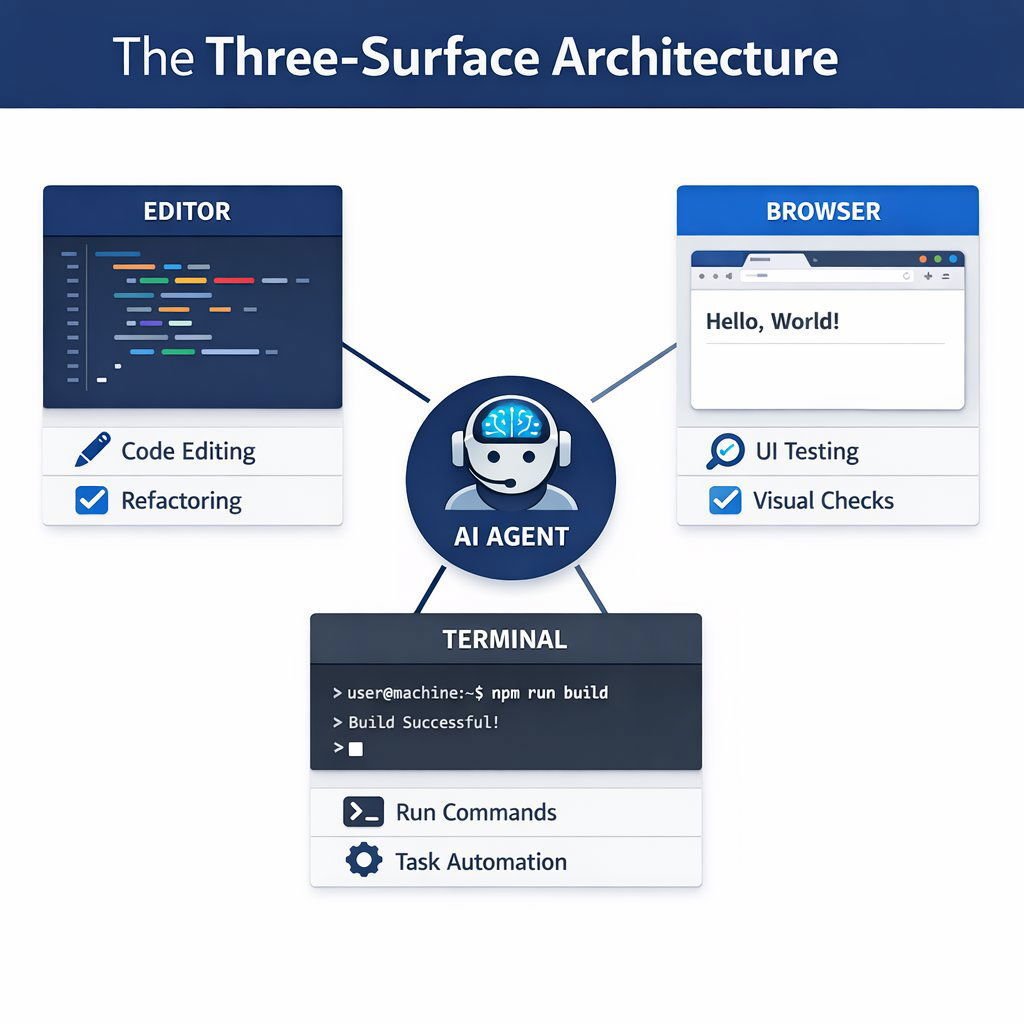
In practice: open the Manager View, describe each task in plain English, press run. One agent can be scaffolding (building the skeleton structure of) your backend database while another writes your frontend components (the user-visible elements of the web page). Each agent returns structured Artifacts — verifiable deliverables including task lists, implementation plans, and annotated code diffs (line-by-line records of every file change) — so you review completed work rather than watching the AI type in real time. This agentic workflow is exactly what makes Antigravity a natural fit for vibe coding — letting AI handle the implementation while you stay focused on direction and review.
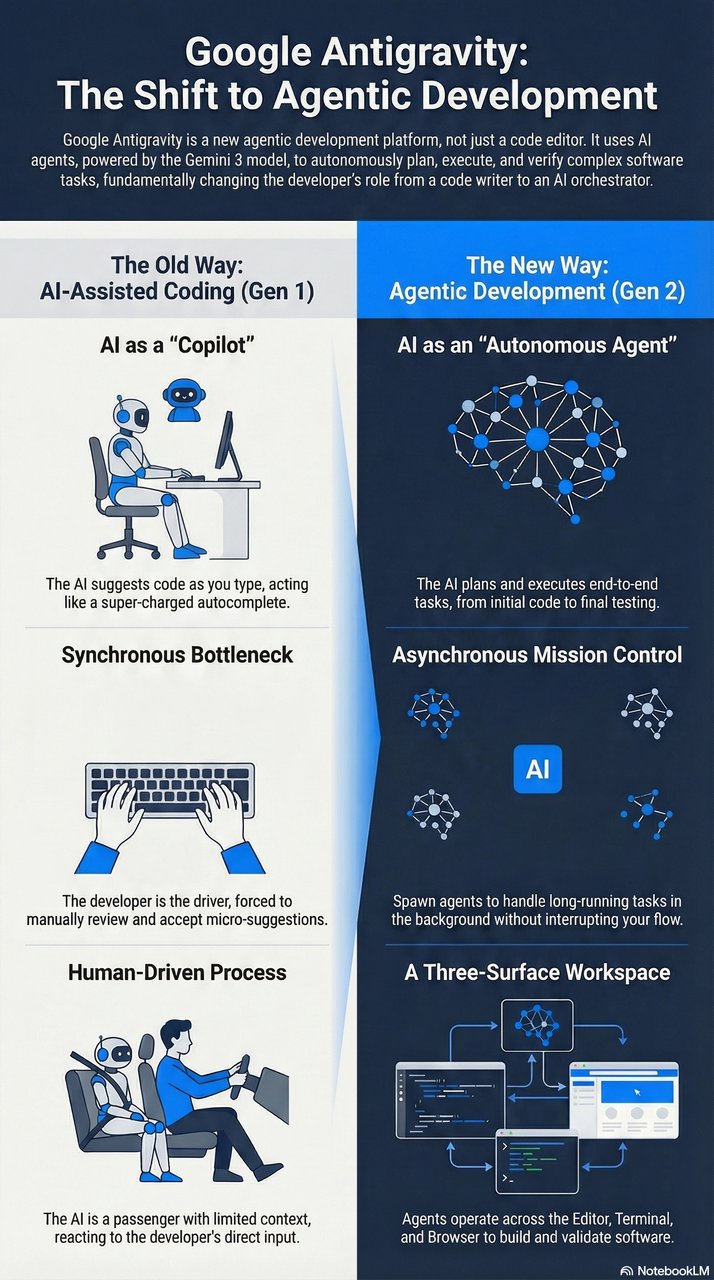
Three integrated surfaces power this workflow:
- Editor Surface — standard AI code editing with inline suggestions and tab completions, identical in feel to Cursor or GitHub Copilot
- Terminal Surface — direct shell (command-line interface) access, letting agents run build commands, execute tests, and trigger scripts autonomously without you opening a separate terminal window
- Browser Surface — a built-in headless Chromium browser (the rendering engine inside Google Chrome) that allows agents to launch your web app, click through the UI, capture screenshots, and read JavaScript console errors, all without leaving Antigravity
For context: Cursor has no built-in browser. Windsurf has no parallel background agents. Antigravity ships both, for free, today. The combination of autonomous multi-agent coordination and built-in visual verification is a genuine step beyond what any competing free tool currently offers.
Google Antigravity vs Cursor: 2026 AI IDE Benchmark Numbers
Performance data from independent testing in early 2026 makes a strong case:
- Refactoring accuracy: 94% (Antigravity) vs 78% (Cursor 2.0) — a 16-point gap on restructuring existing code without introducing errors
- Speed on large codebases: 40% faster than Cursor 2.0 on repositories (project file collections) exceeding 100,000 lines of code
- Feature build time: Next.js + Supabase app completed in 42 seconds vs Cursor's 68 seconds — 38% faster end to end
- SWE-bench Verified score: 76.2% — within 1 percentage point of Claude Sonnet 4.5, the current leading benchmark for real-world software engineering problem resolution
- Context window: 1 million tokens (roughly 700,000 words) — the AI holds your entire large project in working memory at once, eliminating the "forgetting" problem common on multi-file work
The context window (how much text an AI can process in one session without losing earlier information) gap is particularly significant for larger projects. Cursor's standard context window is far smaller — meaning on complex codebases, the AI effectively "forgets" files it read earlier as it moves forward. Antigravity's 1-million-token window keeps your entire project in scope, cutting down on contradictions in generated code and eliminating the frustration of re-explaining architecture from scratch partway through a session.
Three Limits to Check Before You Cancel Your Cursor Subscription
Antigravity is not a frictionless swap for every developer. Three real limitations worth testing before you cancel your Cursor subscription:
- No access to Microsoft's Visual Studio Marketplace extensions. Antigravity is built on VS Code's open-source core but cannot reach Microsoft's proprietary extension store. Popular tools like C# Dev Kit, Pylance (Python language support), and Remote-SSH (for connecting to remote development servers) are unavailable. If your workflow depends on these, audit your extension list before switching.
- All code is processed on Google Cloud servers. There is no local-only processing mode. Every AI request sends your code to Google's infrastructure. For teams handling confidential intellectual property, government contracts, or regulated data (health records, financial data), this requires a security policy review before organizational adoption.
- Higher RAM usage than standard VS Code. The multi-agent orchestration (coordinating multiple AI workers running in parallel) consumes more memory than a basic editor. On laptops with less than 16GB of RAM, running five agents simultaneously may slow things down. Single-agent use runs smoothly on most modern hardware.
For the majority of individual developers, freelancers, students, and small startup teams building standard web and mobile products, none of these are dealbreakers. The free preview is open now — and there is no cost to test it alongside your current setup before making any decisions.
Download Google Antigravity free at antigravityide.org — available for macOS, Windows, and Linux, no credit card required. If you want to understand how multi-agent AI coding tools work before you dive in, the AI for Automation beginner guides cover the concepts in plain, jargon-free language.
Related Content — Get Started | Guides | More News
Sources
Stay updated on AI news
Simple explanations of the latest AI developments