Thunderbolt: Mozilla's Free Self-Hosted AI Client
Mozilla's Thunderbolt runs any AI model on your server for $0/month—data never leaves your machine. No ChatGPT, no vendor lock-in. Now on GitHub Trending.
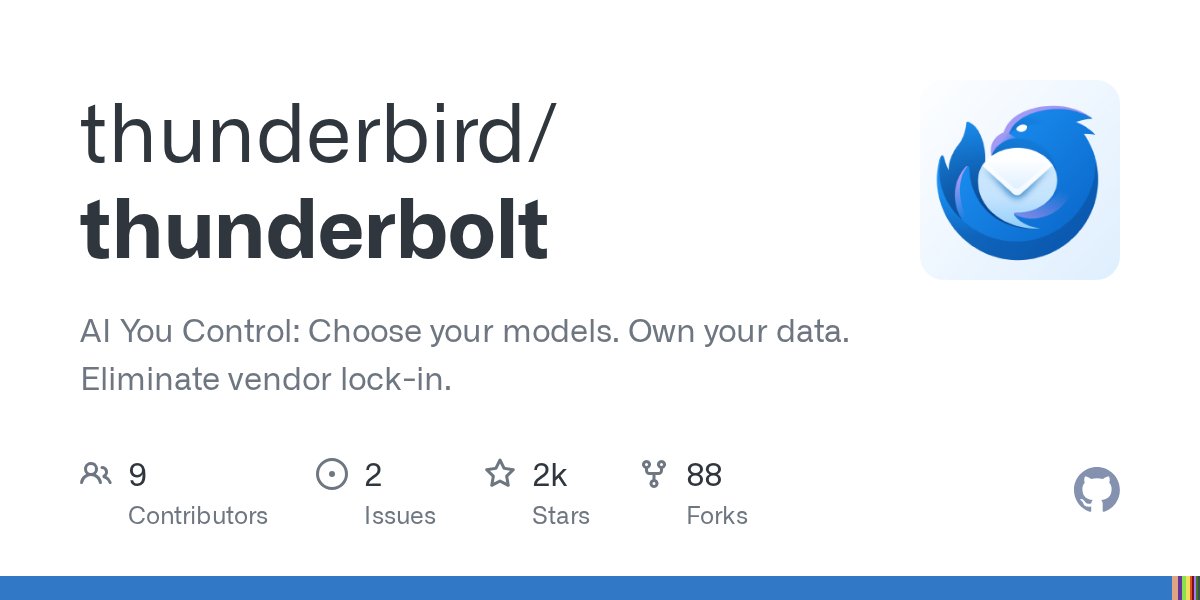
Every question you type into ChatGPT, Claude, or Copilot is stored on a vendor's server — analyzed, logged, and potentially used to train the next version of their model. Thunderbolt, a new free self-hosted AI client from the Mozilla Thunderbird team, is built on a single premise: none of that should be necessary. It just hit GitHub's daily trending list, and developer interest is surging fast.
The tagline says it plainly: "AI You Control — Choose your models. Own your data. Eliminate vendor lock-in." For privacy-conscious users, enterprise IT teams, and anyone operating under GDPR or HIPAA regulations, that's not marketing language — it's the product specification.
Your AI Conversations Are Being Stored Right Now
Most people don't realize what they're trading when they use a cloud AI assistant (a chatbot running on someone else's servers, not yours). When you ask ChatGPT about a confidential business deal or paste a client's notes into an AI tool, that data leaves your machine and enters a commercial pipeline. OpenAI's terms allow using your conversations to improve its models unless you manually opt out. Microsoft Copilot stores session data by default. Even with privacy modes enabled, the prompt (the text you send to the AI) travels to a remote server before any response returns to you.
For the 80 million+ Thunderbird email users already accustomed to running their own mail infrastructure, this is a familiar argument: own your stack, control your data. Thunderbolt extends that philosophy directly from email to AI.

What Thunderbolt Does — And How It Differs From Ollama
Unlike Ollama (a tool for running AI models locally via the command line) or LocalAI (an API-compatible self-hosted AI server requiring terminal configuration), Thunderbolt is designed as an end-user client — a graphical interface you install and use, not a server daemon (a background process you configure in a terminal). The Thunderbird team's key capabilities at launch:
- Pluggable model support: Connect Llama 3, Mistral, Gemma, or any compatible local model. Switch models without rebuilding your setup — no forced single-provider lock-in.
- Self-hosted inference: All inference (the computation that generates AI responses) runs on hardware you control — your laptop, home server, or private VM. Nothing routes through a commercial cloud.
- Zero vendor telemetry: Your prompts don't touch OpenAI, Anthropic, or Google endpoints. No conversation data leaves your network under any conditions.
- Thunderbird-native design: Built by the same team maintaining the Thunderbird email client — native integration for existing Thunderbird users, familiar UX from day one.
- No subscription required: No $20/month ChatGPT Plus. No $10/month Copilot fee. One-time setup, zero recurring cost.
Thunderbolt vs. ChatGPT, Claude, and Ollama — Full Comparison
Here's how Thunderbolt positions against the most common alternatives:
| Factor | Thunderbolt | ChatGPT / Claude | Ollama |
|---|---|---|---|
| Hosting | Your server | Vendor cloud | Your server |
| Data ownership | 100% user-controlled | OpenAI / Anthropic | 100% user-controlled |
| Model choice | Any compatible model | Single vendor only | Multiple models |
| Target user | Privacy-first, enterprises | General consumers | Developers only |
| Monthly cost | $0 (self-hosted) | $20–$200/month | $0 (terminal setup) |
| Vendor lock-in | None by design | High | None |
| Interface | Graphical (GUI) | Web / app | Command line only |
The biggest differentiator from Ollama is Thunderbolt's graphical interface. The Thunderbird team has decades of experience making complex email protocols (like IMAP and SMTP — the standards computers use to send and receive email) feel approachable to non-technical users. That same design philosophy now applies to self-hosted AI.
Three Forces Driving Developer Interest — And Why It Matters to You
GitHub Trending isn't driven by marketing spend — it reflects organic developer activity: stars, forks (copies of a project saved to a personal account), and new contributors over 24 hours. Hundreds of developers flagged Thunderbolt as worth watching in a single day. Three converging pressures explain the timing:
- Regulatory exposure is real: GDPR (Europe's data protection law) fines for AI data mishandling have climbed into the hundreds of millions of euros. Companies under EU jurisdiction face legal risk every time employee prompts flow through US-based commercial AI servers without proper data processing agreements in place.
- Hardware barriers dropped dramatically: Quantized models (compressed AI models optimized to run without expensive GPUs) like Llama 3 and Mistral 7B now run acceptably on a standard 16GB RAM laptop. The hardware cost of self-hosting AI fell sharply over the last 18 months.
- Trust erosion is accelerating: ChatGPT briefly surfaced other users' conversation titles due to a caching bug. Copilot has been flagged for repeating code patterns from private repositories. IT departments and individual users are actively seeking alternatives that don't require trusting a vendor with sensitive prompts.
Three Groups That Should Test Thunderbolt This Week
Thunderbolt is most immediately valuable for 3 specific audiences:
1. Enterprises under compliance frameworks — If your company operates under GDPR, HIPAA (US healthcare data regulations), or SOC 2 audit requirements, routing employee AI queries through commercial platforms creates measurable compliance exposure. Self-hosted infrastructure removes that risk entirely — no data processing agreements to negotiate, no vendor breach risk to inherit.
2. Existing Thunderbird users running self-hosted mail — If you've already invested in your own mail server infrastructure, Thunderbolt plugs into that same security perimeter. No new vendor relationships, no new data retention terms to review, no new cloud accounts to manage.
3. Team leads evaluating AI tools for non-technical staff — Thunderbolt offers a significantly lower-friction entry point than Ollama or LocalAI setups, which require command-line comfort. If your IT policy blocks cloud AI services but your team needs AI productivity tools, this is the most practical path available right now.
For casual users without data privacy concerns, ChatGPT and Claude remain more capable for most everyday tasks — Thunderbolt's value is precisely in the control it delivers, not raw performance benchmarks.
You can explore and get started at github.com/thunderbird/thunderbolt. With GitHub Trending placement confirmed, the repository is actively maintained and community-facing issues are monitored. This week is a good time to test your use case, submit feedback, or star the project — then check the self-hosted AI setup guides on this site to plan your deployment.
Related Content — Get Started | Guides | More News
Stay updated on AI news
Simple explanations of the latest AI developments