Claude Code Codebase Search: Zilliztech's Free Fix
Claude Code can now search your entire codebase semantically. Zilliztech's free, open-source claude-context removes context window limits — trending on GitHub.
Open Claude Code on a small project and it feels like a superpower — instant suggestions, smart refactors, answers that land on the first try. Try the same thing on a 50,000-line enterprise codebase, and the cracks appear fast: the AI only sees the files you have manually opened. Zilliztech, the company behind the world's most downloaded open-source AI database, just hit GitHub Trending with a tool that solves this problem entirely — and it runs free.
The Claude Code Context Window Problem No One Talks About
Every AI model has a context window (the maximum amount of text it can read and process in a single session — measured in tokens, where 1 token is roughly 3 to 4 characters of code). Claude Code's context window is generous by any standard, but it is still finite. On a production codebase with hundreds of files and years of accumulated history, you physically cannot fit everything into a single session.
The result? Claude Code users develop a workaround almost immediately: manually open the files that seem relevant, copy-paste important class definitions into the chat, point Claude toward the right directory, and hope nothing critical was missed. On a 3-file personal project, this is fine. On a codebase with 200,000 lines, 15 engineers, and 8 years of accumulated decisions, it is a consistent bottleneck that quietly caps how useful AI coding assistance can actually be.
The deeper frustration is that this workaround puts the cognitive burden of "knowing what's relevant" back on the developer — which defeats much of the purpose of using AI assistance. You end up spending mental energy directing Claude rather than describing the problem you need solved.
Zilliztech's Answer: Give Claude a Search Engine for Your Code
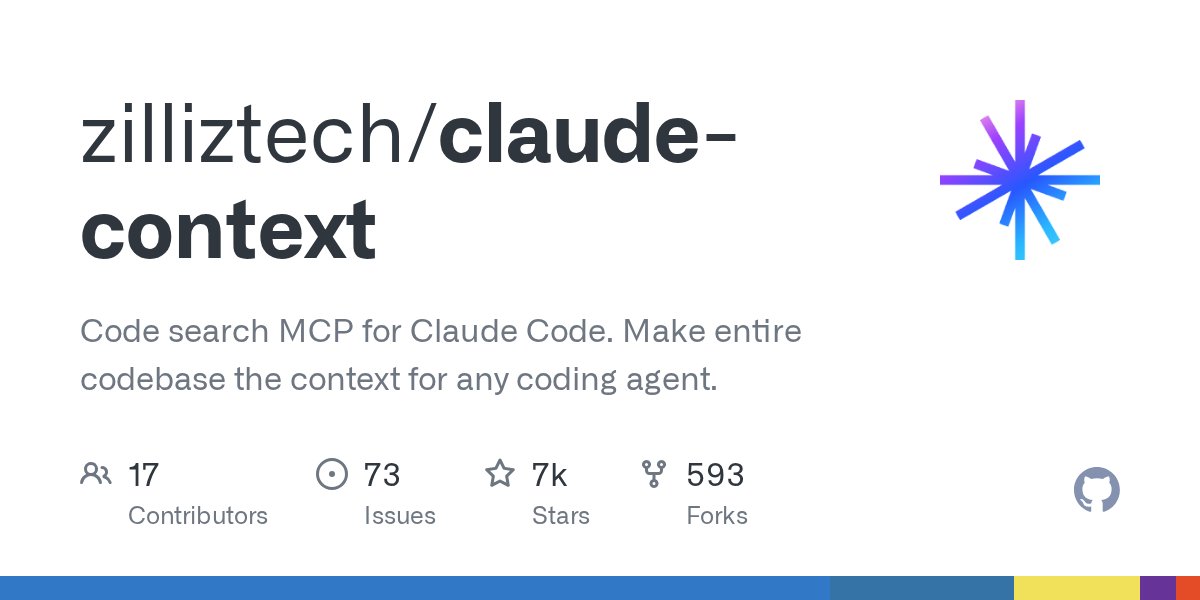
On April 22, 2026, a project called claude-context hit GitHub Trending. Built by Zilliztech — the company behind Milvus, an open-source vector database (a specialized database built to store and search AI-generated mathematical representations of text and code, enabling similarity-based lookups rather than exact keyword matching) — it takes a completely different approach to the context limitation.
Instead of cramming your entire codebase into Claude's context window, claude-context builds a semantic index (an organized, searchable map of your code based on meaning, not just file structure or keyword presence) of your repository. When Claude Code needs to understand a function, trace a dependency, or find where a feature lives, it queries that index and retrieves only the precisely relevant code — like a librarian who can instantly locate every relevant source across the entire library, rather than handing you the complete catalog and stepping aside.
The project's official description makes the goal explicit: "Code search MCP for Claude Code. Make entire codebase the context for any coding agent." The key phrase is "entire codebase" — not the 4 files you happened to have open when you started your session.
MCP stands for Model Context Protocol — a standardized connection layer (think of it as the USB standard for AI integrations) that lets external tools like claude-context plug directly into Claude's agent architecture. Claude can then call on your code index the same way it uses any built-in capability, without any custom plumbing required.
Why Vector Search Beats Every Other Approach
The engine underneath claude-context is vector search — and it solves a problem that traditional code search tools fundamentally cannot. Here is the practical difference:
- Keyword search (grep, IDE "Find in Files"): Finds exact character matches. Search for "authentication" and you get only files containing that literal string. If the relevant code uses "login," "session," "auth," or "oauth" — you miss it entirely.
- Vector search: Code is converted into embeddings (numerical vectors that capture the semantic meaning of the code, generated by running it through an AI model). Those vectors are stored in a vector database. When Claude asks "what handles user sessions?", the search engine finds code that means the same thing — regardless of which specific words the original developer chose to use.
This is where Zilliztech's background matters. The team built Milvus specifically for similarity search at scale — it now powers recommendation engines, fraud detection systems, and medical imaging tools that process billions of data points daily. claude-context is applying that same infrastructure expertise to the developer workflow problem. The vector search engine is not bolted on as an afterthought; it is the product of a company that has built nothing but this kind of technology for years.
Four AI Coding Scenarios Where claude-context Changes Your Workflow
The tool's value is most visible in situations that previously required significant manual effort from the developer:
- Onboarding a new engineer: Ask Claude Code "where does payment processing happen?" on a 200,000-line Rails codebase. Without claude-context, Claude can only answer based on currently open files. With it, the answer is accurate and complete — no senior engineer required to give a guided tour of the directory structure.
- Debugging cross-service issues: When a bug spans 5 different microservices (small, independent services that each handle one part of an application, designed to communicate and work together), Claude now understands all of them simultaneously — no manual "open everything relevant" ritual before you can even describe the problem.
- Security auditing: Ask Claude to identify every direct SQL query in the codebase — patterns that could be vulnerable to SQL injection (a common attack where malicious user input manipulates your database commands to expose or corrupt data). With claude-context, it searches the entire repository, not just what happens to be visible in the editor right now.
- Refactoring with confidence: Before changing a function's signature (its inputs and outputs, which all dependent code must match exactly), you need to know every caller. Previously: a manual grep search across the repository. Now: Claude can trace the full dependency graph semantically, in seconds.

Try It on Your Own Codebase Today
claude-context is open-source and available at github.com/zilliztech/claude-context. The project hit GitHub Trending in April 2026, which means the community is already moving fast — and the README is your most reliable source for current installation instructions as the project evolves quickly.
Tools like this typically configure in under 5 minutes via a single block added to Claude Code's settings file. If you are running Claude Code with MCP support enabled, claude-context costs nothing additional — the tool is free and open-source with no subscription attached.
If your codebase has grown past a few dozen files and you rely on Claude Code regularly, this is worth 10 minutes of your time today. The context window bottleneck has been a quiet, consistent friction point since AI coding tools went mainstream. Zilliztech just made it optional — and the GitHub Trending signal suggests the broader developer community already agrees.
Start with the GitHub repository for setup instructions, or explore more AI automation workflow guides at AI for Automation.
Related Content — Get Started | Guides | More News
Stay updated on AI news
Simple explanations of the latest AI developments