Hacker News: 15 Years No Redesign, 1,831 Engineers Grateful
Hacker News hasn't changed since 2007 — and 1,831 engineers just thanked Y Combinator for it. Why restraint beats redesign in tech.
For 15 years, Hacker News has looked almost identical to its 2007 launch: a plain orange header, a numbered list of links, and a small upvote arrow. No algorithmic feed (a system that ranks content based on predicted engagement rather than time), no infinite scroll (a design pattern that removes natural stopping points), no dark patterns (manipulative design choices that steer users toward actions benefiting the platform rather than them). And in 2026, 1,831 engineers publicly thanked Y Combinator for keeping it that way.
The viral post "Tell HN: Thank you for not redesigning Hacker News" generated 390 comments and sits among the platform's most-upvoted discussions ever — a rare moment of near-unanimous community agreement in a forum known for intense, often fractious debate. In a tech landscape where every platform races to overhaul its UI each year, Hacker News' 15-year freeze has become something nobody predicted: a competitive advantage built entirely on restraint.

Why 1,831 Hacker News Engineers Thanked Y Combinator for Not Redesigning
When a community of software engineers — people who build products for a living — takes time to publicly thank a platform for doing nothing, something significant is happening. The "Thank you for not redesigning" post reached 1,831 upvotes within days, joining a short list of meta-discussions that define Hacker News culture. Each of the platform's all-time highest-scoring posts shares a common thread:
- 1,831 upvotes — "Tell HN: Thank you for not redesigning Hacker News"
- 1,714 upvotes — Discussion of the official HN API (application programming interface) documentation
- 1,663 upvotes — The New Yorker's "The Lonely Work of Moderating Hacker News"
- 1,450 upvotes — The platform's own 15th birthday post
- 1,384 upvotes — A community-built "honest titles" parody that rewrites clickbait headlines in plain language
The "honest titles" project is particularly telling. The fact that it earned 1,384 upvotes — nearly as many as the redesign gratitude post — signals deep community fatigue with manipulative framing. These are not passive users: they built a tool to fix headlines they found dishonest, then voted it to near the top of the forum. When a community's highest-voted content is about authenticity and resistance to manipulation, the platform hosting that community is doing something right.
Hacker News vs. Reddit: 15 Years of Refusing to Redesign
The scale of Hacker News' restraint only registers when compared to what every competitor chose to do instead:
- Reddit: redesigned 5+ times since its 2005 founding; introduced algorithmic feeds, awards, video content, and controversially killed its third-party API in 2023, triggering a mass moderator protest
- Twitter/X: rebranded, restructured its feed algorithm repeatedly, introduced paid verification — platform identity now in permanent flux
- Digg: added algorithmic recommendations and promoted content in 2010 — the community exodus that followed became a business school case study in how product decisions destroy trust
- Slashdot: expanded topics, added video, redesigned multiple times — steadily lost audience to simpler alternatives
- Product Hunt: adopted heavy modern UI with gamification and maker badges — high visual weight, lower information density
Hacker News did none of this. The platform runs on a publicly documented "gravity" formula (a ranking algorithm that deprioritizes older stories even when they accumulate more upvotes, preventing stale content from staying on the front page forever). There is no recommendation engine, no "you might also like," no paid placement. A bootstrapped two-person startup and a $100 billion company receive identical treatment in the queue.
The result: HN archives from 2007 remain fully accessible at the same URL structure used at launch. Eighteen-plus years of tech industry history — early Bitcoin debates, the first iPhone reactions, the rise of cloud computing — indexed, searchable, readable without a login. You can learn how communities like this shape which AI tools engineers actually adopt — the signal quality matters enormously.
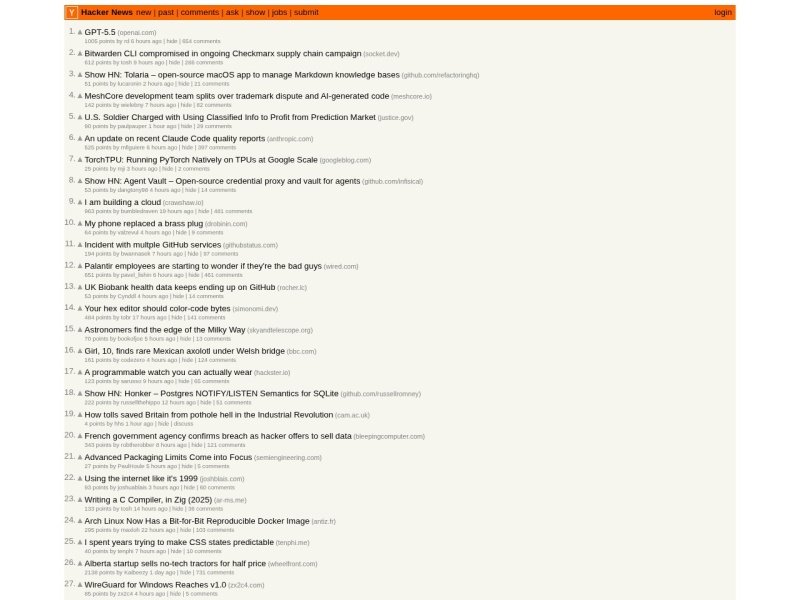
What the Hacker News Front Page Tells Engineers That Algorithms Cannot
Because Hacker News relies on community upvotes rather than engagement optimization (automated boosting of content based on predicted interaction patterns), its front page functions as an unfiltered barometer of what working engineers actually care about. The data from any given day reveals dramatic contrasts in what this audience values:
- Developer tools story: New 10 GbE USB adapters — 533 points
- Engineering philosophy: "Sabotaging projects by overthinking" — 511 points
- Cultural/design crossover: "The Great Wave" rendered in 1-bit art — 507 points
- Top AI story: GPT-5.5 Bio Bug Bounty — 125 points
- Non-technical cultural items: typically 8–10 points, rarely surfacing
Technical stories outperform cultural content by a factor of 50x or more — and this isn't the platform suppressing non-tech topics. It's the community expressing genuine preferences through votes. No algorithm distorts what rises. The absence of recommendation machinery means the signal is clean: these numbers reflect real curiosity, not engagement optimization designed to keep users scrolling past sponsored content.
The "honest titles" phenomenon reinforces this. Engineers built a parody project that rewrites clickbait in plain language, gave it 1,384 upvotes, and use it as a daily correction layer on top of the internet's information stream. This is a community so committed to low-manipulation communication that it built tools to enforce it. Hacker News didn't create this culture — it created the conditions for it to persist.
The Invisible Labor Keeping Hacker News Civil
The New Yorker profile "The Lonely Work of Moderating Hacker News" became one of the platform's most-discussed external articles ever: 1,663 upvotes and 777 comments — the highest comment count in the dataset. It revealed something most users never think about. The platform's remarkable discourse quality is sustained by a small team of volunteer moderators who receive no compensation from Y Combinator (the startup accelerator that owns Hacker News and uses it as a recruitment and signaling tool for its founder network).
These moderators enforce one defining rule: comments must be substantive. No snark for its own sake, no low-effort dismissal, no pile-on pile-ons. Violations result in account-level penalties applied quietly, without public shaming. The result is a forum where a first-year computer science student can challenge a senior engineer at a major tech company without the conversation degrading into personal attacks within three replies.
This is not a solved problem at scale. Every large online community eventually faces moderation collapse as user numbers grow — Reddit subreddits, Twitter replies, YouTube comments all demonstrate this at different inflection points. Hacker News maintains discourse quality with fewer than five active moderators for an estimated 500,000+ daily users. The 777-comment engagement on the moderation profile suggests the community is deeply aware of how unusual — and how precarious — this arrangement is.
How Hacker News Restraint Became a Competitive Strategy in Tech
In 2026, the prevailing logic of digital platforms is engagement maximization (designing products to extend session time, increase return frequency, and extract behavioral data) — not information delivery. This logic produced infinite scroll, notification systems engineered to create compulsive checking behavior, and algorithmic feeds tuned to surface outrage because it generates more clicks than nuance.
Hacker News does none of this, deliberately:
- No infinite scroll — stories paginate, giving users a natural stopping point
- No notification system — users must actively return to check replies
- No recommendation algorithm — the front page is identical for every visitor
- No mobile-optimized design — third-party apps fill this gap without HN owning the relationship
- No paid placement — a $50 billion company and a two-person startup receive equal treatment
The consequence: Hacker News cannot maximize its own engagement metrics. It has no mechanism to do so. And the community has responded by treating it as a trusted default — the platform where major security vulnerabilities get serious engineer attention within hours, where Y Combinator quietly recruits founders, where the honest consensus on a new AI model or programming language shift appears before any tech journalist writes the retrospective.
The 1,831-upvote "thank you" post is really an expression of something deeper: in an industry that calls constant change "innovation," the most countercultural move in 2026 is doing nothing. Watch whether other platforms — especially those facing community trust crises after algorithmic overhauls — start paying attention to what Hacker News has quietly demonstrated across 15 years of refusing to "improve."
Related Content — Get Started | Guides | More News
Sources
Stay updated on AI news
Simple explanations of the latest AI developments