Railway Hits 3M Users With AI Deployment, No Kubernetes
Railway hit 3M users with 35 people using AI cloud deployment — no Kubernetes, no Docker. Bare metal infrastructure, 70% margins, 100K signups/week.
Railway, the AI-powered cloud deployment platform, just crossed 3 million users — with a team of 35 people. The platform adds 100,000 new signups every week, has raised $124 million, and requires zero Docker files, zero Kubernetes manifests (the YAML configuration files used to describe how software runs on cloud clusters), and zero Ansible scripts. Founder Jake Cooper's six-year obsession with removing deployment friction is paying off at a scale few predicted when he personally greeted every new Discord user six years ago.
From Two Monitors and Discord to 100,000 Signups a Week
The first 100 Railway users took 18 months to acquire. Jake Cooper, who had previously worked on distributed systems at Bloomberg and on Uber's Jump Bikes division, sat in front of two monitors personally greeting every new user who joined Railway's Discord server — catching each signup the moment it happened.
That obsessive, manual approach revealed something important early: developers weren't just looking for a faster server. They wanted the entire experience to feel frictionless. Railway's pitch crystallized into a single sentence: "Push code, get a URL, iterate." No configuration files stacked on configuration files. No cloud provider dashboard maze to navigate before a single line of code runs in production. It's a philosophy built for the age of AI automation.
- 3 million users on the platform today
- 100,000 new signups per week — organic, not paid acquisition
- 35 full-time employees total (roughly 86,000 users per employee)
- $124 million in total funding raised since founding in 2020
- Weekly signup pace growing from near-zero in 2020 to current levels across 6 years of compound growth
The $500K/Month Mistake That Made Railway Stronger
In 2022 and 2023, Railway offered a generous free tier — open access, no credit card required. The result was brutal: $500,000 in monthly losses against roughly $50,000 in monthly revenue, bleeding from a $20 million starting bank account. The culprit wasn't careless spending. It was structural exploitation.
Reddit bots and cryptocurrency miners (automated scripts that consume computing power to generate digital currency) flooded the free tier, consuming infrastructure resources while contributing nothing in return. Railway's open-door policy had become a liability that threatened the company's survival.
"During the free-tier era, we were losing about half a million dollars a month… That's a horrible business." — Jake Cooper, Railway Founder
Rather than patch the abuse with band-aid rate limits, Railway dismantled the free tier entirely and rebuilt its business model around sustainable pricing. The decision was painful in the short term but transformational: it forced the team to identify which users actually valued the product enough to pay for it. Those users became the foundation for the 3 million who followed.
Bare Metal Infrastructure: How Railway Escaped the Cloud Tax
Most developer platforms rent computing capacity from Amazon Web Services, Google Cloud Platform, or Microsoft Azure — paying a margin to the cloud provider on every dollar of infrastructure they use. Railway made a different bet: it built and now owns bare metal data centers (physical servers the company operates directly, rather than renting virtual machines from a cloud provider).
The economics are striking compared to the industry norm:
- 3-month payback period on hardware investment (industry standard is 3–5 years for traditional data center builds)
- 70% hardware margins — the profit that would otherwise flow to AWS or GCP stays in Railway's economics
- Hardware value appreciation: rising RAM prices have increased Railway's physical asset value beyond its total $124 million in funding raised — an unusual reversal for a software company
The strategy also revealed a dependency to fix. On May 19, 2026, a major Google Cloud Platform outage cascaded through Railway despite the company's multi-AZ architecture (multi-availability zone, meaning servers spread across different physical locations to prevent any single point of failure). The weak link: workload discoverability (the internal routing system that directs traffic to the right servers) had remained unintentionally tied to GCP infrastructure. Railway survived, but the team is patching that dependency this week.

Claude AI and the Death of the Pull Request
Railway doesn't treat AI as a chatbot bolted onto a dashboard. Claude (Anthropic's large language model — an AI system trained to follow instructions and generate text and code) is integrated directly into the deployment workflow, making Railway a natural destination for vibe coding — the emerging practice where developers describe intent in plain language and let AI handle execution. Whether you're working with Claude Code, an AI coding agent, or any other AI automation tool, you can open Railway's visual canvas and simply type:
Deploy a Postgres instance, connect my GitHub repository, and run this codeRailway handles provisioning the database (a structured system for storing and retrieving data), connecting it to the application, setting environment variables (configuration values the app reads at runtime to locate its dependencies), and generating a live public URL. No terminal commands, no configuration files, no infrastructure knowledge required.
What Replaces the Pull Request When Agents Deploy at Machine Speed?
The classic deployment loop — write code → open a pull request (a formal request to merge your changes into the main codebase, reviewed by teammates) → get approval → merge → deploy — was designed for humans reviewing human-written code at human speed. When an AI coding agent generates a complete feature in 30 seconds, waiting 48 hours for pull request review becomes the bottleneck, not the safety net.
Railway's upcoming roadmap replaces that model with agent-safe deployment primitives (basic building blocks designed for machine-speed shipping):
- Progressive rollouts — deploy to 10% of real traffic first, watch error rates and latency, then expand to 100% automatically if metrics look clean
- Production forks — clone a live production environment with real data in seconds, for safe testing without maintaining a separate staging server
- Shadow traffic — send a silent copy of real user requests to a new version before it goes live, catching bugs before users see them
- Versioned environments — every deploy is instantly reversible, like Git commits but for entire infrastructure states including databases and configuration
Jake Cooper is currently writing custom Linux kernel patches to optimize Railway's storage layer for agent workloads — a level of systems depth (literally modifying the operating system's core code) that signals Railway intends to own the agent deployment stack, not merely rent it from someone else. As he puts it: "We fundamentally don't care how deep we have to go. We will swim to the bottom of the swimming pool to get the experience."
Deploy Your First Project on Railway in Under 5 Minutes
If you have spent time debugging Dockerfiles or configuring Kubernetes clusters (systems for automatically running many copies of your app across multiple servers, managing load balancing and failover) for a project that needed exactly one server, Railway offers a faster path. Explore how modern deployment tools fit into AI-powered workflows in our AI automation guides.
Three ways to ship your first Railway project:
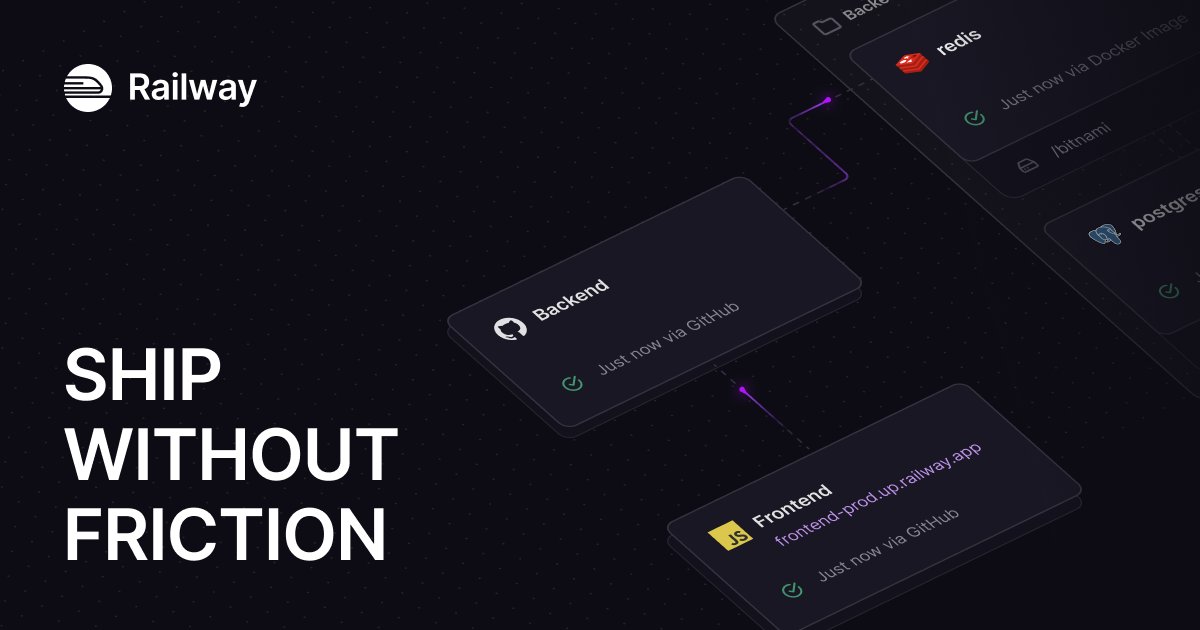
- Web canvas: Go to railway.com, connect your GitHub account, select your repository — Railway auto-detects your stack and deploys it immediately with a public URL.
- Claude AI prompt: In Railway's interface, type "Deploy my GitHub repository at [your repo URL]" — Claude configures the entire deployment without you writing a single config file.
- Git push: After initial project setup, every
git pushto your repository triggers an automatic deploy with a unique preview URL you can share instantly.
Railway supports Node.js, Python, Go, Ruby, Java, and dozens of other runtimes — detected automatically via Nixpacks and Railpack (open-source build systems that identify your programming language and dependencies without any configuration). The platform's roadmap signals a world where most code is written and deployed by AI agents, with human developers shifting from managing infrastructure to reviewing outcomes. Jake Cooper is betting bare metal data centers on that future — and 100,000 new users per week are placing the same bet.
Related Content — Get Started | Guides | More News
Stay updated on AI news
Simple explanations of the latest AI developments