They put a fly brain in a virtual body — it started eating
Eon Systems wired a 140,000-neuron fly brain to a virtual body. Without programming, the digital fly started foraging and feeding.
A team at Eon Systems just did something that sounds like science fiction: they took a digital copy of a real fruit fly's brain — 140,000 neurons and 50 million connections — wired it to a virtual body, and watched as the fly started looking for food, cleaning itself, and eating. Nobody programmed those behaviors. The brain figured it out.
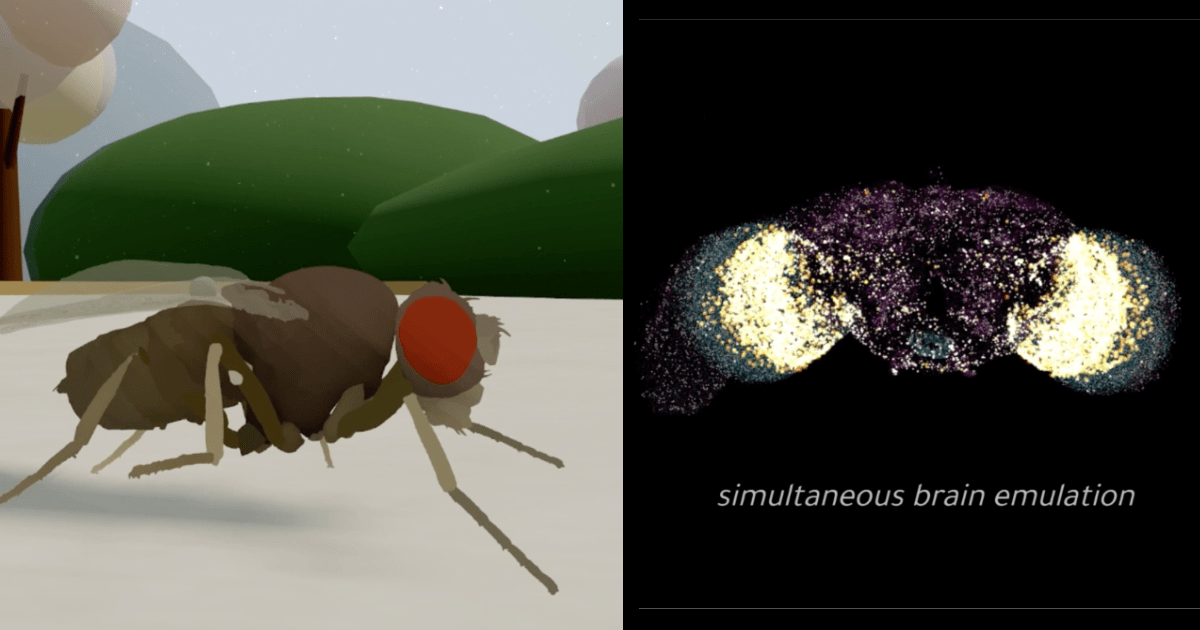
This is the first time a realistic brain model has been connected to a physics-based virtual body and produced meaningful, life-like behavior on its own.
How a digital brain controls a virtual body
The system works in a continuous loop, just like a real brain and body:
1. Sense: The virtual fly has simulated taste, smell, touch, and vision. When it "touches" food or "sees" a threat, specific neurons in the brain model fire.
2. Think: The 140,000-neuron brain processes those signals through 50 million connections — the same wiring map as a real fly's brain, digitized from microscope scans.
3. Move: The brain's output activates motor commands that control the virtual body — an anatomically accurate fly with 87 joints, modeled from X-ray scans of a real insect.
4. Repeat: Movement changes what the fly senses, creating a closed feedback loop. Every 15 milliseconds, the brain and body sync up.
Behaviors that emerged — without programming
The remarkable part: nobody told the virtual fly how to behave. These actions emerged naturally from the brain's structure:
Foraging: The fly navigated toward food sources using taste and smell cues
Grooming: When virtual dust appeared on its antennae, it started cleaning itself
Feeding: Contact with a sugar-like substance triggered a feeding response
Escape: A looming visual threat activated escape neurons (though full flight behavior isn't implemented yet)
As the team puts it: "connectome structure alone can recover substantial sensorimotor structure for behaviors such as feeding and grooming." In plain English: just copying the brain's wiring is enough to recreate real behaviors.
The technology stack behind the fly
This wasn't built from scratch. It combines years of neuroscience with modern simulation tools:
The brain model comes from the FlyWire project, which mapped every single neuron and connection in an adult fruit fly brain — one of biology's most complete brain maps.
The virtual body uses NeuroMechFly v2, a biomechanically accurate insect model built from X-ray micro-CT scans, running on the MuJoCo physics engine (the same engine used to train many robotics AI systems, now open-sourced by DeepMind).
Why this matters beyond flies
For robotics: If a brain's wiring diagram alone can produce meaningful behavior, future robots might be controlled by brain-inspired architectures rather than hand-coded rules or today's AI training methods.
For neuroscience: This gives researchers a way to test theories about how brains work — change a connection, see what behavior changes.
For the long term: The fly brain has 140,000 neurons. A human brain has 86 billion. This is a proof of concept at an extremely small scale, but it demonstrates that digital brain emulation can produce real behavior — a stepping stone toward understanding (and eventually simulating) far more complex brains.
The Eon team — Scott Harris, Aarav Sinha, Viktor Toth, Alexis Pomares, and Philip Shiu, guided by co-founder Dr. Alex Wissner-Gross — notes significant limitations: the model lacks hunger, learning, and hormones, and uses simplified neuron dynamics. But as a proof of concept, watching a brain-in-a-jar start eating on its own is hard to ignore.
Read the full technical writeup at eon.systems.
Related Content — Get Started with Easy Claude Code | Free Learning Guides | More AI News
Stay updated on AI news
Simple explanations of the latest AI developments