Tencent is building an AI agent inside WeChat for 1.3 billion people
Tencent launched QClaw as a WeChat mini-program, bringing an AI agent that orders food, books rides, and controls your computer to 1.3 billion monthly users.
Tencent just embedded an AI agent inside WeChat — the messaging app used by 1.3 billion people every month. The agent, called QClaw, launched as a WeChat mini-program (a lightweight app inside the chat) on March 18, 2026. It can order food, book rides, manage files, and even remotely control your computer from your phone.
If you don't know WeChat, think of it as China's version of WhatsApp, Uber, Venmo, and the App Store combined — all in one app. Adding an AI agent to it means 1.3 billion people now have AI automation at their fingertips without installing anything new.
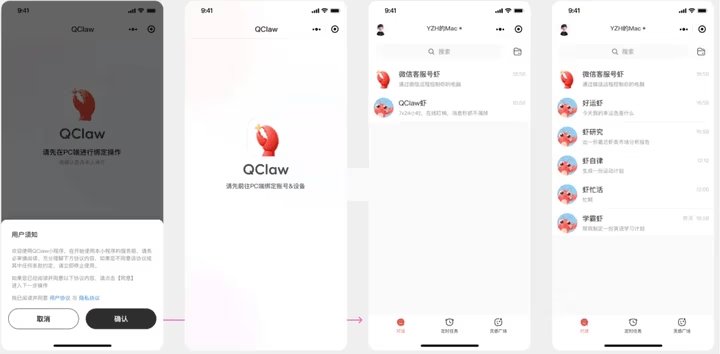
Send a chat message, get a task done
QClaw works through natural conversation. You type (or will soon speak) a request in the WeChat chat, and the AI agent figures out how to execute it. No menus, no app-switching — just describe what you need.
What QClaw can do right now:
A feature called "Inspiration Square" offers pre-configured tasks and skills — you can execute them with a single click without writing a prompt. Think of it as an app store for AI actions.
Plugged into China's entire digital economy
WeChat's power comes from its mini-program ecosystem — millions of lightweight apps for everything from hailing rides to paying bills. Tencent's plan is to connect QClaw to all of them.
Tencent President Martin Lau confirmed that the company wants QClaw to handle daily tasks like ride-hailing, food delivery, grocery shopping, and travel booking — all through conversational prompts. This would eliminate the need to manually open and navigate each mini-program.
The AI can also switch between multiple language models including Kimi, DeepSeek, Zhipu GLM, and MiniMax — giving users flexibility in which AI brain powers their requests.
Built on open-source, but designed for mass market
QClaw is built on top of OpenClaw, the open-source AI assistant framework. But Tencent wrapped it in a one-click interface — no command line, no technical setup. Open the mini-program, type what you want, done.
Tencent is also developing a standalone QClaw mobile app expected to launch soon, and plans to release Hunyuan 3.0 (their own large language model) in April to power more advanced features.
The race to put AI agents in every chat app
Tencent isn't alone in this race. Amazon just launched Alexa+ in the UK with similar agentic features. Google is deepening Gemini into every Workspace app. Meta has its own AI assistant across WhatsApp, Instagram, and Messenger.
But Tencent has an advantage none of them match: WeChat is already the place where Chinese users do everything. Adding an AI agent there isn't asking people to adopt a new tool — it's upgrading the tool they already live inside.
Gray-box testing is targeting mid-2026, with a wider rollout potentially in Q3. For now, QClaw is available as a WeChat mini-program in China.
Related Content — Get Started with Easy Claude Code | Free Learning Guides | More AI News
Stay updated on AI news
Simple explanations of the latest AI developments